

Table of Contents
- How Paint Quality Affects Color Accuracy and Vibrancy
- Prime Pigments and Pigment Dispersion: The Foundation of Quality
- Binder Technology and Adhesion on Plastic Surfaces
- Best Acrylic Paints for Gunpla and Scale Models
- Acrylic vs Enamel Paint for Scale Models: Durability and Finish
- How to Prevent Paint Chipping on Model Kits
- Why Low-Quality Paint Costs More in the Long Run
- Frequently Asked Questions
Last Updated: September 24, 2026
How Paint Quality Affects Color Accuracy and Vibrancy
Understanding why paint quality matters in model kits starts with recognizing that high-quality paints deliver richer colors, better coverage, and finishes that stay vibrant for years. Low-quality paints fade, chip, and require multiple coats to achieve basic coverage.
Why paint quality matters in model kits starts with pigment concentration. Premium paints pack more pigment per milliliter, delivering deeper saturation and true-to-life color representation. Poorly pigmented paint looks dull and requires extra coats that muddy the finish and obscure fine details.
A single coat of quality acrylic paint covers evenly and maintains color fidelity. Budget paints require two to four coats to achieve the same result, building up on your model and filling in panel lines, obscuring decals, and creating unwanted sheen.
Prime Pigments and Pigment Dispersion: The Foundation of Quality
Prime pigments determine color accuracy and longevity. High-quality paints use pigments engineered for stability and color purity; cheaper formulations use inferior pigments that break down under UV exposure or don't mix evenly.
Pigment dispersion refers to how evenly pigments are suspended throughout the paint. Poor dispersion causes particles to settle, requiring constant stirring and resulting in inconsistent color, darker streaks where pigment settled, lighter patches where it didn't. Quality paints maintain consistent distribution, delivering uniform color throughout application.
A poorly dispersed paint looks fine initially, but after weeks the pigments separate, causing inconsistent coverage across multiple builds.
We recommend paints from established manufacturers like Bandai's official paint lines and Tamiya, which invest heavily in pigment quality and dispersion technology. These paints maintain color consistency across batches and shelf life, so a bottle purchased today will match one you bought six months ago.
Binder Technology and Adhesion on Plastic Surfaces
The binder holds pigments together and makes them stick to your model. Premium paints use advanced binder formulations that create strong molecular bonds with plastic, though not all binders bond equally well to all plastics.
Poor adhesion leads to chipping, flaking, and peeling after handling, temperature changes, or humidity exposure. Low-quality paints rely on surface tension rather than chemical bonding, failing when your model gets bumped or flexed.
Chemical Compatibility: The Overlooked Factor
Most modelers don't realize that plastic type matters as much as paint quality. The two most common kit plastics have different chemical properties:
Polystyrene (used in most Gundam kits and mainstream model kits) is compatible with both water-based acrylics and solvent-based enamels. Both work reliably on polystyrene when surface prep is correct.
Resin (used in high-end display kits) is chemically reactive with certain solvents. Solvent-based enamels can partially dissolve resin, creating strong bonds if done intentionally, but incompatible solvents cause crazing or damage. Resin kits are safer with water-based acrylics or resin-compatible paints.
A cheap acrylic might work on polystyrene but will fail on resin because its binder lacks the engineered flexibility for resin's thermal expansion. Quality acrylics account for these material differences.
Binder Types and Their Adhesion Profiles
Water-based acrylic binders cure through water evaporation, leaving a flexible polymer film. This flexibility is essential because plastic expands and contracts with temperature changes. Quality acrylics remain slightly flexible after curing, preventing adhesion failure from thermal cycling.
Solvent-based enamel binders cure through chemical hardening, creating a harder finish that works well on polystyrene. On resin, however, that rigidity can cause problems if the resin is flexible or prone to warping.
Lacquer binders use strong solvents that partially dissolve the plastic surface, creating a durable but risky finish on resin and requiring excellent ventilation.
Surface Preparation Amplifies Binder Performance
Surface preparation amplifies binder quality. De-grease model parts with warm soapy water or isopropyl alcohol before painting. For resin kits, use a soft brush to avoid scratching during cleaning.
A quality primer layer dramatically improves adhesion by bridging plastic and paint. Plastic-specific primers are engineered to bond to plastic surfaces while providing a grip for paint binders.
For polystyrene kits, a standard plastic primer works across acrylic and enamel paints. For resin kits, use a primer specifically labeled for resin, as standard primers may not cure properly on resin's non-porous surface.
Best Acrylic Paints for Gunpla and Scale Models
Acrylic paints dominate the model kit market because they're water-based, easy to clean up, and safe to use indoors. The best acrylic paints for Gunpla deliver smooth flow, excellent coverage, and finishes that match the original kit aesthetics.
Quality acrylics have consistent pigment density, binders that cure flexible, and thinning ratios that don't require excessive solvent. They thin well with water while maintaining color accuracy for airbrush or brush application.
Cheaper acrylics teach bad habits: over-thinning, excessive coats, and techniques that mask paint deficiencies. Quality paint eliminates these workarounds, improving results immediately.
Water-based acrylics also offer flexibility in application. You can brush them on for detail work, spray them with an airbrush for smooth coverage, or use both methods on the same model. The curing time is fast enough for multi-coat projects (typically 30 minutes to an hour between coats) without the strong odors of solvent-based alternatives.
Acrylic vs Enamel Paint for Scale Models: Durability and Finish
The choice between acrylic and enamel paint depends on your priorities: speed and convenience versus durability and sheen consistency. Both have legitimate advantages for scale model building.
Acrylics dry in 30 minutes to an hour, are water-soluble, and produce matte or satin finishes. Enamels cure in 4-8 hours, require solvent cleanup, and deliver gloss finishes.
Enamels typically outlast acrylics, creating harder, more resistant finishes that withstand handling and temperature fluctuations better. This matters for display pieces or frequently handled models.
However, enamels demand better ventilation, require solvent-based thinners, and take longer to cure between coats. For most hobbyists, especially those building multiple kits in a small space, acrylics offer the better balance of performance and practicality. A quality acrylic paint on a properly prepared surface with appropriate primer will last years without significant degradation.
Enamels level better and settle into smooth surfaces naturally. Acrylics require more attention to avoid brush strokes but are easier for airbrush work because they thin with water.
How to Prevent Paint Chipping on Model Kits
Paint chipping happens when adhesion fails, usually due to one of three factors: inadequate surface preparation, low-quality paint, or insufficient primer. The good news is that all three are within your control.
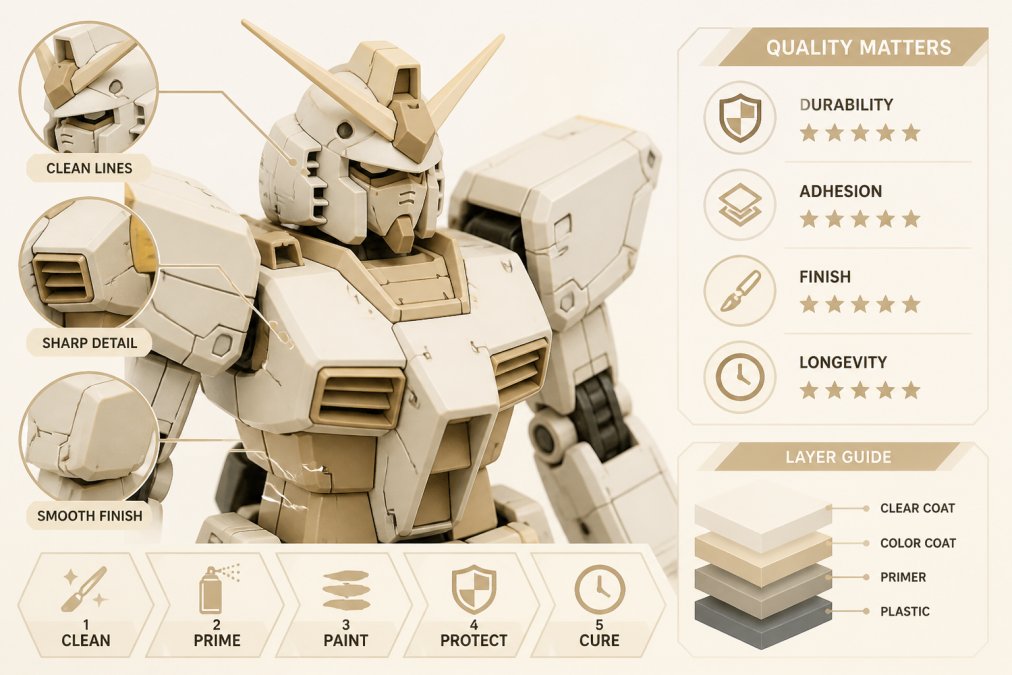
Wash all plastic parts with warm soapy water to remove mold release agents. Dry thoroughly, then wipe with isopropyl alcohol to remove remaining oils and ensure a clean surface for primer.
Apply primer before color coats.
Why Low-Quality Paint Costs More in the Long Run
Quality acrylic may have a higher initial cost per bottle, but that math changes when factoring in real-world usage, hidden costs, and true cost-per-model economics.
The Paint Consumption Math
The Environmental and Health Cost Differential
The practical cost difference:
- Budget acrylic paints may contain higher VOCs by volume, potentially requiring more ventilation for occasional use and creating cumulative exposure over multiple projects.
- Quality acrylic paints typically contain lower VOCs, potentially allowing safer indoor use without dedicated ventilation systems.
- Budget enamel paints contain higher VOCs, often requiring a dedicated spray booth or outdoor ventilation to use safely.
- Quality enamel paints contain lower VOCs compared to budget enamels, still requiring ventilation but with potentially lower exposure risk per application.
The Learning Curve Cost
True Cost-Per-Model Analysis
When you factor everything together:
Budget paint scenario (per model):
- Paint cost: $12-18 (extra volume needed)
- Ventilation equipment amortized: $5-10 per model (if needed)
- Rework/stripping cost: $3-5 (occasional failures)
- Time cost (inefficiency): $8-15 per model
- Total: $28-48 per model
Quality paint scenario (per model):
- Paint cost: $6-12 (efficient coverage)
- Ventilation equipment amortized: $0-3 per model (minimal or none)
- Rework/stripping cost: $0-1 (rare failures)
- Time cost (efficient workflow): $2-5 per model
- Total: $8-21 per model
Frequently Asked Questions
Does the quality of paint matter for plastic models?
Yes. Quality paint adheres better to plastic substrates, resists chipping during handling, and maintains color accuracy over time. Premium paints use superior binder technology and pigment dispersion, which means fewer coats needed and better coverage. Low-quality paints often require multiple applications, dry unevenly, and fail under normal use. For model kits you've invested time and money into, quality paint directly protects your work.
What's the difference between hobby-grade and craft-grade paints?
Hobby-grade paints are formulated specifically for plastic models and include additives for better adhesion, flow control, and durability. Craft-grade paints are general-purpose and lack these optimizations, resulting in poor surface tension control, inadequate curing time, and weak color retention. Hobby brands engineer their products for scale effect and fine detail work. Craft paints often contain fillers that reduce opacity and pigment density, requiring extra coats and producing inferior finishes.
Can I use acrylic paint on model kits?
Yes, water-based acrylics designed for models work well on plastic substrates when properly applied. However, not all acrylic paints are equal. Dedicated model acrylics have superior leveling agents and solvent compatibility with primers. Generic craft acrylics lack these properties and may not adhere properly or maintain sheen consistency. Look for brands formulated for polystyrene and resin models. Always apply a primer first to ensure adhesion and color accuracy.
How does paint quality affect the durability of a model kit?
Premium paint formulations cure properly, bond securely to plastic, and resist weathering and handling damage. Quality binders create a flexible film that flexes with the model rather than cracking. Better pigment dispersion means more even coverage and less likelihood of bare spots. High-quality finishes maintain their sheen consistency and resist yellowing. Poor-quality paint cracks, chips easily, fades quickly, and leaves the plastic substrate exposed to damage. Over a year or more, quality paint preserves detail and appearance while cheap paint deteriorates noticeably.