

Table of Contents
- What Is Gunpla and Why Adults Are Building Now
- Gunpla Grade Differences Explained: Finding Your Starting Point
- Essential Gunpla Tools for Beginners: What You Actually Need
- How Long Does It Take to Build a Gunpla: Realistic Timelines
-
Top Recommended Beginner Gunpla Kits for Adults
- 1. RX-78-2 Gundam (HG 1/144) - The Classic Starting Point
- 2. HGBD Gundam Build Divers (HG 1/144) - Modern Snap-Fit Design
- 3. RG RX-78-2 Gundam (RG 1/144) - Intermediate Challenge
- 4. Barbatos (HG 1/144) - Excellent Articulation and Poseability
- 5. Gundam Astray Red Frame (HG 1/144) - Customization-Friendly
- How to Choose Your First Beginner Gunpla Kit
- Assembly Tips and Common Mistakes to Avoid
- The Therapeutic Benefits of Building Gunpla as an Adult
Last Updated: August 7, 2026
What Is Gunpla and Why Adults Are Building Now
Gunpla, short for Gundam plastic model kits, has become a sophisticated hobby for adults seeking creative outlets, stress relief, and tangible accomplishment. What once seemed niche has evolved into a legitimate pastime for professionals, artists, and collectors across all demographics. Unlike passive entertainment, building Gunpla demands focus without requiring expertise. A first-time builder can complete a quality kit in a weekend and walk away with a display-ready model.
The hobby offers genuine therapeutic benefits. The repetitive, focused nature of assembly quiets racing thoughts. Many builders describe the process as meditative, similar to drawing or woodworking. That mental clarity, combined with the social aspect of joining online communities and local hobby shops, explains why adults are discovering Gunpla now more than ever.
Gunpla Grade Differences Explained: Finding Your Starting Point
The grade system directly determines your building experience. Each grade represents a different complexity level, part count, and articulation degree. Understanding these grades prevents buying a kit that's either too simple or too complex for your skill level.
High Grade (HG) and Entry Grade (EG) for True Beginners
High Grade kits at 1/144 scale are the industry standard for beginners. HG models feature snap-fit assembly, meaning most parts lock together without glue, clear instruction manuals with visual diagrams, and a manageable part count (typically 100-150 pieces). You'll spend 2-4 hours building an HG kit.
Entry Grade (EG) kits are even simpler, designed explicitly for first-time builders with fewer parts, larger components, and forgiving snap-fit tolerances. The tradeoff is reduced articulation, but that's not a problem when learning fundamentals.
The 1/144 scale balances practicality with visual impact: small enough to fit on a shelf without dominating space, yet large enough to see detail work and handle parts comfortably.
Real Grade (RG) and Master Grade (MG) When You're Ready
Real Grade kits at 1/144 scale pack impressive articulation and detail into a small footprint. They're more complex than HG, typically 150-200 pieces with tighter tolerances. RG kits demand patience and precision but reward you with models that pose beautifully and look substantially more detailed.
Master Grade kits at 1/100 scale are the intermediate-to-advanced tier. Double the size of HG models, MG kits feature internal frame details, articulated hands, and engineering complexity that makes building genuinely engaging. You're looking at 6-12 hours of assembly time. However, they're overkill for true beginners. Start with HG, progress to RG or MG once you understand sprue removal and basic assembly techniques.
Perfect Grade (PG) kits exist at 1/60 scale and represent the hobbyist's endgame. Skip these entirely as a beginner, they're expensive, require advanced tools, and demand patience you haven't yet developed.
Essential Gunpla Tools for Beginners: What You Actually Need
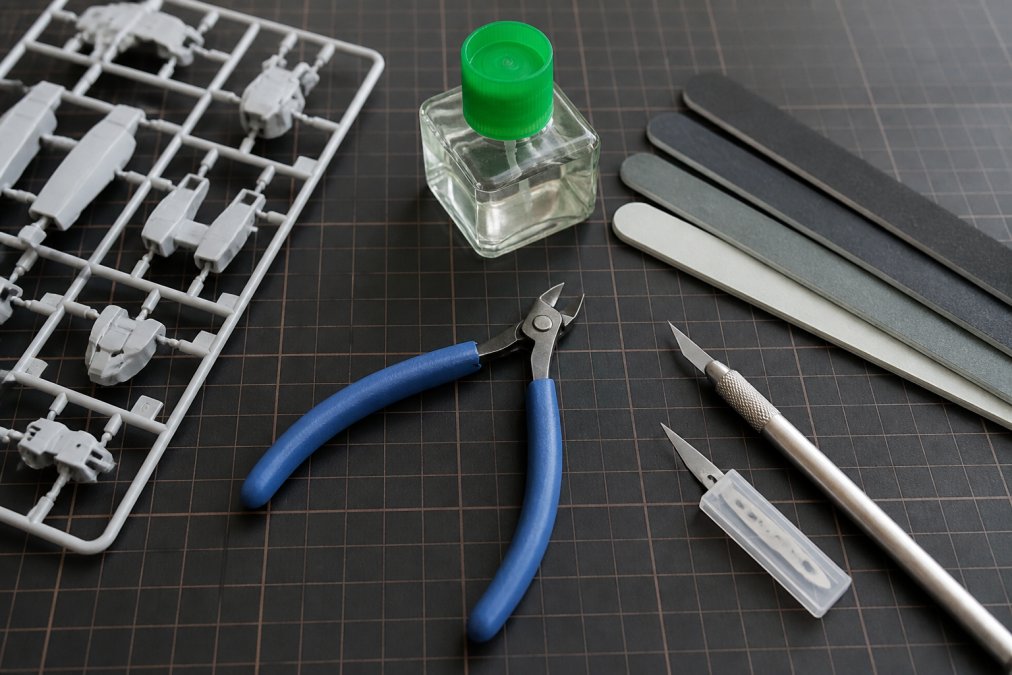
You don't need a workshop or expensive equipment. Focus on three core tools: nippers, a hobby knife, and sandpaper.
Nippers are your most important purchase. They're precision cutters designed to separate parts from the sprue, the plastic frame holding components together. Quality nippers make clean cuts and leave minimal nubs. Invest in a decent pair; they'll outlast multiple kits.
A hobby knife (like an X-Acto knife) handles gate marks, the small marks left where parts connected to the sprue. After nipping, you'll use the hobby knife to carefully shave these marks flush.
Sandpaper or sanding sticks (400-1000 grit) smooth rough edges and gate marks. A few sheets in different grits work fine. Spending 10 extra minutes sanding parts makes a visible difference in the final result.
Beyond those three, everything else is optional. You don't need glue for snap-fit HG kits. You don't need paint unless adding custom details. A clean desk, good lighting, and a small container for tiny parts is sufficient.
Snap-Fit Assembly vs. Glue and Paint Requirements
Most beginner kits use snap-fit assembly, meaning plastic parts lock together without adhesive. You can disassemble and reassemble models without damage, experiment with different configurations, and avoid the mess and fumes of plastic cement.
Glue becomes relevant only when customizing or building advanced kits. Paint is similarly optional. HG kits arrive in color-molded plastic that looks finished without paint. Advanced builders add paint for detail work, but that's a separate skill entirely. You can build impressive models without ever touching paint.
How Long Does It Take to Build a Gunpla: Realistic Timelines
Build time varies dramatically by grade and experience level.
Entry Grade kits take 1-2 hours for beginners. High Grade kits typically require 2-4 hours for first-time builders. Real Grade kits demand 4-6 hours. Master Grade kits range from 6-12 hours depending on complexity.
These timelines assume methodical work without rushing. Rushing introduces mistakes: broken parts, misaligned pieces, or poor gate mark cleanup. The hobby rewards patience.
Top Recommended Beginner Gunpla Kits for Adults
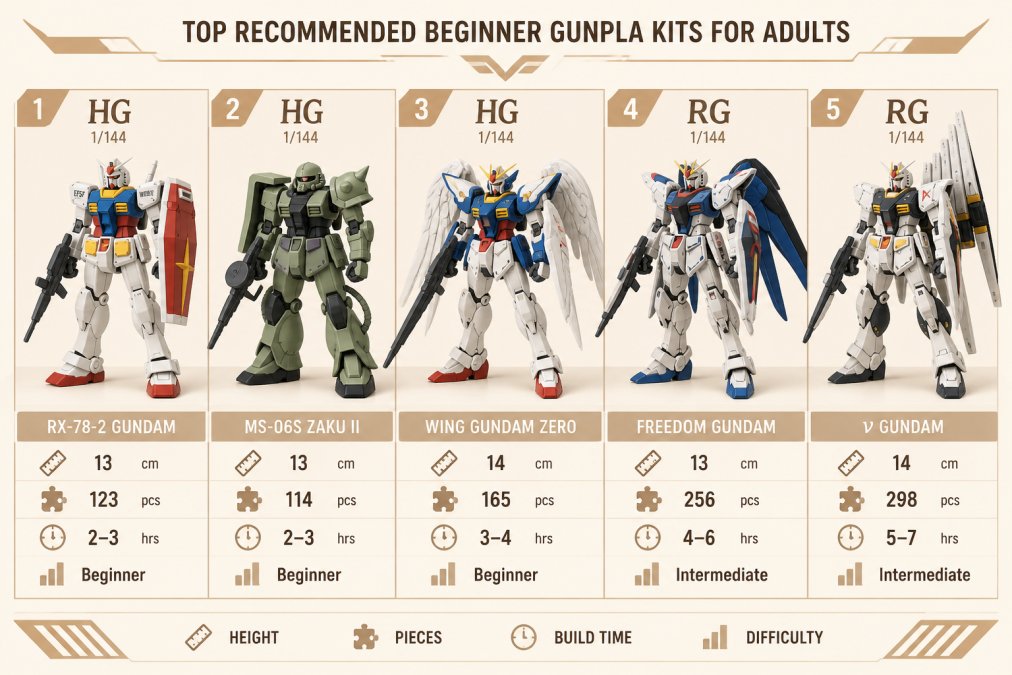
These five kits represent the best starting points for adults new to the hobby. All are readily available through Utopia Toys and Models, which carries a curated selection of beginner-friendly kits with reliable in-stock availability and transparent shipping information.
1. RX-78-2 Gundam (HG 1/144) - The Classic Starting Point
This is the original Gundam and the perfect entry point for beginners. The HG 1/144 RX-78-2 is iconic, straightforward to build, and visually impressive when finished. You're looking at roughly 3 hours of assembly for a first-timer.
The instruction manual is exceptionally clear with large diagrams and logical progression. Parts snap together reliably. The finished model looks like a proper Gundam with genuine presence on a shelf. However, joint tolerances are looser than modern kits, so loose hip joints are common.
Best for: Adults who want the iconic Gundam experience without complexity.
2. HGBD Gundam Build Divers (HG 1/144) - Modern Snap-Fit Design
Build Divers represents modern HG design philosophy: improved joint engineering, better part separation, and enhanced articulation. It's still straightforward snap-fit, but noticeably more refined.
The joints are tight and hold poses reliably. Part separation is clean with minimal gate marks. The design is visually striking and modern. Assembly is intuitive, and the finished model looks substantially more detailed than its part count suggests.
Best for: Builders who want modern engineering and improved articulation without stepping up to Real Grade complexity.
3. RG RX-78-2 Gundam (RG 1/144) - Intermediate Challenge
Real Grade packs the detail and articulation of Master Grade kits into 1/144 scale. Articulation is exceptional, and internal frame details create genuine visual depth. However, part count jumps to 150+, assembly takes 4-6 hours, and tolerances are tighter. This isn't a casual build; it demands focus.
Best for: Builders who've completed 2-3 HG kits and want a genuine challenge. Skip this as your first kit.
4. Barbatos (HG 1/144) - Excellent Articulation and Poseability
Barbatos is a modern HG design that punches above its complexity level. Joints are tight and reliable with multiple articulation points that allow genuinely dynamic poses. Gate mark cleanup is minimal.
Best for: Builders who prioritize pose-ability and articulation. If you plan to photograph your models or display them in dynamic positions, Barbatos delivers HG-level simplicity with RG-level articulation.
5. Gundam Astray Red Frame (HG 1/144) - Customization-Friendly
Red Frame is a builder's kit. The design is clean, assembly is straightforward, and the finished model provides an excellent foundation for customization. The color scheme is striking even without customization.
Best for: Adults interested in eventually customizing their models. Red Frame teaches fundamentals while providing a platform for experimentation.
How to Choose Your First Beginner Gunpla Kit
Selecting your first kit matters more than most beginners realize. Consider these factors methodically.
Consider Your Time Commitment
Honestly assess how much time you can dedicate to building. If you have 2-3 hours on a weekend, HG kits are your range. If you're looking for a single-evening project, Entry Grade is safer. Don't overestimate your patience. Start with a kit you can realistically finish in the time you actually have available.
Workspace Setup for Small Apartments
You don't need a dedicated workshop. A small desk, good lighting, and a container for parts is sufficient. Lighting is more important than space. You're working with small parts and need to see gate marks clearly.
Consider storage for tools and parts. A small toolbox or drawer holds nippers, hobby knife, sandpaper, and spare parts. Parts containers prevent losing tiny pieces.
Post-Build Display and Storage Solutions
Think about what you'll do with finished models. Shelves with glass doors or acrylic cases protect models from dust. For storage, acid-free boxes and tissue paper prevent yellowing.
Display considerations also influence which kits you choose. If you plan to photograph models, articulated kits like Barbatos reward the effort. If you're building for shelf display, simpler kits like the classic RX-78-2 are equally impressive.
Assembly Tips and Common Mistakes to Avoid
Rushing sprue removal is the most common error. Cut slightly away from the part, then use a hobby knife to carefully shave the nub flush. This takes an extra 30 seconds per part but prevents visible blemishes.
Ignoring instruction manual diagrams creates assembly errors. The manual shows exactly how parts fit. Follow it methodically.
Forcing parts together breaks plastic. If a part doesn't fit smoothly, stop and check the manual. Gentle, deliberate assembly prevents damage.
Neglecting joint care causes loose models. If a joint is too loose, a small amount of plastic cement on the connection point tightens it without permanently bonding.
Skipping panel lining misses an easy visual improvement. Panel lining, drawing thin lines along panel seams with a fine-tip marker, adds enormous visual depth without requiring painting skill.
The Therapeutic Benefits of Building Gunpla as an Adult
Building Gunpla provides something increasingly rare: sustained, focused attention on a single task. Modern life fragments attention constantly. Building reverses this. You're present, methodical, and engaged with a tangible task that produces visible progress.
This focused attention quiets racing thoughts. Anxiety diminishes when your mind is occupied with precise part placement. Many builders describe the process as meditative.
The hobby also provides completion and accomplishment. You finish the kit and have something tangible to show for your effort. That sense of completion is psychologically valuable.
The social aspect matters too. Online communities are welcoming and encouraging. Local hobby shops connect builders with others who share the interest. These social connections combat isolation and create genuine community.
For adults managing stress, depression, or general mental fatigue, Gunpla offers an accessible entry point into a meaningful hobby. It's affordable, doesn't require exceptional skill, and delivers genuine satisfaction.
Choosing your first beginner gunpla kit is about matching your interests, time, and patience level to the right kit. The five recommendations above represent the strongest starting points for adults entering the hobby. If you're ready to begin, Utopia Toys and Models offers a curated selection of these kits with reliable in-stock availability, transparent shipping information, and the expertise to answer questions as you build. Start with an HG kit, understand your pace and preferences, then expand into more complex grades. The hobby rewards patience and attention to detail, qualities that make the building experience genuinely rewarding.
Frequently Asked Questions
What is the best grade of Gunpla for beginners?
High Grade (HG) kits at 1/144 scale are ideal for beginners. They offer excellent snap-fit assembly that requires minimal tools, feature good articulation and poseability, and build in 2-4 hours. Entry Grade (EG) kits are even simpler if you want the absolute easiest start. Real Grade (RG) and Master Grade (MG) kits demand more precision and time but reward patient builders with superior detail and complexity.
Do I need special tools to build my first Gunpla kit?
Not for snap-fit beginner kits. You'll need nippers to separate parts from the sprue and a hobby knife to clean gate marks. Many builders skip glue and paint on their first build. As you progress, you may want sanding sticks, plastic cement, and top coat spray to enhance your models. Start simple and add tools as your skills grow.
How long does it take to build a beginner Gunpla kit?
High Grade beginner kits typically take 2-4 hours for first-time builders. Entry Grade kits may finish in 1-2 hours. Real Grade and Master Grade kits require 4-8+ hours depending on your experience and whether you add painting and decal application. Build time also depends on workspace setup and how carefully you work, rushing leads to mistakes that cost time later.
Are Gunpla kits suitable for adults?
Absolutely. Gunpla building offers stress relief, improved focus, and creative satisfaction. Many adult builders appreciate the meditative quality of assembly, the challenge of customization, and the community aspect. Adults often invest in higher-grade kits and advanced techniques like panel lining and water slide decals, making the hobby as deep as you want it to be.
What's the difference between snap-fit and glue-based Gunpla builds?
Snap-fit kits hold together through plastic joints without adhesive, most beginner HG and EG kits work this way. Glue-based builds use plastic cement to permanently bond parts, offering stronger joints and better poseability for display. Most beginners start snap-fit to learn assembly basics, then add glue on later builds for durability and customization flexibility.
This article was written using GrandRanker