

Table of Contents
- Quick Comparison: Top Model Kit Brands for Beginners
- Bandai: Snap-Fit Gundam Models for Zero Experience
- Tamiya: Precision Engineering and Glue-Together Kits
- Airfix: All-in-One Starter Sets with Paint and Glue
- Revell: Wide Selection at Local Retailers
- HobbyBoss: Stepping Up to Detail Without Overwhelming Complexity
- Essential Model Building Tools for Beginners
- How to Paint Gundam Model Kits and Other Polystyrene Models
- Frequently Asked Questions
Last Updated: September 21, 2026
Quick Comparison: Top Model Kit Brands for Beginners
The 5 best model kit brands for beginners offer different entry points: snap-fit simplicity, bundled supplies, or affordability and local availability.
Whether you're drawn to Gundam models, classic aircraft, or vintage cars, the 5 best model kit brands for beginners offer a clear path forward with minimal frustration.
| Brand | Assembly Type | Best For | Starting Price | Standout Feature |
|---|---|---|---|---|
| Bandai | Snap-fit (no glue) | Zero experience, Gundam fans | $12 | Color-molded parts, highly articulated |
| Tamiya | Glue-together | Precision seekers | $20 | Excellent part fit, detailed instructions |
| Airfix | Glue-together | Budget builders | $15 | Starter sets include paint & glue |
| Revell | Glue-together | Local retail access | $10 | Wide distribution, diverse subjects |
| HobbyBoss | Glue-together | Detail enthusiasts | $25 | Simplified complexity, modern tooling |
Bandai: Snap-Fit Gundam Models for Zero Experience
Bandai's snap-fit system removes the biggest barrier to entry: you don't need glue, paint, or solvents. Parts snap together using friction-fit joints, and color-molded plastic means many pieces are already the right color, so even an unpainted Gundam looks finished and satisfying.
Snap-fit tolerances are looser than glued assemblies, but the articulation in Bandai kits is impressive and poses dynamically, making display rewarding.
Use side cutters or hobby nippers to remove parts from the sprue, a regular knife can slip and crack the plastic. This single investment makes assembly dramatically better.
Tamiya: Precision Engineering and Glue-Together Kits
Tamiya's injection-molded parts fit so tightly that many builders need zero sanding or filling. The plastic quality is noticeably higher, and instruction manuals are legendary for clarity.
Choose Tamiya to learn proper technique: gluing teaches patience, adhesive chemistry, and assembly planning. Minimal gaps make the result feel genuinely built.
You'll need plastic cement, which requires ventilation and learning curve: how much to apply, how long to hold parts, and cleanup timing. Most beginners master this by their second or third part.
Tamiya's aircraft and automotive kits are well-regarded for beginner-friendly complexity. Precision engineering means less cleanup time.
Airfix: All-in-One Starter Sets with Paint and Glue
Airfix starter sets bundle the kit, plastic cement, paint, and brushes in one box, removing decision paralysis and the risk of buying wrong supplies.
Airfix's all-in-one approach is thoughtful: pre-selected paint, standard plastic cement, and functional brushes, no guessing required.
Some Airfix molds are decades old, meaning more flash and looser tolerances. You'll spend more time cleaning parts, but this teaches you to handle imperfect fit.
Airfix excels at historical aircraft and vehicles; anime and modern military subjects are limited.
Revell: Wide Selection at Local Retailers
Revell's superpower is distribution: available at craft stores, hobby shops, and general retailers. Seeing kits in person before purchase is valuable for first-time buyers.
Quality is variable: newer releases are solid and beginner-friendly, while older re-issues require more patience. Check the release year on the box.
Revell's skill-level ratings (1-5) are useful: Level 1 has under 50 parts, Level 2 requires more time. Stick to Level 1 or 2 for your first build.
Starter sets often include glue and paint. The range spans cars, ships, aircraft, and pop-culture subjects.
HobbyBoss: Stepping Up to Detail Without Overwhelming Complexity
HobbyBoss simplifies complex subjects: modern military aircraft or armor normally requiring 500+ parts are reduced to 200-300, with modern plastic quality and manageable assembly time.
Many kits include photo-etched parts (tiny pre-cut metal details) for antenna, railings, and fine details. They're fragile but add substantial realism.
Instructions are generally clear. Plastic quality is modern and crisp. Part fit is good; light sanding is needed but nothing excessive. This is for builders ready to level up.
HobbyBoss has a narrower subject range (primarily military vehicles and aircraft) and higher starting prices.
Essential Model Building Tools for Beginners
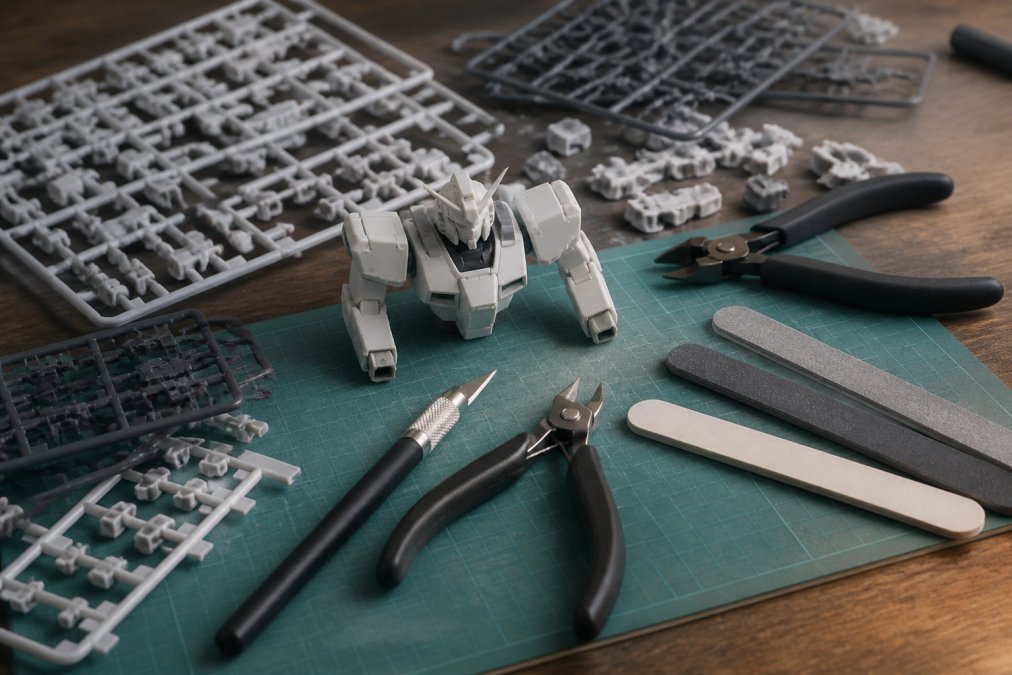
Essential tools are minimal: a hobby knife, side cutters, sanding sticks, and a work surface. Everything else is optional.
Hobby Knife: Primary tool for removing parts and cleaning gates. A basic X-Acto style knife costs under $10. Keep blades sharp and extra blades on hand.
Side Cutters (Nippers): Essential for clean cuts without crushing parts. Quality matters; cheap cutters damage plastic. A decent pair costs $15-25.
Sanding Sticks: Abrasive strips in various grits smooth edges and remove mold lines. A basic set costs $8-12.
Work Surface: A self-healing cutting mat protects your table and costs $10-15.
Optional: A hobby vise, magnifying lamp, and natural-hair brushes become valuable after your first kit.
Snap-Fit vs. Glue-Together: Which Should You Choose?
Snap-fit assembly (primarily Bandai) requires no adhesive and no paint to look finished. You remove parts, snap them together, and display. Assembly time is 30-90 minutes depending on part count. The learning curve is minimal. The downside: joints can be loose, and you're limited to color-molded plastic unless you paint.
Glue-together assembly (Tamiya, Airfix, Revell, HobbyBoss) uses plastic cement to bond parts permanently.
Understanding Scale and Part Count
Scale describes the ratio between your model and the real object. A 1:35 scale tank is 1/35th the size of an actual tank. A 1:48 aircraft is 1/48th the size of the real plane. Smaller scales (1:72, 1:144) result in smaller, simpler models. Larger scales (1:24, 1:32) are bigger and more detailed.
How to Paint Gundam Model Kits and Other Polystyrene Models
Many beginners skip painting because they assume it's difficult or requires expensive equipment. The truth is simpler: basic painting transforms a model dramatically, and you can start with supplies under $30.
Primer, Acrylic Paint, and Clear Coat Basics
Primer is the foundation. It provides a uniform surface for paint to adhere to and helps you see imperfections in the plastic. Use a gray or white primer designed for plastic models (not spray primer for wood). A small bottle of brush-on primer costs $5-8 and covers dozens of small parts.
Weathering and Dry Brushing Techniques
Dry brushing is the beginner's secret weapon for adding depth and realism with minimal skill. Load a brush with paint, wipe most of it off on a paper towel, then lightly drag the nearly-dry brush across raised details. The paint catches only on the high points, creating shadows and highlights. This takes 10 minutes and transforms a flat paint job into something with dimension.
Frequently Asked Questions
What is the best model kit brand for a complete beginner?
Bandai's snap-fit Gundam model kits are ideal for absolute beginners because they require no glue or paint, parts simply click together. If you prefer traditional glue-together assembly, Tamiya offers exceptional part fit and beginner-friendly instructions. Airfix starter sets are also excellent because they include everything: glue, paint, and brushes. Your choice depends on whether you want zero tools required (Bandai) or a more traditional building experience (Tamiya or Airfix).
What essential model building tools for beginners do I actually need?
Start with side cutters to remove parts from sprues cleanly, a hobby knife for cleanup, and sanding sticks for smoothing rough edges. For snap-fit kits like Bandai Gundam models, quality nippers are the main tool. If painting, you'll need brushes, acrylic paint, and primer. Most beginners overspend on tools they don't use, focus on cutters, sanding, and one good brush before buying specialty items. Many brands now include basic tools in starter sets.
Should I choose a snap-fit or glue-together kit as my first model?
Snap-fit kits (like Bandai Gundam) eliminate assembly stress and let you focus on learning painting and detailing. Glue-together kits (Tamiya, Revell, Airfix) teach fundamental building skills but require hobby cement, which adds cost and safety considerations. If you're nervous about commitment, start with snap-fit. If you want the full traditional hobby experience and don't mind solvents, glue-together kits build stronger foundations for future complexity.
How do I paint Gundam model kits if they come pre-colored?
Bandai Gundam kits come color-molded but benefit from painting for detail work. Apply primer first to help paint adhere to polystyrene. Use acrylic paints (safer than enamel for beginners) and thin coats, multiple thin coats look better than one thick coat. Focus on panel lining, dry brushing to add weathering, and a clear coat for protection. Many builders skip full painting on their first Gundam and focus on assembly, posing, and decal application instead.
What scale should I choose for my first model kit?
1:48 and 1:35 scales are beginner-friendly, large enough to see detail and handle parts easily, but not so large they become overwhelming. Bandai Gundam kits typically range from 1:100 to 1:60 scale; 1:100 is smaller but still manageable. Avoid 1:72 aircraft or 1:144 scale as first projects, parts are tiny and frustrating. Larger scales (1:24, 1:25) mean higher cost but easier assembly. Match the scale to your patience level and workspace.