

Table of Contents
- What Acrylic Risers Do for Model Displays
- Gundam Model Kit Display Ideas with Risers
- How to Arrange Figures on Risers Effectively
- Acrylic Riser Weight Capacity and Material Durability
- Comparing Single-Tier vs. Multi-Tier Display Systems
- Cost vs. Value: When Risers Make Financial Sense
- Common Mistakes to Avoid When Using Display Risers
- Frequently Asked Questions
Last Updated: September 1, 2026
What Acrylic Risers Do for Model Displays
Are acrylic risers worth it for model displays? The answer depends entirely on what you're trying to achieve with your collection. At Utopia Toys and Models, we've helped countless collectors transform their displays from flat, cramped shelves into dynamic, visually compelling showcases. Acrylic risers solve a specific problem: they create vertical hierarchy, maximize shelf space, and keep your models visible from multiple angles without competing for real estate.
Here's what matters most: risers aren't just about looking good, though they absolutely do that. They're about functionality. A well-arranged display with proper risers lets you fit more models in the same footprint while making each one more visible than it would be on a flat surface. That's not theoretical, it's how collectors who care about presentation actually organize their shelves.
The core value proposition is simple. Without risers, your Gundam models sit side by side, and anything behind the front row disappears. With risers, you create sightlines. A figure on a riser sits at eye level even when it's positioned deeper in the cabinet. That changes everything about how your collection reads as a cohesive display rather than inventory.
But there's a catch. Risers only work if you choose the right ones for your specific use case. A riser designed for diecast cars might be too small for larger action figures. A riser without proper stability features can damage your models if it tips. And if you don't think through your layout before buying, you'll end up with mismatched heights and a cluttered look that defeats the purpose.
Gundam Model Kit Display Ideas with Risers
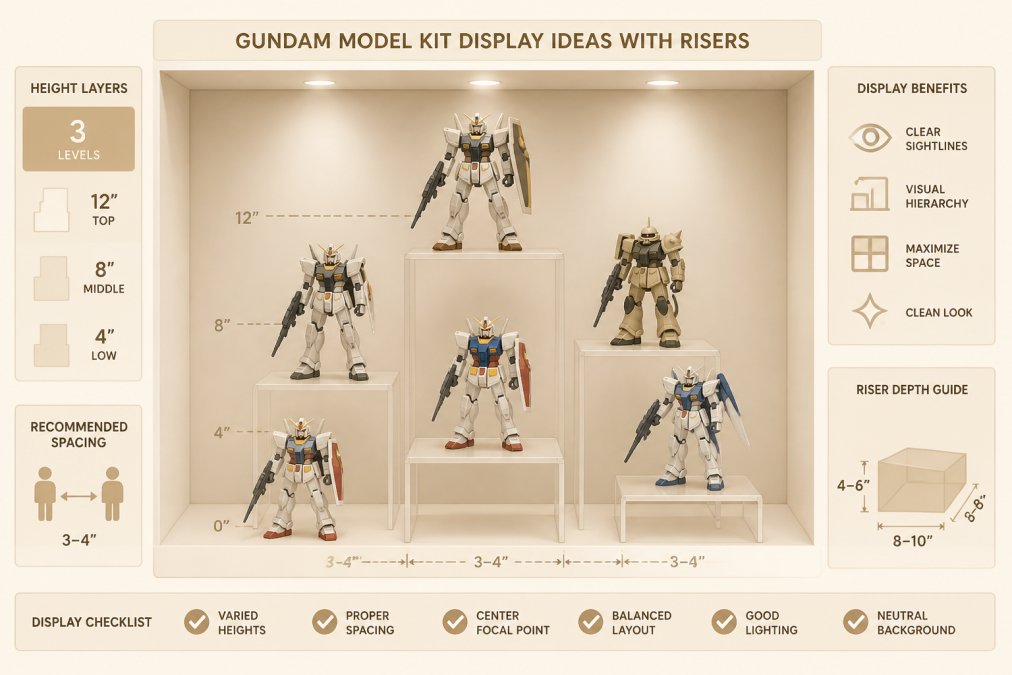
Gundam models demand a different approach than smaller collectibles. These kits, whether you're displaying High Grade, Real Grade, or Master Grade builds, have visual weight. They command attention. The right risers amplify that presence instead of fighting against it.
Start with scale. Most Gundam models sit between 4 and 8 inches tall depending on grade (bandai.com). You need risers that create enough elevation difference to matter visually without dwarfing the model. A 2-inch riser works. A 4-inch riser creates dramatic effect. The key is variety. If all your risers are the same height, your display becomes monotonous. Mix heights to create visual rhythm.
Consider the backdrop. Gundam models look exceptional against solid backgrounds, black, white, or neutral gray. Acrylic risers in clear construction work best here because they disappear visually and let the model command attention. If you're using colored risers, they should complement the model's color scheme, not compete with it. A white Gundam on a white riser vanishes. A white Gundam on a black riser pops.
Grouping matters more than you'd expect. Instead of scattering individual models across a shelf, cluster them by series or color palette. Three RX-78 variants on risers at different heights tell a story. Thirteen random Gundams at random heights just look busy. Create focal points. One showpiece model, your favorite build, your most detailed work, should occupy a prime position with supporting models arranged around it at varying heights.
Lighting transforms everything. If your display cabinet has backlighting or side lighting, position your risers to take advantage of it. The acrylic transparency means light passes through the riser and illuminates the model from beneath. This creates depth and dimension that flat displays can't achieve. Without lighting, even the best riser arrangement feels flat.
How to Arrange Figures on Risers Effectively
The difference between a mediocre display and a stunning one comes down to arrangement logic. Most collectors make the same mistake: they place their best figures front and center, then fill in the gaps. That creates a pyramid shape that actually hides your collection instead of showcasing it.
Reverse that instinct. Place your largest or most visually dominant model slightly back and elevated. Surround it with smaller supporting figures at varying heights. This creates depth. Your eye travels through the display instead of stopping at the front row. You see more models because they're not stacked on top of each other competing for attention.
Height variation is mechanical but critical. If you have five risers, don't make them 1 inch, 2 inches, 3 inches, 4 inches, 5 inches in a line. Instead, create a pattern: 1 inch on the left, 4 inches in the middle-back, 2 inches on the right, 3 inches center-front. This breaks up the visual monotony and creates sightlines that let you see deeper into the display.
Spacing prevents crowding. Leave air between models. A common mistake is treating the shelf like a storage unit instead of a display. Space is part of the design. If you have room for twelve figures, display ten. The negative space makes each figure more powerful, not less.
Consider sight angles. Where will you actually look at this display? If it's a shelf you see from your desk, arrange it for that specific vantage point. Front-facing? Create depth by staggering heights front to back. Side view? Arrange in a gentle curve so the eye flows left to right. Most displays get viewed from one primary angle, so optimize for that.

Acrylic Riser Weight Capacity and Material Durability
This is where risers stop being aesthetic and become functional. Weight capacity determines what you can actually display. A riser that looks sturdy but can't handle your models creates risk.
Standard acrylic risers come in different thicknesses. Thin acrylic (2-3mm) is affordable but flexes under weight. Medium acrylic (4mm) handles most collectibles without issue. Thick acrylic (6mm and above) is overkill for most home displays but necessary for commercial installations or if you're displaying particularly heavy models.
The weight-bearing question matters most for larger Gundam kits. A Master Grade Gundam fully built and detailed can weigh 8-12 ounces. That's not heavy in absolute terms, but it concentrates force on a small footprint. A riser rated for 5 pounds per square inch handles that easily. A flimsy riser rated for 2 pounds might flex visibly under that load, and visible flex means visible stress on your model. alternative display stands.
Material quality determines longevity. Cast acrylic, the type used in most display risers, stays clear for years if maintained properly (peer-reviewed research). Injection-molded acrylic is cheaper but yellows faster under UV exposure (astm.org). If your display gets direct sunlight, cast acrylic is worth the premium. If it's in a cabinet with controlled lighting, either works.
Scratches are the real enemy. Acrylic scratches easily. A riser that looked pristine six months ago can look cloudy if you've cleaned it with rough cloths or placed models without care. The good news: minor scratches don't affect function. The bad news: they're visible and they accumulate. Handle your risers carefully during setup and when rearranging. Use soft cloths for cleaning. Avoid abrasive materials.
Stability features matter more than material thickness. A riser with a wide base and low center of gravity won't tip even under moderate weight. A tall, narrow riser with a small footprint is unstable regardless of acrylic quality. Look for risers with non-slip feet or ridges that prevent models from sliding. These features cost slightly more but prevent damage that costs far more to repair.
Comparing Single-Tier vs. Multi-Tier Display Systems
The choice between a single shelf with risers and a dedicated multi-tier riser system comes down to space, budget, and aesthetic preference.
Single-tier risers, individual acrylic blocks you place on an existing shelf, offer flexibility. You buy exactly what you need. You arrange them however you want. You can change the layout without replacing the entire system. They work in existing shelving, display cases, or even on dressers. This approach appeals to collectors who like to experiment and rearrange frequently.
The downside: single-tier risers require planning. You need to visualize the final arrangement before buying. You might end up with mismatched risers if you buy from different suppliers. And managing individual pieces means more clutter in storage when you're not using them.
Multi-tier systems, pre-assembled risers with built-in steps, create instant visual impact. They're designed as a cohesive unit. Heights are calculated to work together. Setup takes minutes instead of hours of arrangement. They photograph beautifully because the geometry is intentional.
The trade-off: multi-tier systems are less flexible. You're locked into the height configuration. Rearranging means moving the entire structure. They take up more footprint space even though they use vertical space efficiently. And they're more expensive as a single purchase, though the cost-per-riser might be lower.
| Aspect | Single-Tier Risers | Multi-Tier Systems |
|---|---|---|
| Flexibility | High, arrange however you want | Low, fixed configuration |
| Setup Time | 30-60 minutes | 5-10 minutes |
| Space Efficiency | Depends on your arrangement | Optimized by design |
| Cost | Lower upfront, scalable | Higher upfront cost |
| Rearrangement | Easy | Requires moving entire unit |
| Aesthetic Cohesion | Depends on matching | Built-in visual harmony |
| Best For | Frequent changers, small collections | Permanent displays, larger collections |
For most collectors, the answer is hybrid: use a multi-tier system as your anchor display, then supplement with single-tier risers for overflow or secondary collections. This gives you the visual impact of a designed system plus the flexibility to expand.
Cost vs. Value: When Risers Make Financial Sense
Acrylic risers aren't expensive in absolute terms, but they're an investment that only makes sense in specific scenarios.
If you have five models and a shelf, risers are probably overkill. The cost-to-benefit ratio doesn't justify it. You have plenty of space already.
If you have twenty models and limited shelf space, risers become practical. They let you display more in the same footprint. That's value, the ability to show your collection instead of rotating pieces in and out of storage.
If you're a serious collector with fifty-plus models and a dedicated display area, risers aren't optional. They're infrastructure. The question isn't whether to buy them but which system to buy.
The financial logic is this: compare the cost of risers against the cost of additional shelving or display cabinets. A set of risers costs less than a new shelf unit. If risers let you eliminate the need for extra furniture, they've paid for themselves in space savings alone.
There's also the intangible value of presentation. A well-displayed collection is more enjoyable to look at. You spend more time appreciating your models. You're more likely to show them to friends. That's not quantifiable, but it's real. If you care enough about your collection to buy quality models, you probably care enough to display them properly.
The break-even point is roughly fifteen to twenty models. Below that, risers are nice-to-have. Above that, they're necessary infrastructure.
Common Mistakes to Avoid When Using Display Risers
The most frequent error is overcrowding. Collectors see risers as permission to display everything at once. A riser doesn't create space; it creates the illusion of space. If you pack models densely, they compete visually and none of them shine.
The second mistake is ignoring stability. Risers need a stable base. A wobbly shelf amplifies the wobble in the risers. A riser on an uneven surface tips easily. Test your setup before placing valuable models on it. A five-minute stability check prevents a broken model.
Third: mismatched aesthetics. Buying risers from three different sources creates visual chaos. Stick with one supplier or one material type. Consistency matters more than you'd think. Mixed clear and frosted acrylic looks chaotic. Mixed heights without logic look random.
Fourth mistake: static arrangements. Once you set up risers, many collectors never touch them again. But arrangements age. What looked balanced six months ago might feel stale now. Rearrange seasonally. Rotate your display. This keeps it fresh and lets you appreciate different models.
Fifth: neglecting lighting. A display without proper lighting is like a movie without sound. Backlighting, spotlights, or even ambient LED strips transform a good display into a great one. If you're investing in risers, invest in lighting too.
Sixth: choosing risers based on price alone. A cheap riser that flexes visibly or scratches easily costs more in the long run because you'll replace it. Mid-range acrylic risers from reputable makers hold up better and look better. The price difference is usually under ten dollars per riser. It's worth it.
Finally, avoid risers that are too tall or too narrow. A riser that's unstable or makes your models look tiny defeats the purpose. Test before committing to a full set.
The real question isn't whether acrylic risers are worth it in theory, it's whether they solve your specific problem. If you're displaying a growing collection in limited space, they're essential. If you're showing off carefully curated models you care about, they're the right tool. If you're trying to fit everything you own into one shelf, they're a band-aid on a space problem.
At Utopia Toys and Models, we work with collectors every day who transform their displays with the right risers. We carry risers that match Bandai Gundam models, Funko collectibles, and Kotobukiya figures. Whether you need single-tier risers for flexibility or a complete multi-tier system, our team can help you find the right setup for your collection and your space. Visit us to explore options that work for your specific models and display goals.
Frequently Asked Questions
Q: Are acrylic risers durable enough for heavy model kits?
A: Durability depends on acrylic thickness and the riser's weight capacity. Quality risers made from 4mm or thicker acrylic can safely support most model kits and action figures. However, extremely heavy display pieces (such as large-scale Gundam models or resin figures exceeding 5 pounds) require risers specifically rated for higher load capacity. Always check the manufacturer's weight limit before placing items on acrylic risers to prevent cracking or warping over time.
Q: What is the best material for a display case for collectibles?
A: Acrylic is the most popular choice for collectible displays because it offers excellent optical clarity, is affordable, and resists yellowing better than polycarbonate. Clear acrylic provides an unobstructed view of your models and figures while maintaining transparency. For maximum protection from dust and damage, enclosed display cases with acrylic lids and removable risers offer a good combination of visibility and preservation, though open risers work well for accessible collections.
Q: How do I maximize shelf space with acrylic risers?
A: Create visual hierarchy by staggering riser heights across your shelf. Place taller risers toward the back and shorter ones in front to ensure every figure is visible. Multi-tier risers allow you to stack items vertically, effectively doubling or tripling your display capacity without expanding your footprint. Group similar-sized pieces together and use risers strategically to fill gaps, turning a single shelf into a dynamic, layered display that showcases your entire collection.
Q: Why do collectors prefer acrylic stands for anime figures?
A: Collectors favor acrylic risers because they're nearly invisible, allowing figures and models to be the visual focus. Unlike wood or metal stands, acrylic doesn't distract from the piece being displayed. The material also provides stability without adding bulk, and its clear construction works with any aesthetic, minimalist, modern, or eclectic. Additionally, acrylic is affordable and easy to clean, making it practical for long-term figure care and display maintenance.
This article was written using GrandRanker