

Table of Contents
- Why Proper Gundam Model Kit Storage Solutions Matter
- Best Gundam Model Kit Display Cases for Your Collection
- Gundam Model Kit Dust Protection Strategies
- How to Store Built Gundam Kits: Step-by-Step Setup
- Gundam Model Kit Storage for Small Spaces
- Managing Runners, Spare Parts, and Instruction Manuals
- Inventory Tracking and Moving Your Gundam Model Kit Collection
- Protecting Against Plastic Degradation and UV Damage
Gundam Model Kit Storage Solutions: A Complete Guide
Last Updated: July 30, 2026
Proper gundam model kit storage protects your investment and preserves the craftsmanship in your collection. At Utopia Toys and Models, we understand that Gunpla enthusiasts invest significant time and resources into their kits. Improper storage exposes models to dust accumulation, UV fading, plastic degradation, and accidental damage. This guide covers display cases, dust protection, space-saving solutions, and long-term preservation strategies that keep your collection gallery-ready.
Why Proper Gundam Model Kit Storage Solutions Matter
Dust settles on exposed models within days, embedding itself in panel lines and joints. Sunlight causes plastic discoloration through UV exposure, accelerating in bright rooms and near windows. Temperature fluctuations and humidity swings warp plastic, loosen joints, and degrade decals. Models kept in sealed, dust-free environments maintain their original colors and structural integrity.
Best Gundam Model Kit Display Cases for Your Collection
A display case shows off your models while protecting them simultaneously. Glass-door options offer maximum visibility with dust protection. Wall-mounted systems save floor space. Acrylic cases with UV protection safeguard both sealed boxes and built models from light damage.
Glass-Door Cabinets for Maximum Visibility
The IKEA Detolf Glass-door Cabinet remains the industry standard for Gunpla display. Four glass shelves accommodate roughly 20-30 HG kits or 12-16 MG models per unit. The transparent design allows viewing from all angles without opening the cabinet, preventing dust exposure during inspection. The IKEA Detolf Glass-door Cabinet typically costs around $99.99.
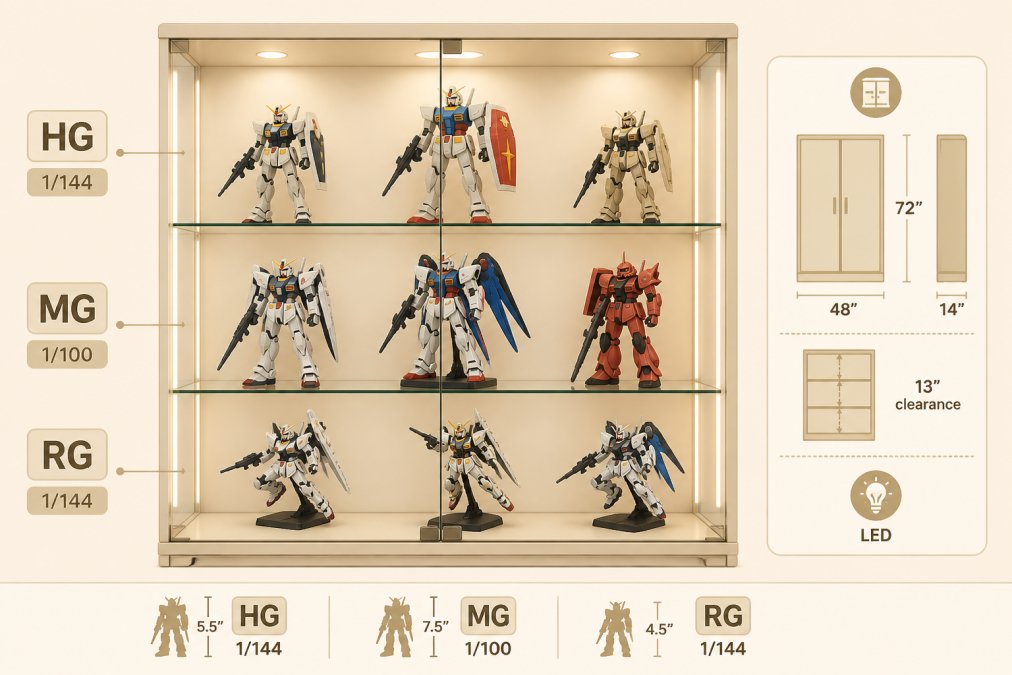
Setup takes roughly 45 minutes with basic tools. Adding weatherstripping tape around the door frame reduces dust infiltration by 80-90%. LED strip lighting mounted along the top shelf transforms the display; use 5000K cool white strips to avoid heat damage.
Wall-Mounted Display Cases for Space-Saving Setups
Wall-mounted systems like Showcase Express cabinets excel when floor space is limited. These units mount directly to studs, freeing your entire room footprint while creating a gallery-style presentation. Expandable rail systems let you customize length and add multiple shelves for growing collections. Showcase Express offers train display cases for various scales, and their shelving units are constructed from extruded and anodized aluminum.
Wall mounting requires drilling into studs and using appropriate anchors. Most wall-mounted systems can be more expensive than freestanding cabinets but offer superior aesthetics and space efficiency. Shelves typically hold 50 pounds per section, accommodating large PG models alongside smaller HG kits. Showcase Express shelves hold up to 50 lbs per shelf.
Acrylic Display Cases with UV Protection
Premium acrylic cases with 99% UV protection address a specific need: protecting sealed Gundam boxes and high-value collectibles from light damage. These cases are stackable, feature magnetic closures, and maintain clarity over years of use. UV protection prevents fading that turns vibrant packaging dull over time, directly preserving resale value for collectors storing sealed boxes as investments.
Gundam Model Kit Dust Protection Strategies
Dust settles into panel lines and becomes nearly impossible to remove without risking damage. Effective dust protection requires sealed storage containers, environmental controls, and strategic placement away from dust sources.
Sealed Storage Containers and Protective Covers
Clear plastic storage bins with lids offer affordable, stackable protection for unbuilt kits and completed models. Standard 27-quart bins cost $8-15 and stack efficiently in closets, under beds, or shelving units. Line bin bottoms with acid-free tissue paper or foam padding to prevent scratching during stacking.
Built models stored long-term benefit from individual clear plastic bags or sealed boxes. Ziploc-style bags work for smaller HG kits; larger models need custom-fitted boxes with tissue padding.
Environmental Control for Long-Term Preservation
Ideal storage conditions maintain 65-75°F and 40-50% relative humidity. Basements and attics experience wider temperature swings and higher humidity, accelerating plastic degradation and paint cracking. Climate-controlled closets or interior rooms offer significantly better preservation.
Monitor conditions using basic digital hygrometers ($15-25). If humidity exceeds 55%, use desiccant packets or small dehumidifiers in your storage area. Silica gel packets work effectively in sealed bins; replace them monthly when saturated.
How to Store Built Gundam Kits: Step-by-Step Setup
Storing completed models requires balancing protection with accessibility. The approach depends on whether you're displaying them permanently, rotating them seasonally, or archiving them long-term.
Preparing Your Kits Before Storage
Before placing a built model into storage, perform these preparation steps:
-
Inspect for loose parts (5 minutes): Check that all joints are secure and small parts won't detach during handling.
-
Clean gently with a soft brush (10 minutes): Use a soft-bristled brush or air blower to remove dust from panel lines.
-
Secure fragile pieces (10 minutes): Wrap delicate weapons, antennas, or shields in acid-free tissue paper and secure with painter's tape.
-
Document condition with photos (5 minutes): Take clear photos from multiple angles before storage for reference and insurance purposes.
-
Pack in individual boxes or bags (10 minutes): Place each model in a clear plastic bag or custom-fitted box with tissue padding.
Organizing by Grade and Scale
Organize stored collections by grade and scale to simplify inventory management and prevent smaller HG kits from being crushed under MG models.
Storage organization by grade:
- HG (High Grade) models: smallest footprint, stack efficiently
- MG (Master Grade) models: larger, require individual boxes, prone to joint stress if stacked
- RG (Real Grade) models: delicate articulation, benefit from individual boxes
- PG (Perfect Grade) models: largest scale, require dedicated shelf space
Keep runners and spare parts from each kit in labeled bags attached to the model's storage box.
Gundam Model Kit Storage for Small Spaces
Space constraints force creative solutions. Vertical storage, cube organizers, and wall-mounted displays multiply effective storage capacity without requiring additional floor space.
Vertical Storage and Cube Solutions
Vertical storage transforms wall space into functional display and storage. IKEA Kallax or similar cube organizers create modular storage accommodating bins, small display boxes, and built models simultaneously. A single 5x5 Kallax unit holds roughly 40-50 HG models in clear bins plus 8-10 displayed MG models on open shelves.
Wall-mounted shelving above desks or dressers doubles storage without consuming additional floor space. Floating shelves rated for 25-30 pounds per shelf accommodate 5-8 MG models or 12-15 HG models depending on pose.
DIY Shelving and Custom Storage Hacks
Budget-conscious builders create custom storage using PVC pipe, wooden shelving, and plastic storage components. A basic PVC frame with clear acrylic shelves can be a cost-effective alternative to commercial display cabinets while offering comparable protection and visibility.
Rotating display stands maximize limited shelf space by allowing 360-degree viewing without requiring additional footprint. Under-bed storage bins use otherwise wasted space efficiently, keeping storage out of sight while remaining accessible for archiving completed models.
Managing Runners, Spare Parts, and Instruction Manuals
Organized spare parts and documentation prevent frustration when you need specific pieces or building instructions.
Organizing Spare Parts and Runners
Keep runners and spare parts with their original kits using small ziplock bags or compartmentalized boxes. A Plano 2-Tray Tackle Box, which costs around $19.99, or similar fishing tackle organizer works well for managing small parts across multiple kits. For large collections, create a master inventory spreadsheet listing kit name, grade, part description, and storage location.
Storing Instruction Manuals and Decals
Store manuals in acid-free folders or archival boxes to prevent yellowing and degradation. Keep them in climate-controlled environments away from moisture and direct sunlight.
Decals and water slides require careful storage to remain usable. Store them in sealed bags with desiccant packets in cool, dry conditions. High humidity causes decals to stick together; temperature fluctuations degrade adhesive.
Inventory Tracking and Moving Your Gundam Model Kit Collection
Large collections benefit from digital inventory systems. Spreadsheets or specialized hobby apps track kit names, grades, build status, storage location, and condition.
Digital Inventory Systems for Collection Management
A basic spreadsheet tracks essential information: kit name, grade, series, build status, storage location, and condition notes. Add a "photo" column with links to phone photos or box art scans. Specialized hobby inventory apps like Collect offer mobile-friendly interfaces and barcode scanning for faster data entry. Collect is a debt collection solution with pricing starting at $49/month.
Transporting Built Kits Safely During Moves
Moving presents the highest risk period for built models. Wrap each model individually in bubble wrap or foam padding, securing with painter's tape. Use sturdy boxes with interior padding and avoid stacking boxes containing models. Pack models last when moving and unpack them first at your new location. For valuable or prize-build models, consider professional moving services with specialty packaging for collectibles.
| Storage Solution | Best For | Cost Range | Space Efficiency | Dust Protection |
|---|---|---|---|---|
| Glass-door cabinet (IKEA Detolf) | Displaying 20-30 HG models | ~$99.99 | Moderate | Good |
| Wall-mounted display case | Limited floor space, gallery aesthetic | Pricing depends on configuration and vendor | Excellent | Excellent |
| Clear plastic storage bins | Archiving unbuilt or completed models | $8-30 per bin | Excellent | Good |
| Acrylic cases with UV protection | Sealed boxes, high-value collectibles | $30-50 | Good | Excellent |
| Cube organizers (Kallax) | Mixing display and storage | $60-150 | Excellent | Moderate |
| DIY PVC shelving | Custom configurations, budget-conscious | $50-150 | Excellent | Moderate |
| Rotating display stands | Showcasing individual prize builds | $20-40 | Good | Moderate |
Protecting Against Plastic Degradation and UV Damage
Plastic model kits deteriorate through multiple mechanisms. UV exposure causes discoloration and brittleness. Temperature fluctuations warp plastic and crack paint. High humidity promotes mold growth and adhesive degradation.
UV protection is the single most important defense against visible degradation. According to The Smithsonian's Conservation Guidelines for Plastic Artifacts, ultraviolet light causes irreversible color changes and structural weakening in polymer materials. Store models away from windows and direct sunlight. If displaying near windows, use UV-filtering window film or UV-blocking acrylic sheets in front of display cases.
Climate control prevents plastic embrittlement that develops in temperature-unstable environments. Maintain storage temperatures between 65-75°F and humidity between 40-50%. Research from The Getty Conservation Institute's Plastics Care Guidelines indicates that storing models in attics or basements exposes them to temperature and humidity extremes that accelerate degradation.
Acid-free storage materials prevent chemical degradation of plastic and paint. Use acid-free tissue paper, archival-quality storage boxes, and avoid plastic bags that trap moisture.
Protecting your Gundam model collection requires intentional storage strategies tailored to your space and collection size. Whether displaying prize builds in a glass cabinet or archiving runners in sealed bins, shield models from dust, control temperature and humidity, and use protective materials that won't degrade your investment. At Utopia Toys and Models, we help collectors build systems that keep their models pristine for years. Our team carries a complete range of display cases, storage solutions, and protective materials from trusted brands like Bandai, ensuring you have everything needed to preserve your collection properly. Start with a single display case or storage system, document your models with photos, and expand your setup as your collection grows.
Frequently Asked Questions
What's the best way to protect built Gundam models from dust?
The most effective approach combines sealed storage containers with environmental control. Clear plastic storage bins with lids offer affordable dust protection for models not on active display. For displayed kits, glass-door cabinets or acrylic display cases provide visibility while shielding from dust. Additionally, maintain humidity levels between 40-50% and keep models away from direct sunlight to prevent fading and plastic degradation. Regular gentle cleaning with a soft brush also helps maintain your collection.
How can I store Gundam model kits in a small space?
Maximize vertical storage using wall-mounted display cases, floating shelves, or cube organizers. These solutions save floor space while keeping your collection visible and accessible. Stackable clear plastic storage bins work well for unbuilt kits and backlog models. Consider corner shelving units or over-the-door organizers for additional storage without consuming floor real estate. Organizing by grade (HG, MG, RG) helps optimize shelf space efficiently.
What should I do with spare runners, decals, and instruction manuals?
Store runners and spare parts in small compartmentalized organizers or tackle boxes with dividers, these keep small pieces organized and prevent loss. Instruction manuals should be kept in acid-free sleeves or photo storage boxes to prevent yellowing and damage. Use Ziploc bags or labeled containers for decals and water slides to protect them from moisture and dust. Maintaining organized spare parts storage extends the life of your collection and makes future customization easier.
How do I safely transport built Gundam kits when moving?
Wrap each completed model individually in soft cloth or bubble wrap, securing it gently without excessive pressure. Place wrapped kits in sturdy boxes with padding material like foam or packing peanuts to absorb shock. Label boxes clearly and keep them upright during transport. For high-value Master Grade or Perfect Grade kits, consider using custom acrylic cases or specialized model transport boxes. Avoid stacking heavy items on top of model boxes, and transport them in climate-controlled vehicles when possible.
What's the difference between HG, MG, and RG Gundam kits in terms of storage needs?
HG (High Grade) kits are smaller and more numerous, making them ideal for compact storage solutions like cube organizers or stacked display cases. MG (Master Grade) kits are larger and more detailed, requiring dedicated shelf space and sturdy support. RG (Real Grade) kits are highly detailed despite smaller size, needing careful handling and dust-free environments. PG (Perfect Grade) kits are the largest and require the most stable, spacious display solutions. Organizing by grade helps optimize your storage layout and display strategy.
This article was written using GrandRanker