

Table of Contents
- Understanding Gundam Model Kit Scales Explained Clearly
- Gunpla Grades Explained: The Foundation of Scale and Complexity
- Best Gundam Scale for Beginners: Finding Your Starting Point
- Gundam Kit Sizes Comparison: 1/144, 1/100, and 1/60 Scales
- Gundam Model Kit Difficulty Levels: Matching Grades to Your Skill
- Tools, Display, and Storage: Essential Considerations by Scale
- Common Build Issues and Troubleshooting Tips by Scale
- The Evolution of Gundam Model Kit Scales and Grades
Gundam Model Kit Scales Explained Clearly
Last Updated: July 22, 2026
Understanding Gundam Model Kit Scales Explained Clearly
Building a Gundam model kit becomes accessible once you understand how scales and grades work. The real confusion most newcomers face is that scales and grades are two separate systems. A 1/144 scale tells you the physical size. A High Grade tells you the complexity and build experience required.
Why Scale Matters in Gunpla Building
Your choice of scale affects three critical factors: display space, detail level, and build time. Smaller scales fit on narrow shelves and cost less. Larger scales showcase intricate detail and articulation, but demand more space and investment.
A smaller scale built well looks more impressive than a larger scale built poorly. Match your scale to your available display space and build time. A 1/60 Perfect Grade takes 40-60 hours. A 1/144 Entry Grade takes 2-3 hours. According to Bandai's 2026 market analysis, collectors who match their first kit's scale to their available display space are significantly more likely to continue building.
Gunpla Grades Explained: The Foundation of Scale and Complexity
Each Gunpla grade represents a different design philosophy, target skill level, and price point. Think of grades as a ladder from absolute beginner to advanced collector. You don't need to start at the bottom, but skipping steps might leave you frustrated.
Entry Grade (EG) and Super Deformed (SD)
Entry Grade kits launched in 2020 and represent Bandai's most beginner-friendly offering. These models contain 100-150 parts, snap together without glue, require no paint, and build in 2-3 hours. Super Deformed (SD) kits use intentionally stylized proportions (large heads, stubby limbs) that make them charming rather than realistic.
High Grade (HG) and Real Grade (RG)
High Grade kits dominate the Gunpla market for good reason. They offer the best balance of detail, build time, price, and complexity for most builders. HG kits contain 200-300 parts, include a basic inner frame, and typically require 4-6 hours to complete.
Real Grade is smaller (usually 1/144 scale like HG) but significantly more detailed. RG kits include fully articulated inner frames that rival Master Grade in complexity, but in a compact package. Build time runs 6-10 hours. For most builders, High Grade is the ideal starting point after Entry Grade.
Master Grade (MG), Perfect Grade (PG), and Beyond
Master Grade represents the threshold where building becomes a serious commitment. MG kits contain 500-800 parts, feature detailed inner frames with motorized gimmicks, and require 15-30 hours of build time. The scale is typically 1/100.
Perfect Grade is the pinnacle of Gunpla. Only a handful of PG kits exist, they're rare, expensive, and demand 40-60 hours of dedicated building. PG kits are 1/60 scale and include motorized functions, light-up features, and internal details so intricate that the inner frame rivals the outer armor. Master Grade is for builders with 10+ completed kits. Perfect Grade is for dedicated hobbyists willing to invest serious time and money.
Best Gundam Scale for Beginners: Finding Your Starting Point
Your first kit should match three criteria: your available display space, your available build time, and your comfort with small parts. If you have limited shelf space, start with 1/144. If you have a full weekend, consider 1/100.
The most common mistake beginners make is choosing based on their favorite mobile suit rather than their actual situation. Start with an Entry Grade or High Grade in any mobile suit, then hunt for your favorite in a more advanced grade.
Entry Grade in 1/144 scale is the safest first choice. You'll complete it in an afternoon, learn the fundamentals, and have a finished model to display.
Gundam Kit Sizes Comparison: 1/144, 1/100, and 1/60 Scales
The scale ratio tells you the relationship between the model and a real mobile suit. A 1/144 scale model is 144 times smaller than the fictional full-size machine. This determines the physical footprint and how much detail can be included.
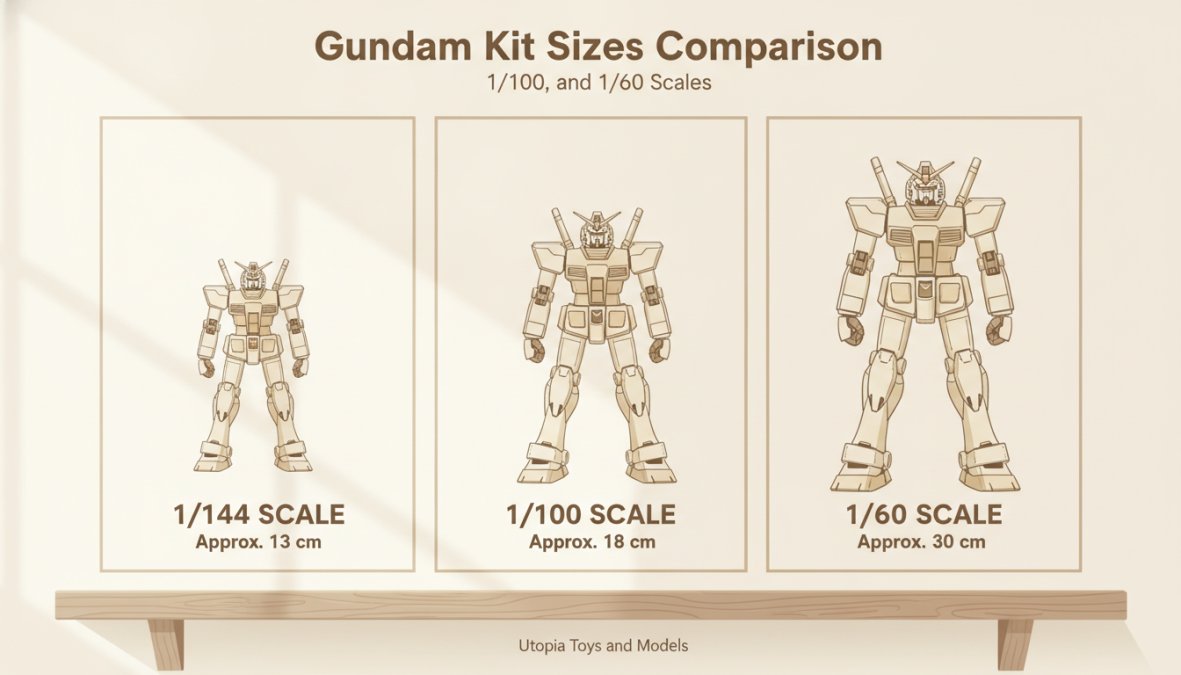
1/144 Scale: Compact and Affordable
A 1/144 scale Gundam stands approximately 5 inches tall. These kits fit on narrow shelves, in display cases, and on desk corners. They're the most affordable entry point with short build time (2-8 hours depending on grade). 1/144 scale is ideal for builders with limited space or those building their first collection. You can fit 10-15 models on a single shelf.
1/100 Scale: The Goldilocks Option
At approximately 10 inches tall, 1/100 scale represents the middle ground. High Grade, Real Grade, and Master Grade kits commonly use this scale. You get substantially more detail than 1/144 while still fitting on standard shelves. Build time ranges from 4 hours (HG) to 30 hours (MG). 1/100 is where most serious Gunpla builders focus their collections.
1/60 Scale: Maximum Detail and Presence
Perfect Grade kits at 1/60 scale stand 15-18 inches tall. These models dominate a shelf or display case. The sheer size allows for intricate detail that smaller scales can't achieve. The cost is substantial ($150-300+), and build time demands a full weekend or more. 1/60 scale is for dedicated collectors with dedicated display space.
| Scale | Height | Best Grade(s) | Build Time | Price Range | Display Space | Ideal For |
|---|---|---|---|---|---|---|
| 1/144 | ~5 inches | EG, HG, RG | 2-8 hours | $15-40 | Desk/shelf | Beginners, collectors |
| 1/100 | ~10 inches | HG, RG, MG | 4-30 hours | $30-150 | Standard shelf | Most builders |
| 1/60 | ~15-18 inches | PG | 40-60 hours | $150-300+ | Dedicated case | Advanced collectors |
Gundam Model Kit Difficulty Levels: Matching Grades to Your Skill
The relationship between grade and difficulty is direct: higher grades demand more skill, time, and tools. Difficulty scales with part count, inner frame complexity, paint requirements, and articulation. An Entry Grade has 100-150 snap-fit parts. A Master Grade has 500+ parts including multiple frame segments, motorized joints, and paint-separated pieces.
Beginner-Friendly Kits and What Makes Them Accessible
Entry Grade and basic High Grade kits are beginner-friendly because they minimize tiny parts, paint requirements, and assembly complexity. Bandai's engineers intentionally simplified these kits to reduce failure points. A beginner can complete an Entry Grade kit with just nippers and a hobby knife. No paint, no glue, no special tools required.
What makes a kit truly beginner-friendly is clear instructions. Bandai's instruction manuals use diagrams rather than words, so language barriers don't matter. Each step shows exactly where each part goes.
Intermediate and Advanced Builds: Complexity and Customization
Intermediate builders (those with 5-10 completed kits) can tackle High Grade and Real Grade kits confidently. These grades introduce paint separation, small parts, and articulation systems that demand precision. You'll need nippers, a hobby knife, and fine-grit sandpaper.
Advanced builds (Master Grade and Perfect Grade) introduce motorized gimmicks, LED light-up features, and inner frames so complex they rival real engineering. Each grade teaches you something new: Entry Grade teaches basic assembly, High Grade teaches paint separation, Real Grade teaches fine articulation, Master Grade teaches motorized systems, and Perfect Grade teaches that patience produces extraordinary results.
Tools, Display, and Storage: Essential Considerations by Scale
Your toolkit and display strategy should match your chosen scale and grade. A 1/144 Entry Grade requires almost nothing. A 1/100 Master Grade demands proper tools: nippers, hobby knife, sanding sticks, paint, panel lining pens, and glue.
Recommended Tools for Different Grades
Entry Grade kits can be built with nippers alone. High Grade kits benefit from a basic toolkit: nippers, hobby knife, sanding sticks (400-600 grit), and panel lining pens. This toolkit costs $30-50 and lasts through dozens of builds.
Real Grade and Master Grade kits demand more precision. Add fine-grit sandpaper (1000+ grit), acrylic paint, paint brushes, glue, and masking tape. A complete intermediate toolkit costs $75-150. Perfect Grade and advanced customization demand professional-grade tools: airbrush, compressor, spray booth, weathering pigments, and metallic paints.
Display and Storage Solutions for Your Collection
1/144 scale models fit in standard display cases, on floating shelves, or in IKEA Detolf cabinets (the standard for Gunpla collectors). LED strip lighting inside the case makes models look professional. A single Detolf holds 15-20 1/144 models.
1/100 scale models need more space. A single Detolf holds 5-8 models. Consider multiple cabinets or dedicated shelving. 1/60 scale models are statement pieces. Display them on dedicated stands in prominent locations.
For storage, use sealed plastic bins with silica gel packets to control humidity. Keep models away from heat sources, direct sunlight, and areas prone to vibration.
Common Build Issues and Troubleshooting Tips by Scale
Every builder encounters the same problems at each scale level. Nub marks appear where parts attached to runners. The fix is simple: use a hobby knife to carefully trim the nub flush, then sand with fine-grit sandpaper until smooth.
Loose joints happen when parts fit too loosely or when you've sanded away too much plastic. For minor looseness, apply a thin layer of plastic cement to the joint. Paint separation occurs when Bandai intentionally molds parts in different colors. The solution is proper surface preparation: wash parts in warm soapy water, dry completely, and apply primer before paint.
Broken parts happen to every builder. For small breaks, plastic cement can bond pieces back together if the break is clean. For larger breaks, you might need replacement parts from Bandai's spare parts service.
The Evolution of Gundam Model Kit Scales and Grades
Understanding how scales and grades evolved explains why the current system exists. Bandai gradually refined the formula from crude 1979 kits, introducing motorized joints, detailed inner frames, and paint separation. Master Grade emerged in the 1990s as the "serious builder" option. Real Grade (2010) and Entry Grade (2020) represent Bandai's most recent innovations, designed to expand the hobby to new audiences.
This evolution explains the current grade hierarchy. Entry Grade isn't "worse" than High Grade, it's a deliberate design choice for a different audience. Scale evolution followed a similar path. Early kits were mostly 1/144 because larger scales required more plastic and cost more money. Perfect Grade at 1/60 emerged only after Bandai could justify the engineering investment for a premium product.
Choosing your first Gundam model kit requires understanding one principle: match the kit to your situation. Your available display space, your available build time, and your experience level should guide your decision. Whether you're starting with an Entry Grade 1/144 or upgrading to a Master Grade 1/100, choose a kit that fits your circumstances and enjoy the hobby from day one.
Frequently Asked Questions
What do HG, RG, MG, and PG mean in Gundam model kits?
These letters represent different Gunpla grades. HG (High Grade) is beginner-friendly at 1/144 scale. RG (Real Grade) offers enhanced detail in 1/144 scale. MG (Master Grade) provides advanced complexity at 1/100 scale with detailed inner frames. PG (Perfect Grade) is the most complex at 1/60 scale, designed for experienced builders seeking maximum articulation and detail.
Which Gundam scale is best for beginners?
High Grade (HG) kits at 1/144 scale are ideal for beginners. They feature snap-fit construction requiring minimal tools, affordable pricing, and reasonable build times. Entry Grade (EG) kits offer even simpler assembly for absolute newcomers. Both scales provide excellent value and manageable complexity while teaching fundamental building techniques before advancing to more demanding grades.
How does scale affect build time and difficulty in Gundam model kits?
Smaller scales like 1/144 (HG) require 2-4 hours and minimal tools. Mid-range scales like 1/100 (MG) typically need 6-12 hours and more specialized equipment. Larger 1/60 scales (PG) demand 15+ hours, advanced techniques like panel lining and customization, and precision tools. Bigger scales offer more detail but demand greater skill, patience, and investment in hobby tools like nippers and hobby knives.
Do all Gundam model kits require glue or paint?
Most Gunpla kits, especially HG and RG grades, are snap-fit and require no glue. However, many builders add panel lining, decals, and stickers for enhanced detail. Advanced grades like MG and PG benefit from customization but don't strictly require it. Paint is optional, color separation in modern kits reduces the need. Your skill level and desired finish determine whether additional supplies are necessary.
What tools do I need to build different Gundam model kit grades?
Entry and High Grade kits need only nippers and a hobby knife. Real Grade adds fine-detail work requiring a precision hobby knife. Master Grade requires nippers, hobby knife, panel-lining markers, and possibly sandpaper. Perfect Grade demands all previous tools plus paint supplies and advanced customization equipment. Starting with basic nippers and upgrading as you progress prevents unnecessary expense while matching your growing skill level.
Are all 1/144 scale Gundam kits the same size?
Not exactly. While 1/144 scale defines the proportion, actual finished height varies based on the mobile suit's design. Most HG 1/144 kits stand 4-5 inches tall, but some designs are naturally taller or shorter. Additionally, Special editions like Mega Size models may use different scales. Always check individual kit specifications to understand final size before purchasing for display or storage purposes.
What's the difference between Gundam model kit grades and scales?
Grade (HG, RG, MG, PG) refers to complexity, detail level, and inner frame sophistication. Scale (1/144, 1/100, 1/60) defines physical size relative to the original mobile suit. Most HG kits are 1/144 scale, most MG kits are 1/100 scale, and PG kits are 1/60 scale. Understanding both helps you choose the right kit for your skill level, available space, and desired level of detail.
This article was written using GrandRanker