

Table of Contents
- What Are High Grade Gundam Kits?
- Gundam Grades Explained: How HG Fits Into the Scale
- HG vs RG vs MG Gundam: Side-by-Side Comparison
- Key Features and Benefits of High Grade Kits
- Gunpla for Beginners: Why HG Is the Smart Starting Point
- Best High Grade Gundam Kits: Top Recommendations Across Eras
- Customization and Advanced Techniques for High Grade Kits
- Conclusion
High Grade Gundam Kits Explained: Scale, Features & Best Picks
Last Updated: July 20, 2026
What Are High Grade Gundam Kits?
High Grade (HG) Gundam kits are 1/144 scale plastic model kits manufactured by Bandai that feature snap-fit assembly, moderate detail, and excellent articulation at an accessible price point. Within Bandai's product hierarchy, "high grade" refers to a classification offering a genuine step up from Entry Grade models in detail and engineering, while remaining far more affordable than Master Grade or Perfect Grade alternatives. The engineering is what makes them genuinely high grade: Bandai packs impressive articulation, panel separation, and color accuracy into a compact 1/144 frame.
Most HG kits snap together without glue, require minimal tools beyond nippers, and take 2-4 hours to complete. They ship with pre-molded plastic parts in multiple colors, stickers for details, and an inner frame that provides surprising poseability for their scale.
Gundam Grades Explained: How HG Fits Into the Scale
The Gundam model kit ecosystem contains six primary grades, each targeting different skill levels and budgets.
Entry Grade (EG) sits at the bottom tier. These simplified 1/144 kits snap together in 30-45 minutes with zero tools required, sacrificing detail and articulation for accessibility. Most cost under $15.
High Grade (HG) occupies the mainstream position at 1/144 scale, offering genuine articulation, multiple color separation, and panel lining opportunities without demanding advanced skills. Typical HG kits cost $15-25 and build in 2-4 hours.
Real Grade (RG) debuted in 2010 as a premium 1/144 option featuring inner frame systems rivaling Master Grade complexity while maintaining the smaller footprint. RG kits cost $25-40 and require 4-6 hours to build.
Master Grade (MG) scales up to 1/100, doubling linear dimensions compared to HG. These kits showcase exceptional detail, complex inner frames, and multiple articulation points. MG kits typically cost $40-70 and require 6-10 hours to complete.
Perfect Grade (PG) represents the ultimate consumer kit at 1/60 scale, featuring motorized components and light-up features. PG kits cost $100-150 and demand 15-20+ hours of assembly.
Super Deformed (SD) takes a stylized, chibi-proportioned approach at various scales, prioritizing fun over realism. These cost $10-20 and build quickly.
High Grade sits at the inflection point where accessibility meets capability, delivering real articulation and customization potential at an affordable price.
HG vs RG vs MG Gundam: Side-by-Side Comparison
| Aspect | High Grade (HG) | Real Grade (RG) | Master Grade (MG) |
|---|---|---|---|
| Scale | 1/144 | 1/144 | 1/100 |
| Typical Price | $15-25 | $25-40 | $40-70 |
| Build Time | 2-4 hours | 4-6 hours | 6-10 hours |
| Articulation | Excellent | Outstanding | Exceptional |
| Inner Frame | Basic | Complex | Very Complex |
| Detail Level | Good | Excellent | Outstanding |
| Customization | Easy | Moderate | Advanced |
| Tool Requirements | Nippers + hobby knife | Nippers + tools | Full hobby toolkit |
| Best For | Beginners to intermediate | Intermediate builders | Advanced collectors |
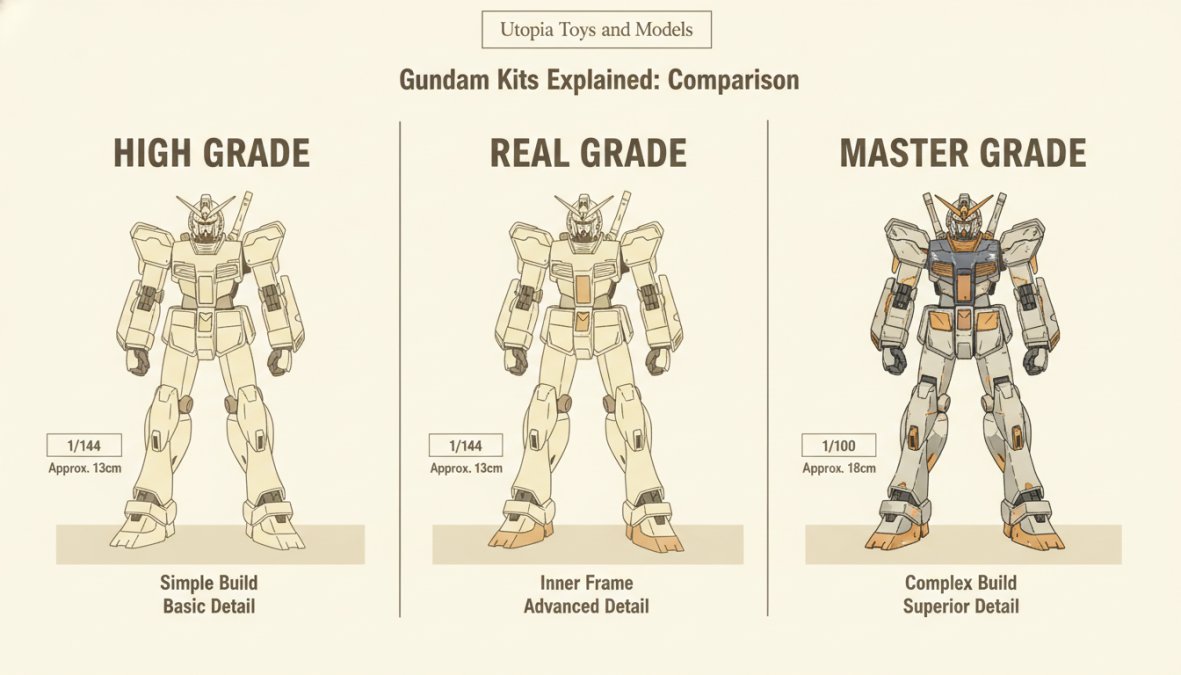
Real Grade kits deliver superior inner frame engineering and detail density within compact 1/144 scale, but demand precision during assembly. Master Grade kits provide the most impressive display piece and allow advanced customization, but their size and complexity intimidate newcomers. High Grade represents the pragmatic choice for most builders, delivering 85% of the articulation and detail that RG offers at lower cost and with simpler assembly. A well-built HG with panel lining rivals an RG in visual impact once displayed.
Key Features and Benefits of High Grade Kits
Ease of Assembly and Snap-Fit Design
High Grade kits employ Bandai's snap-fit system, where parts connect through friction and plastic tabs rather than requiring glue. This democratizes the hobby, you can build a respectable HG kit with just nippers. Assembly follows logical sequences, guiding you through frame construction first, then armor assembly, then final details. Most builders complete their first HG kit without problems, building confidence for subsequent projects.
Affordability Without Sacrificing Detail
HG kits typically cost $15-25, making them accessible for experimentation. A $20 HG kit with panel lining and topcoat delivers surprisingly similar visual impact to a $60 MG kit. This affordability also enables kitbashing, purchasing multiple HG kits to harvest parts for custom creations costs $45-75, while attempting the same with Master Grade kits exceeds $150.
Articulation and Poseability
Despite their small size, HG kits feature multiple articulation points rivaling much larger grades. The inner frame system provides ball-jointed shoulders, articulated waists, and knee bends enabling dynamic posing. Even basic HG kits receive inner frames with 15+ articulation points, with advanced kits featuring nearly as many options as Real Grade counterparts.
Gunpla for Beginners: Why HG Is the Smart Starting Point
Lower Barrier to Entry
Entry Grade kits teach basic handling but don't develop real building skills. High Grade kits bridge this gap, demanding enough precision to develop genuine skills without overwhelming newcomers. The $20 financial commitment feels reasonable compared to $60 for a Master Grade kit. Most builders who start with HG become lifelong hobbyists.
Essential Tools and Supplies
You need very little to build HG kits successfully:
- Nippers ($8-15): Essential for cleanly removing parts from runners
- Hobby knife ($3-8): Optional but recommended for cleaning nub marks
- Sanding sticks ($5-10): Optional for smoothing nub marks
- Panel line marker ($4-6): Optional but transforms visual impact
- Topcoat spray ($8-12): Optional for protecting panel lines
You can build a respectable HG kit with just nippers. Everything else enhances the final result but isn't mandatory.
Common Beginner Mistakes and How to Avoid Them
Nub mark damage represents the most common problem. When cutting parts from runners, leaving small plastic nubs is normal. Beginners often apply excessive pressure with the hobby knife, cracking plastic. Solution: use the knife at shallow angles, making multiple light passes rather than one aggressive cut.
Loose joints plague builders who assemble too quickly. HG kits require patience during frame assembly, forcing parts together can crack plastic or create permanent loose connections. Solution: assemble slowly, checking fit before final connection.
Sticker misalignment creates visible defects. Solution: use a hobby knife to pre-score sticker placement lines on the plastic, then apply stickers carefully, smoothing from center outward to expel air bubbles.
Skipping panel lining leaves HG kits looking flat and toy-like. A few minutes with a panel line marker transforms visual impact dramatically, separating beginner-looking kits from impressive display pieces.
Best High Grade Gundam Kits: Top Recommendations Across Eras
Universal Century Classics
The RX-78-2 Gundam Revive remains the definitive entry point. Bandai's Revive project updated classic designs with modern engineering. This kit delivers exceptional articulation, color separation requiring minimal paint, and the emotional resonance of building the iconic Mobile Suit. Build time runs 3-4 hours.
The Zeon Gouf Revive provides the opposing perspective, showcasing close-combat design with massive claws and heat rod. The claw mechanisms require careful attention, but the final poseability rewards your effort.
The Zeta Gundam Revive features a transformation gimmick converting between Mobile Suit and Waverider forms. The transformation requires no tools and works smoothly, making this kit engaging for collectors valuing playability alongside display quality.
Modern Series Standouts
The Barbatos from Iron-Blooded Orphans emphasizes close-combat brutality through design language. The kit's articulation enables aggressive posing reflecting the series' tone. Armor design includes satisfying mechanical details rewarding panel lining.
The Aerial from Gundam: The Witch from Mercury represents the newest generation of HG engineering. The transformation gimmick executes flawlessly, and color separation rivals Master Grade kits in some areas.
Hidden Gems
The Xamel from the original Mobile Suit Gundam represents an underrated design. This massive cannon-equipped Mobile Suit challenges building assumptions, emphasizing structural stability over articulation.
The Guncannon Revive deserves mention as an underrated classic. This support Mobile Suit features extensive beam rifle and cannon armament, creating impressive display presence at an affordable price point.
Customization and Advanced Techniques for High Grade Kits
Panel Lining and Paint Application
Panel lining represents the single highest-impact customization for HG kits. Apply dark paint or markers into recessed panel lines separating armor sections. The contrast creates visual depth, making the kit appear significantly more detailed.
Most builders use panel line markers for simplicity. Apply the marker along panel lines, allowing capillary action to draw paint into recesses. Use a clean cotton swab with thinner to wipe excess from flat surfaces. This process takes 15-20 minutes and costs under $10.
Topcoat spray ($8-12 per can) seals panel lines and paint while providing finish control. Matte topcoat creates realistic finish; gloss topcoat emphasizes panel lines.
Kitbashing and Modification
Kitbashing, combining parts from multiple kits to create custom Mobile Suits, represents advanced HG customization. The 1/144 scale and standardized frame systems make this practical. Successful kitbashing requires understanding frame compatibility and careful cutting with hobby knives.
A practical example: combining the Barbatos frame with Aerial armor creates a unique Mobile Suit appearing factory-designed. This project costs $40-50 and teaches valuable modification skills.
Troubleshooting Common HG Build Issues
Parts that won't fit usually indicate misalignment or debris. Solution: verify alignment visually before forcing connection and clear plastic debris from connection points.
Loose joints result from worn connection points or improper assembly. Solution: disassemble the joint, inspect for cracks, and reassemble carefully. If joints remain loose, apply thin plastic cement around the connection point.
Stickers that won't adhere indicate oily residue. Solution: gently clean the area with soft cloth and mild soap before applying stickers.
Paint that cracks or peels indicates improper surface preparation. Solution: clean the plastic surface thoroughly before painting and apply thin coats rather than one thick coat.
Where to Build Your Collection
Starting your High Grade Gundam kit collection requires reliable access to genuine Bandai products and quality tools. Utopia Toys and Models offers a curated selection of HG kits from current and classic series, with transparent inventory status and reliable shipping that protects your models during transit. Whether you're building your first kit or expanding an existing collection, having access to a retailer that understands the hobby makes the difference between frustration and genuine enjoyment. Visit Utopia Toys and Models to explore current High Grade options and discover why serious collectors trust them for their Gunpla needs.
Frequently Asked Questions
What does HG mean in Gunpla, and how is it different from other grades?
HG stands for High Grade in the Gundam model kit system. High Grade kits are 1/144 scale Gunpla that balance affordability, ease of assembly, and detail. Unlike Entry Grade (EG) kits which are simpler and smaller, HG kits offer more articulation and better color separation. Compared to Real Grade (RG), Master Grade (MG), and Perfect Grade (PG) kits, HG models are less complex, more budget-friendly, and faster to build while maintaining excellent poseability and visual appeal. This makes HG kits the ideal middle ground for most builders.
Are high grade Gundam kits good for beginners?
Yes, high grade Gundam kits are excellent for beginners. They require only basic tools like nippers, a hobby knife, and sanding sticks, no glue or paint is mandatory since they use snap-fit assembly. HG kits build confidence quickly due to their straightforward instructions and manageable complexity. The affordability of HG models means you can practice without major financial risk, and the satisfying articulation and detail make finished builds feel rewarding. Many experienced builders also continue collecting HG kits alongside higher grades, proving their appeal spans all skill levels.
What tools do I need to build a high grade Gundam kit properly?
Essential tools include: nippers for cleanly cutting runners, a hobby knife for removing nub marks, and sanding sticks for smoothing edges. A topcoat spray (matte or gloss) protects your build and improves appearance. Optional but recommended tools are panel lining markers or pens for detail work, stickers or waterslide decals for color separation, and a display stand for posing. Many builders start with just nippers and a hobby knife, then gradually add tools as they develop their skills. Utopia Toys and Models can help you identify which supplies match your building goals.
What is the 1/144 scale, and why do high grade kits use it?
The 1/144 scale means each model is 1/144th the size of a real Mobile Suit. This scale balances detail visibility with manageable size and affordability, kits typically range from 4 to 8 inches tall. The 1/144 scale allows Bandai to include impressive articulation, color-separated plastic, and inner frame details without excessive cost or complexity. This standardization across HG kits means you can display multiple models together cohesively and build a collection without needing massive shelf space. It's the sweet spot for casual and serious collectors alike.
How do high grade kits compare to real grade and master grade in terms of detail and cost?
High Grade kits offer solid detail at the lowest cost among premium grades. RG kits feature more complex inner frames and engineering but cost more and require greater skill. Master Grade (MG) kits are larger (1/100 scale), highly detailed, and expensive, best for experienced builders. Perfect Grade (PG) kits are the ultimate luxury option with extreme detail and price tags. HG kits deliver 80% of the visual appeal at a fraction of the cost, making them the best value. Many builders mix grades, collecting HG for variety and affordability while occasionally investing in RG or MG showpieces.
Can I customize and paint high grade Gundam kits?
Absolutely. High Grade kits are highly customizable. Panel lining with markers or pens adds depth to details. Paint can be applied for better color separation and custom color schemes using spray paint or acrylics. Kitbashing, mixing parts from multiple kits, is popular with HG models due to their compatibility. Topcoat protects painted finishes and improves appearance. LED units can be added for lighting effects. The snap-fit design means you can disassemble and reassemble kits for modifications. Many builders start with basic panel lining and progress to full repaints and kitbashing as they gain confidence.
What are some of the best high grade Gundam kits for someone just starting out?
Recommended beginner HG kits include Universal Century classics like the RX-78-2 Gundam and the Zaku II, which have straightforward builds and iconic designs. Modern series offer excellent kits too, check recent Revive project releases from Bandai for improved engineering. Avoid overly complex variants initially; stick with standard Mobile Suits before attempting special editions or Ver. Ka versions. Utopia Toys and Models can recommend specific current releases that balance ease of assembly with satisfying detail. Starting with one or two well-reviewed HG kits helps you develop skills before tackling more advanced grades.
This article was written using GrandRanker