

Table of Contents
- Why Shipping Model Kits Requires Extra Care
- Selecting the Right Shipping Box and Materials
- Best Packing Materials for Scale Models
- Building a Protective Cradle and Support Structure
- Double-Boxing Methods for High-Value Kits
- Best Shipping Carriers for Fragile Collectibles
- Shipping Insurance for Collectibles and Damage Prevention
- Labeling, Documentation, and Final Checks
- Frequently Asked Questions
Last Updated: September 3, 2026
Why Shipping Model Kits Requires Extra Care
Collectible model kits demand specialized handling because they combine structural fragility with significant monetary and sentimental value. Unlike mass-produced toys, scale models and diecast figures feature intricate details and delicate components that are vulnerable to even minor impacts during transit. The shipping process exposes your model to vibration, temperature fluctuations, and shock that standard packaging cannot address.
At Utopia Toys and Models, proper packing prevents costly damage claims and ensures your models arrive in pristine condition. The difference between amateur packing and expert-level protection comes down to understanding your kit's vulnerabilities, choosing materials that provide genuine shock absorption, and building structural integrity into your packaging strategy.
Selecting the Right Shipping Box and Materials
The foundation of safe shipping starts with choosing a double-wall corrugated box with a crush strength rating appropriate for your shipment's dimensional weight. Measure your model's dimensions carefully and select a box that provides at least 2-3 inches of clearance on all sides. This space becomes your void fill zone, the critical buffer between your packaged model and the outer box walls.
Verify the box rating for your carrier, USPS, UPS, and FedEx have minimum standards. A damaged or insufficient box becomes your liability. Test the box by pressing firmly on all sides; it should resist deformation. For extremely valuable collectibles, double-boxing is the professional standard and is discussed in detail later.
Best Packing Materials for Scale Models
Bubble wrap with larger bubbles (5/8-inch or 1-inch diameter) remains the industry standard because it provides consistent shock absorption and cushions against vibration (peer-reviewed research). Larger bubbles compress gradually, distributing impact energy across a wider surface area.
Packing peanuts offer an alternative that many collectors prefer for filling irregular spaces around your cradle structure. Kraft paper and crinkle fill work well as supplementary materials but shouldn't be your primary shock absorption layer. For scale models with fragile components like thin canopies or delicate landing gear, consider specialty materials like closed-cell foam sheets, which resist compression and don't absorb moisture.
Temperature and humidity control matter more than many shippers realize. Certain materials like adhesive bonds and painted finishes can degrade in extreme conditions. If your shipment will spend time in uncontrolled environments, consider adding a moisture barrier or thermal insulation layer.
Building a Protective Cradle and Support Structure
A protective cradle is the structural framework that holds your model securely in place and prevents movement inside the box. This is where amateur packing diverges from professional-level protection.
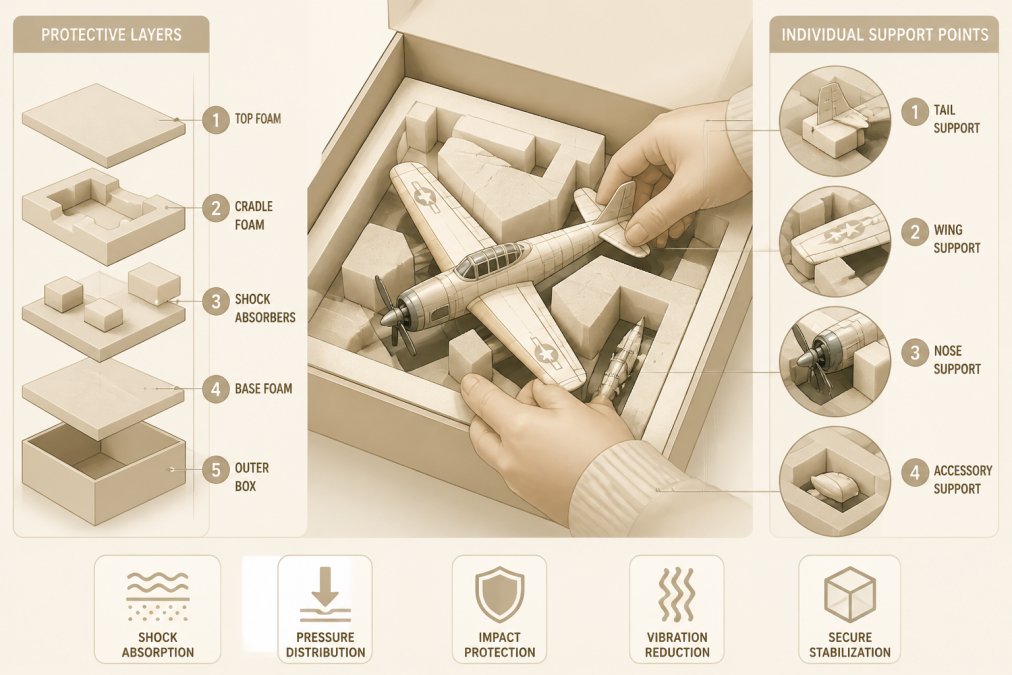
Start by creating a base layer of 2-3 inches of bubble wrap, packing peanuts, or foam. Next, create custom-fitted supports that contact your model at its strongest structural points. For aircraft models, support the fuselage at the wing root and tail section. For articulated kits, support the torso and avoid placing pressure on thin arms or legs.
Foam cradles can be purchased pre-made for popular models or created using dense foam sheets. Cut the foam to match your model's profile, creating recesses where the model sits securely without moving. Test this by gently rocking the packed box, if you hear or feel any movement, add more support material.
For models with protruding components like canopies, create separate protective chambers. Wrap these delicate parts individually in bubble wrap, then secure them within the cradle so they cannot contact other components. The cradle itself should be surrounded by void fill material, creating a buffer zone between your structural support and the outer box walls.
Double-Boxing Methods for High-Value Kits
Double-boxing is the gold standard for models valued above $150 (the FTC). This method uses two boxes with an air gap between them, dramatically reducing the transmission of external impact forces to your model.
Start with your inner box containing your model and its protective cradle, packed completely and sealed. Place this sealed inner box into a larger outer box with 2-3 inches of cushioning material on all sides. Fill the space around the inner box completely with packing peanuts, foam, or bubble wrap. The key to effective double-boxing is ensuring the inner box remains absolutely stationary inside the outer box. packing fragile items.
The outer box dimensions should be at least 6-8 inches larger in each direction than the inner box when possible. This creates adequate space for cushioning material and reduces the likelihood of the inner box contacting the outer box walls during rough handling.
Best Shipping Carriers for Fragile Collectibles
UPS generally offers reliable handling for fragile collectibles because their infrastructure emphasizes package tracking and consistent sorting procedures. UPS Ground provides economical shipping with good damage prevention, while UPS Overnight or 2-Day Air accelerates delivery, reducing transit time and exposure to potential damage.
FedEx provides similar service levels with different regional strengths. FedEx Ground works well for cross-country shipments, while FedEx Express offers guaranteed delivery windows. USPS Priority Mail and Priority Mail Express are cost-effective options for smaller models and handle packages more gently than ground services.
All three major carriers offer tracking and insurance options. For collectibles, supplement basic insurance with additional coverage or specialized collectibles insurance. The carrier's handling quality matters less when your protective cradle and double-boxing provide genuine structural protection.
Shipping Insurance for Collectibles and Damage Prevention
Shipping insurance protects your financial investment when damage occurs during transit. Carrier insurance covers declared value up to specific limits, typically $100 for basic coverage and up to $5,000 with declared value insurance. Insurance does not cover items damaged due to inadequate packing, which is why proper protective structure matters even when you have insurance.
Specialized collectibles insurance offers broader coverage than carrier insurance and typically costs 1-2% of the declared value (iii.org). Before shipping, document your model's condition with photographs taken from multiple angles. Clear, well-lit photos create an evidence trail for insurance claims.
When filing a claim, provide the carrier with clear documentation of the damage, photographs of the damaged model, original packing materials if available, and receipts showing the model's value. Claims are more likely to be approved when you can demonstrate that damage occurred due to carrier mishandling rather than inadequate packing.
Labeling, Documentation, and Final Checks
Proper labeling ensures your shipment receives appropriate handling throughout transit. Place fragile labels on the top and at least two sides of your outer box. Include directional labels indicating "This Side Up" if your packaging has a proper orientation.
Add your return address and the recipient's address clearly on the box using waterproof labels or permanent marker. Include a phone number where you can be reached if the carrier needs to contact you. For high-value shipments, include an internal packing list describing the contents and their value.
Before sealing your box, perform a final inspection. Verify that your model is completely immobilized inside its cradle by gently shaking the box, there should be absolutely no movement or sound from inside. Check that all void fill material is properly distributed and no gaps exist between the inner and outer boxes.
Seal your box with strong packing tape, using at least two strips along the center seam and one strip along each edge. Reinforce all corners with additional tape. Create a detailed receipt documenting what's being shipped, its value, and the protection measures implemented. This documentation supports insurance claims if needed.
Shipping collectible model kits safely requires attention to every detail, from box selection through final documentation. When you're sending models valued at $100 or more, the time invested in proper packing prevents costly damage and ensures your models arrive in the condition collectors expect. At Utopia Toys and Models, we understand that every model represents hours of building, painting, and collecting passion. Whether you're shipping a rare Bandai Gundam kit, a detailed diecast model, or a custom-painted commission piece, the protective cradle method and double-boxing approach described here will keep your collectibles safe.
| Packing Stage | Key Materials | Primary Purpose | Common Mistake |
|---|---|---|---|
| Base Layer | Bubble wrap or foam | Initial impact absorption | Using insufficient cushioning |
| Structural Support | Custom foam cradle | Prevent model movement | Relying only on wrapping |
| Void Fill | Packing peanuts or kraft fill | Fill gaps between cradle and box | Leaving empty spaces |
| Outer Protection | Double box with cushioning | Secondary impact barrier | Skipping the second box |
| Documentation | Photos and receipts | Insurance claim support | No pre-shipment photos |
Frequently Asked Questions
What is the safest way to ship high-value collectible models?
Use a multi-layer approach: wrap the model kit individually in bubble wrap, place it in a custom cradle or foam insert, then double-box with void fill between boxes. Add fragile labeling and tracking to your parcel. For models over $100, purchase shipping insurance that covers full replacement value. This combination protects against impact, vibration, and transit damage while ensuring you can document any loss for an insurance claim.
Should I use double-boxing when shipping model kits?
Yes, especially for assembled kits or high-value pieces. Double-boxing creates a shock-absorbing buffer that reduces impact during handling and transit. Place the packed model in the inner box, surround it with at least 2 inches of void fill (packing peanuts or crinkle paper), then place that box inside a larger outer box with another 2 inches of cushioning. This method significantly improves structural integrity and reduces the risk of damage.
What are the best packing materials for fragile plastic models?
Bubble wrap is essential for initial protection around delicate parts like canopies, cowls, and thin plastic components. Layer it with kraft paper to prevent adhesive residue. Use packing peanuts or crinkle fill for void fill between layers. For custom cradles, closed-cell foam or molded foam inserts provide excellent shock absorption. Avoid newspaper or plain kraft paper as sole protection, they offer minimal impact resistance. Combine materials in layers for maximum protection against brittleness and snapping.
How do I document my shipment for an insurance claim?
Before packing, photograph the model kit from multiple angles in its original or display condition. Keep the receipt and proof of purchase. Take photos of your packed shipment showing the protective layering and boxing. When shipping, request tracking and signature confirmation. If damage occurs, photograph the damage immediately, file a claim within the carrier's required timeframe (typically 30 days), and provide all documentation: photos, receipts, tracking number, and carrier damage report. This creates a complete record for claim approval.
This article was written using GrandRanker