

Table of Contents
- How Long Does It Take to Paint Gunpla: The Quick Answer
- Factors That Influence Painting Time
- Essential Tools for Painting Gundam Models
- Gunpla Painting Process for Beginners
- Gunpla Top Coat Drying Time and Curing
- Active vs. Passive Time: Understanding Your Real Workload
- Time-Saving Techniques for Experienced Painters
- Common Mistakes That Add Hours to Your Build
Last Updated: August 30, 2026
How Long Does It Take to Paint Gunpla: The Quick Answer
Most builders can expect 8 to 40+ hours for a complete paint job. A snap build typically takes 8 to 15 hours, while a full custom project with panel lining, decals, and multiple coats can stretch to 40+ hours. The timeline depends on your kit grade, painting method, and desired detail level.
This guide breaks down exactly where those hours go, so you can plan your build realistically and avoid underestimating the work ahead.
Factors That Influence Painting Time
Kit Grade: HG, MG, and PG Differences
High Grade kits typically take 6 to 12 hours to paint with hand brushing. The smaller part count (100-150 pieces) and simpler construction mean less surface area to cover. Most HG kits come with decent plastic color separation, so you might only need to paint a handful of parts.
Master Grade kits consume 15 to 25 hours of painting time. With 200+ pieces and intricate details, they require more masking, more layers, and more attention to panel lining and decal placement. Perfect Grade kits represent the ultimate commitment at 30 to 50+ hours when fully painted and detailed. Real Grade kits fall between HG and MG, usually 10 to 18 hours.
Hand Brushing vs. Airbrushing
Hand brushing takes roughly 1.5 to 2 times longer than airbrushing because each coat requires more time to apply evenly and you need more coats to avoid visible brush strokes (peer-reviewed research). The advantage is minimal setup and cleanup, you can paint almost anywhere with just brushes, paint, and water.
Airbrushing is faster for base coats and large surfaces. A task taking 4 hours by brush might take 1.5 to 2 hours with an airbrush. However, airbrushing requires space, ventilation, equipment maintenance, and practice. For small HG kits, the time savings might not justify the extra effort. For MG and PG kits, airbrushing becomes genuinely worthwhile.
Skill Level and Builder Experience
A beginner might take twice as long as an experienced painter to complete the same kit (the NIH). You'll spend time sanding out dust nibs, fixing paint drips, and waiting for layers to cure. Beginners should add 30 to 50 percent extra time to any estimate. Experienced builders often work at roughly half the pace of their first few attempts.
Essential Tools for Painting Gundam Models
For hand brushing:
- Synthetic brushes in multiple sizes (00, 0, 2, 4)
- Acrylic or lacquer paint designed for models
- Palette or ceramic plate for mixing
- Water cup for rinsing brushes
- Masking tape and painter's tape
- Sanding sponges (400, 600, 1000 grit)
- Primer spray or brush-on primer
- Top coat (gloss or matte)
For airbrushing:
- Airbrush (single or double action)
- Air compressor with moisture trap
- Paint thinner appropriate to your paint type
- Cleaning solution
- Masking supplies (tape, putty, stencils)
- Spray booth or well-ventilated space
- Pressure regulator
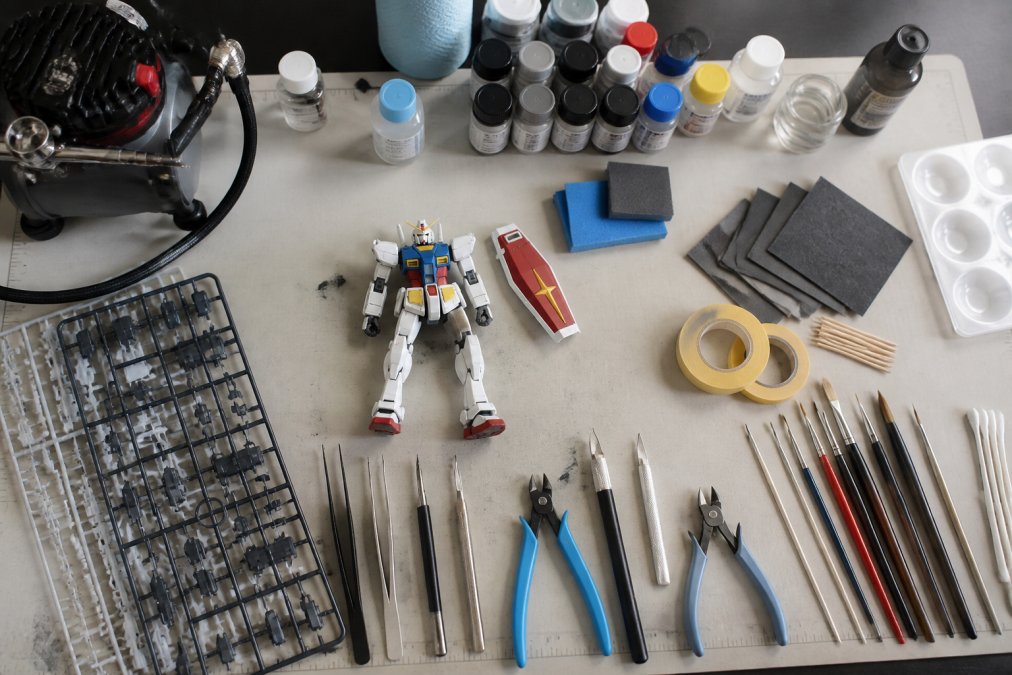
The most important tool is good spray primer. Primer creates a smooth base coat that helps subsequent paint layers adhere properly and look more vibrant. Without primer, you'll need more paint coats, adding hours to your timeline. Utopia Toys and Models stocks primers specifically designed for model kits, providing better coverage than generic spray paint.
Gunpla Painting Process for Beginners
Step 1: Surface Preparation and Sanding
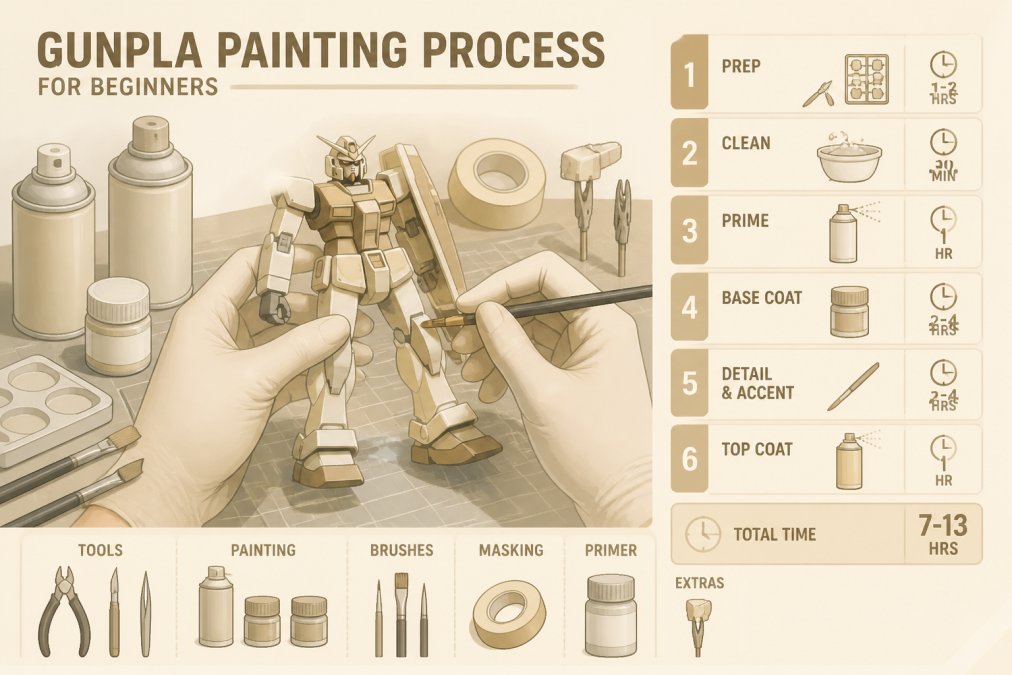
Before applying any paint, remove parts from sprues, sand away nubs, and smooth stress marks. For a typical HG kit, surface prep takes 1 to 2 hours; for an MG, plan on 2 to 4 hours. Start with 400-grit sandpaper to remove nubs, then progress to 600 and 1000 grit for a smooth finish. After sanding, wash all parts with soap and water to remove plastic dust, then let them dry completely before priming.
Step 2: Priming Your Model
Spray primer is faster than brush-on primer. A typical HG kit takes 20 to 30 minutes to prime completely, including drying time between coats. Most primers require two light coats rather than one heavy coat, preventing runs and ensuring even coverage.
Step 3: Applying Base Coats and Detail Painting
Apply thin coats rather than one thick coat. Three to four thin coats provide better coverage and fewer visible brush strokes. Detail painting, adding accent colors to small parts like cockpit windows or weapon details, adds another 1 to 2 hours. Many builders mask off areas to create sharp color transitions, producing professional results. painting guide.
Step 4: Panel Lining and Decals
Panel lining, adding dark paint or markers to panel lines for definition, takes 1 to 2 hours for an HG kit. Water slide decals add another 30 minutes to 1 hour. Decals require careful handling, soak them in water, slide them onto the model, position precisely, and seal with top coat. Rushing this step leads to bubbles and misalignment.
Gunpla Top Coat Drying Time and Curing
Spray top coats dry to the touch in 30 minutes to 1 hour, but full curing takes 24 hours or longer (the FDA). Many builders apply multiple top coat layers for better protection, requiring waits between coats. Plan your painting schedule around drying time, you might prime Saturday morning, apply base coats Saturday afternoon, add details Sunday, and apply top coat Sunday evening.
Active vs. Passive Time: Understanding Your Real Workload
Active time is hours you're actually working, sanding, painting, masking, applying decals. Passive time is waiting for primer to dry, paint to cure, or top coat to harden.
For a typical HG hand-brushed build, you might have 8 to 10 hours of active time spread across 3 to 4 days. If airbrushing, you might compress 12 to 15 hours of active time into 2 to 3 days. You don't need a full week off work to paint a model; you need 10 to 15 hours of actual work spread across several days, with passive drying time filling the gaps.
Time-Saving Techniques for Experienced Painters
Batch your work. Paint all base coats before detail painting. This reduces setup and cleanup time and helps you develop a rhythm.
Use spray cans instead of an airbrush for simple builds. Spray cans are faster than hand brushing and require no cleanup. For HG kits, they often make more sense than maintaining an airbrush setup.
Simplify your paint scheme. A simple two or three-color scheme with good panel lining can look striking and cuts painting time in half.
Skip certain details. You don't have to paint every tiny detail. A model displayed on a shelf won't show internal joints, so there's no reason to paint them.
Pre-assemble subassemblies. Assembling and painting subassemblies before final assembly reduces the number of separate pieces you're handling and masking.
Common Mistakes That Add Hours to Your Build
Not sanding properly. Skipping surface prep means you'll see imperfections in your paint and end up repainting sections. Spending an extra hour on sanding upfront saves 2 to 3 hours of touch-ups later.
Applying thick coats instead of thin ones. One thick coat looks worse and takes longer to dry than three thin coats. You'll end up with runs or visible brush strokes, requiring rework.
Not masking properly. Proper masking prevents paint from appearing where it shouldn't, saving hours of careful removal or repainting.
Painting in poor lighting. You can't see what you're doing, leading to uneven coats, missed spots, or paint over details you meant to leave unpainted.
Rushing the drying time. Applying the next coat before the previous one is fully dry causes paint to lift and adhesion problems. Patience with drying time actually saves time overall.
Buying cheap tools. Low-quality brushes shed bristles, cheap spray cans clog, and poor masking tape leaves residue. Investing in decent tools pays for itself in fewer mistakes.
Painting a gunpla model is an investment in both time and attention, but the results are worth it. Understanding how long it takes helps you plan realistically and enjoy the process. Start with a simple color scheme, invest in decent tools and primer, and don't skip surface prep. As you build more models, you'll develop techniques that cut your timeline and improve your results. Utopia Toys and Models carries everything you need, from primers and paints to brushes and masking supplies. Start with a kit matching your skill level, set aside dedicated time, and approach each stage methodically. Your finished model will reflect the care you invested.
Frequently Asked Questions
Q: Can you paint directly onto Gunpla without priming?
A: Technically yes, but priming is strongly recommended. Primer helps paint adhere better to the plastic, prevents chipping, and provides a smoother base for subsequent coats. Without priming, you risk paint peeling after assembly or handling. Most experienced builders allocate 1-2 hours for a proper priming step, which pays off in durability and finish quality.
Q: How much time should a beginner allocate for their first painted Gunpla build?
A: Plan 20-40 hours total for your first painted HG kit, depending on whether you hand-brush or airbrush. This includes assembly (4-6 hours), surface prep (2-3 hours), priming and painting (8-15 hours), panel lining and decals (2-4 hours), and drying/curing time between coats. MG kits will take 40-60+ hours. Don't rush; quality improves with patience and proper drying intervals.
Q: Is airbrushing faster than hand brushing for Gunpla painting?
A: Yes, airbrushing typically cuts active painting time by 40-50% compared to hand brushing. A single airbrush coat covers a large area in minutes, while hand brushing requires multiple thin coats to avoid brush marks. However, airbrushing requires setup, cleanup, and masking time. For beginners, hand brushing may feel faster initially because it requires less equipment investment and learning curve, but experienced builders favor airbrushing for speed and finish quality.
Q: How long does gunpla top coat drying time typically take?
A: Most spray top coats dry to the touch within 30 minutes to 1 hour, but full curing takes 24 hours. Humidity and temperature significantly affect drying speed; cool, humid conditions slow the process. Allow at least 24 hours before assembly or handling. If you apply multiple top coat layers, space each by 1-2 hours minimum. Rushing this step risks a tacky or cloudy finish.
This article was written using GrandRanker