

Table of Contents
- Master Grade vs Perfect Grade Kits: Key Differences at a Glance
- What Is a Master Grade (MG) Kit?
- What Is a Perfect Grade (PG) Kit?
- Gundam Model Kit Scales: Understanding Size and Presence
- Inner Frame Construction and Articulation: The Engineering Difference
- Gunpla Grades Explained: Complexity and Part Separation
- Gunpla Build Time by Grade: What to Expect
- Most Detailed Gunpla Kits: Surface Detail and Finishing
Last Updated: July 24, 2026
Master Grade vs Perfect Grade Kits: Key Differences at a Glance
Understanding master grade vs perfect grade kits is essential to choosing the right Gundam model for your skill level and budget. At Utopia Toys and Models, we help collectors and builders navigate these distinctions. Master Grade (MG) kits occupy the middle ground between High Grade and Perfect Grade, offering impressive detail and articulation at reasonable complexity. Perfect Grade (PG) kits represent the pinnacle of Gunpla engineering, featuring the most detailed inner frames, highest part count, and most realistic proportions. Master Grade is the better starting point for advancing builders; Perfect Grade suits experienced builders seeking maximum detail and willing to commit 40-60+ hours.
What Is a Master Grade (MG) Kit?
A Master Grade kit is a 1/100 scale Gundam model for builders who've moved beyond beginner High Grade kits. MG kits typically feature 500-800 individual parts, a detailed inner frame system, and articulation that balances poseability with structural integrity. Most builders complete an MG kit in 15-25 hours of focused assembly.
The inner frame is where MG engineering shines. Unlike High Grade kits with simple ball joints, MG frames include multi-axis articulation points and mechanical details visible through panel lines. The frame is both functional and aesthetically appealing. Master Grade's appeal lies in its balance: substantial detail and articulation without the intimidating part count of Perfect Grade. Runner separation is logical, and you'll rarely need tweezers for tiny pieces. Most MG kits include water slide decals rather than stickers, significantly improving the finished appearance.
What Is a Perfect Grade (PG) Kit?
A Perfect Grade kit is a 1/60 scale Gundam representing the absolute peak of Gunpla engineering. PG kits contain 1,000-1,500+ individual parts and feature the most sophisticated inner frame systems in the hobby. The larger scale, roughly 30cm tall versus 15cm for Master Grade, makes every mechanical detail more visible and requires greater precision. A single PG build typically requires 40-60+ hours.
The Perfect Grade inner frame is an engineering marvel with visible hydraulics, detailed wiring harnesses, mechanical pistons, and sometimes LED lighting units. Some PG kits include motorized components that actually move limbs. The frame alone can take 10-15 hours to assemble. Perfect Grade separates itself through sheer surface detail: pre-molded panel lines, 100+ decal pieces, and realistic proportions with visible frame through panel gaps. The articulation is exceptional, though careful handling is necessary due to complexity.
Perfect Grade kits demand respect for their engineering. They're not toys but scale models requiring patience, precision tools, and problem-solving. The investment is substantial, a single PG kit costs significantly more than three or four Master Grade kits, but the engineering, detail, and shelf presence justify the cost for serious collectors.
Gundam Model Kit Scales: Understanding Size and Presence
Scale directly affects how a kit looks on your shelf and how visible details become. Master Grade uses 1/100 scale, producing finished models roughly 15cm tall. Perfect Grade uses 1/60 scale, resulting in models approximately 30cm tall. This is the difference between a kit fitting in a display case and one commanding a shelf.
At 1/100 scale, Master Grade kits maintain impressive detail while remaining compact. The inner frame is visible and detailed, but requires close inspection to appreciate mechanical complexity. For collectors with limited shelf space or those building multiple kits, the compact size is practical.
At 1/60 scale, Perfect Grade kits become statement pieces. Details barely visible on an MG become obvious on a PG. The inner frame is clearly visible through armor gaps. Decals and panel lines create dramatic visual depth. The larger size naturally draws attention in any collection. For displaying a few kits, Perfect Grade's scale creates shelf presence justifying the space and investment.
The scale also affects handling during assembly. Larger models are easier to grip and manipulate. During posing, the larger size provides better control. For photography, the larger scale shows detail more clearly.
Inner Frame Construction and Articulation: The Engineering Difference
The inner frame is where Master Grade and Perfect Grade truly diverge. An inner frame is the skeleton supporting armor and enabling articulation. Master Grade frames are functional and detailed with visible mechanical elements and joints allowing realistic posing. Perfect Grade frames are engineering works of art, with every joint, piston, and mechanical detail engineered for both function and visual authenticity.
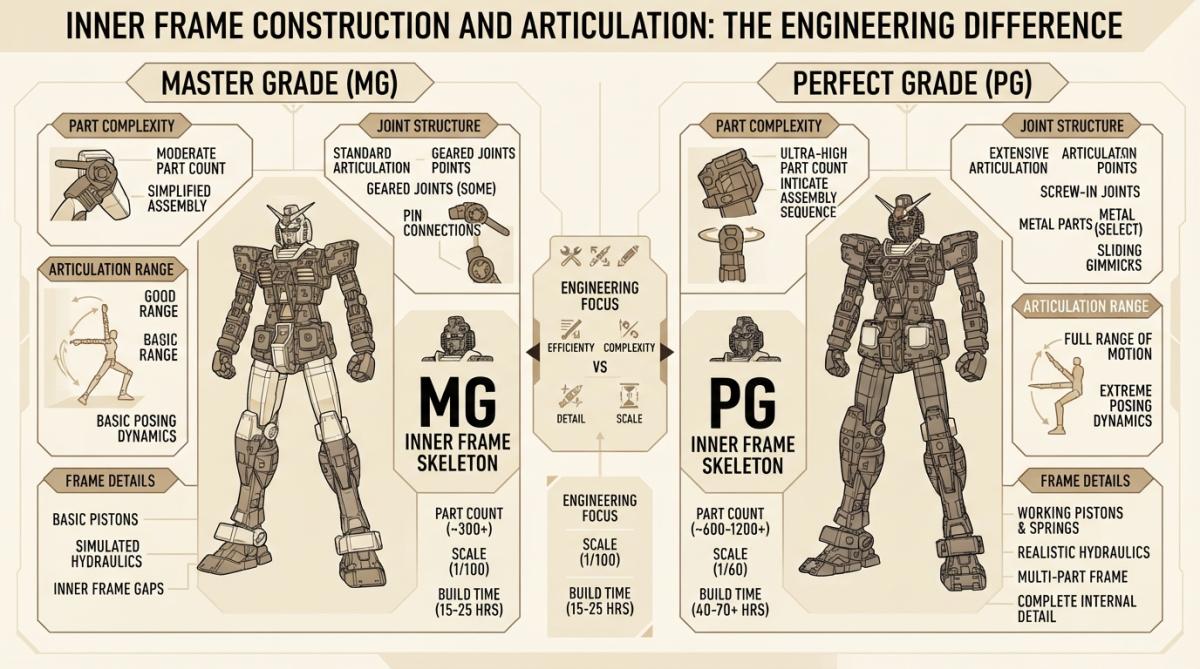
Master Grade Frame Systems
Master Grade frames use modular design with ball joints, pin joints, and frame-mounted armor. The frame assembles first, then armor pieces attach. Articulation is excellent, allowing dynamic posing and full ranges of motion. The frame includes visible mechanical detail like hydraulic lines and joint covers, but complexity remains manageable. Most builders assemble an MG frame in 4-6 hours.
The MG frame design prioritizes reliability and ease of assembly. Joints are strong enough for frequent posing without degradation. Modular design makes disassembly for painting or repair straightforward. The frame is detailed enough to be visually interesting through armor gaps without overwhelming complexity.
Perfect Grade Frame Systems
Perfect Grade frames are engineering systems featuring multi-axis joints with mechanical pistons, visible hydraulic lines, detailed wiring harnesses, and sometimes motorized components. The frame is meant to be studied. Some PG kits include LED lighting units illuminating the frame from within. Frame assembly alone requires 15-20+ hours.
The PG frame design prioritizes authenticity over simplicity. Every joint replicates how mechanical systems actually function. Pistons move as limbs articulate. Hydraulic lines create visual continuity. The frame alone is worthy of display. For builders viewing assembly as part of the hobby, the PG frame is deeply rewarding.
The trade-off is assembly time and precision requirements. PG frames demand careful instruction reading, proper tool use, and patience. Mistakes during frame assembly can affect armor fit later. But for builders who enjoy the assembly process, the PG frame is rewarding.
Gunpla Grades Explained: Complexity and Part Separation
Understanding how Gunpla grades differ in complexity helps you choose the right kit. Part separation refers to how components divide across plastic runners. Master Grade typically uses 10-15 runners with logical separation making assembly intuitive. Perfect Grade uses 20-30+ runners with parts separated so individual mechanical components are isolated.
With Master Grade, you manage a moderate number of parts with clear purpose. You rarely need tweezers. Snap-fit assembly is satisfying, with appropriate tension. Most builders find MG assembly meditative rather than stressful.
With Perfect Grade, part management becomes significant. You'll organize pieces by section and often work with magnifying tools for smallest components. Snap-fit tolerances are tighter due to engineering demands. Some pieces require careful alignment. This complexity appeals to builders enjoying the challenge but is genuinely demanding for those expecting High Grade simplicity.
Complexity also affects customization potential. Master Grade kits are straightforward to paint and modify, with accessible frames and forgiving designs. Perfect Grade kits are more fragile during customization because engineering is tighter. Painting a PG kit requires higher skill to avoid damaging precision-fit components.
Gunpla Build Time by Grade: What to Expect
Build time varies by experience level. A Master Grade kit typically requires 15-25 hours of focused assembly. Builders new to MG might need 25-30 hours; experienced builders might finish in 15 hours. Time includes frame assembly, armor attachment, decal application, and basic finishing.
A Perfect Grade kit demands 40-60+ hours of assembly. The frame alone takes 15-20 hours. Armor assembly adds another 15-20 hours. Decal application with 100+ pieces requires 5-10 hours of careful work. Some advanced builders spend 60-80+ hours customizing and painting, but base assembly is typically 40-60 hours.
The time difference reflects engineering complexity, not just part count. With Perfect Grade, you're assembling mechanical systems. Each joint requires attention. Decal placement demands precision. Instructions are more detailed and require careful reading.
| Grade | Typical Scale | Part Count | Build Time | Best For |
|---|---|---|---|---|
| High Grade (HG) | 1/144 | 100-200 | 4-8 hours | Beginners, casual builders |
| Master Grade (MG) | 1/100 | 500-800 | 15-25 hours | Intermediate builders, detail enthusiasts |
| Real Grade (RG) | 1/144 | 300-500 | 8-15 hours | Builders wanting MG detail at HG scale |
| Perfect Grade (PG) | 1/60 | 1000-1500+ | 40-60+ hours | Advanced builders, serious collectors |
Most Detailed Gunpla Kits: Surface Detail and Finishing
Surface detail is where Perfect Grade dominates. Master Grade kits have respectable detail with pre-molded panel lines, decal placement areas, and mechanical elements visible through armor gaps. Perfect Grade kits take surface detail further with deeper, more numerous panel lines, abundant intricate decals, and photorealistic finish when completed properly.
With Master Grade, you achieve excellent results with basic finishing. Panel lining with a fine-tipped marker adds depth without requiring painting skills. Water slide decals look significantly better than stickers. Top coat application brings out colors and creates a finished appearance. Most builders produce display-quality MG kits with these basic techniques.
Perfect Grade kits respond dramatically to finishing work. The sheer number of decals demands careful application. Some PG kits include over 100 individual decal pieces. Correct application takes hours but transforms the kit to photorealistic. Panel lines benefit from precise paint application. Advanced builders often paint panel lines in contrasting colors to emphasize mechanical detail.
The difference in surface detail affects shelf presence. A finished Master Grade kit looks impressive, detailed, well-proportioned, and clearly engineered. A finished Perfect Grade kit looks like a museum-quality scale model. Detail visible from arm's length is substantially higher. For builders focused on display and photography, Perfect Grade's surface detail justifies the investment.
Choosing between Master Grade and Perfect Grade depends on your experience level, available time, and display goals. Master Grade kits offer the best balance of impressive detail, manageable complexity, and reasonable investment. They're ideal for builders who've mastered High Grade kits and want to advance without overwhelming themselves. If you're ready to commit 40-60+ hours to assembly and want the absolute pinnacle of Gunpla engineering, Perfect Grade is unmatched. At Utopia Toys and Models, we stock both grades from industry-leading brands like Bandai, ensuring you find the right kit for your collection. Our team can help you evaluate your skill level, discuss build time commitments, and select a kit matching your goals. Visit Utopia Toys and Models today to explore both Master Grade and Perfect Grade options with transparent availability information and reliable shipping.
Frequently Asked Questions
What is the main difference between Master Grade and Perfect Grade Gunpla kits?
Master Grade (MG) kits are typically 1/100 scale with detailed inner frame construction and moderate complexity, while Perfect Grade (PG) kits are larger at 1/60 scale with significantly more intricate internal mechanics, LED units, and advanced gimmicks. Perfect Grade kits represent the pinnacle of Bandai's engineering, featuring more part separation, superior articulation, and exceptional surface detail. Master Grade offers an excellent balance of complexity and manageability, making it popular among intermediate builders, while Perfect Grade demands advanced skills and patience.
Which Gunpla grade is better for beginners: Master Grade or Perfect Grade?
Master Grade is substantially more beginner-friendly than Perfect Grade. MG kits feature snap-fit assembly, manageable part counts, and clear assembly instructions, though they still offer rewarding complexity. Perfect Grade kits require precision tooling, advanced techniques like panel lining and water slide decals, and extensive assembly time (often 40+ hours). If you're new to Gunpla, start with High Grade (HG) kits, progress to Master Grade, and only attempt Perfect Grade after mastering MG builds and understanding your skill level.
How much assembly time should I expect for Master Grade vs Perfect Grade builds?
Master Grade Gunpla typically requires 15-25 hours of assembly time depending on the specific model and your experience level. Perfect Grade kits demand significantly more time, often 40-60+ hours, due to their complexity, runner count, and the meticulous finishing work required for proper detail realization. Build time increases if you're panel lining, applying decals, or adding top coat finishing. Plan accordingly and don't rush, quality assembly directly impacts the final shelf presence and longevity of your model.
Are Perfect Grade kits worth the higher cost compared to Master Grade?
Perfect Grade kits offer exceptional value for advanced builders who appreciate engineering detail and are committed to proper finishing techniques. The higher investment reflects superior inner frame construction, more gimmicks, LED units, and unmatched articulation. However, if you lack advanced tooling, finishing supplies, or time, a Master Grade kit may deliver better satisfaction for your investment. Consider your skill level, available tools, display space, and commitment to maintenance, PG kits are collectible investments that reward proper care and finishing work.
Do Master Grade and Perfect Grade Gunpla kits come with LED units and special gimmicks?
Master Grade kits occasionally feature LED units and gimmicks like motorized parts or light-up features, though these vary by model. Perfect Grade kits more consistently include advanced gimmicks, motorized joints, LED eye units, light-up cockpits, and complex transformation mechanisms, as part of their premium positioning. These features add assembly complexity and require careful handling during building and maintenance. Check the specific kit's specifications before purchasing if LED units or motorized gimmicks are important to your decision.
This article was written using GrandRanker