

Table of Contents
- Why Climate Controlled Storage Matters for Model Kits
- How to Store Finished Model Kits Without Damage
- How to Store Model Kits Long Term in a Climate Controlled Unit
- Protect Model Kits from Humidity with Proper Packaging
- Model Kit Storage Ideas for Home and Facility-Based Options
- Temperature and Humidity Targets for Model Kit Collections
- Common Storage Mistakes to Avoid
- Frequently Asked Questions
Last Updated: October 13, 2026
Why Climate Controlled Storage Matters for Model Kits
Model kits represent significant investments in both money and time. The best climate controlled storage for model kits prevents the deterioration that occurs when temperature swings, humidity spikes, and heat exposure damage plastic, resin, paint, and delicate decals.
Without proper climate control, your models face real threats. Extreme temperature fluctuations cause plastic to warp and shrink. High humidity promotes mold growth and paint degradation. Direct sunlight fades colors and weakens materials.
The difference between casual storage and intentional climate control is measurable. Finished models stored in climate-controlled environments maintain their appearance, structural integrity, and value for years.
How to Store Finished Model Kits Without Damage
Finished model kits require protection from three primary environmental threats: temperature fluctuations, humidity, and heat exposure. Each poses distinct risks to different materials.
Protecting Against Temperature and Humidity Swings
Temperature swings cause plastic and resin to expand and contract. Over time, this cycling weakens joints, causes paint to crack, and can separate glued components.
The solution is consistent environmental conditions. Stable temperature and humidity prevent the material stress that leads to visible damage. When you move from a warm room to a cold garage, your models experience stress.
Store your finished models in spaces where temperature remains relatively constant throughout the year. Basements, interior closets, and climate-controlled storage units all work better than attics, garages, or sheds where seasonal changes are extreme.
Shielding from Heat and Direct Sunlight
Heat accelerates paint degradation and can soften plastic, especially on models built with lower-melting-point materials. Direct sunlight fades colors and weakens adhesives. Even indirect sunlight through windows causes cumulative damage over months and years.
Position your storage away from windows and heat sources. Interior walls are better than exterior walls. If you're using a climate-controlled storage unit, confirm it's not in a location where afternoon sun heats the building's exterior.
How to Store Model Kits Long Term in a Climate Controlled Unit
Long-term storage requires deliberate preparation. Models stored for six months or longer need extra protection beyond standard packaging.
Preparation Steps Before Storage
Before placing models into climate-controlled storage, document your collection. Take photos of each model from multiple angles. This creates a reference record and helps identify any damage that occurs during storage.
Clean your models gently with a soft, dry cloth. Remove any dust or debris that could scratch surfaces during transport or storage. For models with exposed decals or fragile parts, consider adding temporary protective layers using acid-free tissue paper.
Pack models in their original boxes if available. Original packaging is designed to protect contents during transport and storage. If original boxes are unavailable, use sturdy cardboard boxes or plastic bins with secure lids.
Inventory and Access Planning
Create a detailed inventory before storage. List each model, its location in your storage unit, and any special handling notes. Store this inventory digitally and as a printed backup.
Organize your storage unit so you can access models without disturbing others. Place frequently accessed items near the front. Stack heavier boxes on lower shelves and lighter ones above. Leave space between stacks for air circulation.
Protect Model Kits from Humidity with Proper Packaging
Humidity is one of the most damaging environmental factors for model collections. Proper packaging creates a moisture barrier between your models and the surrounding air.
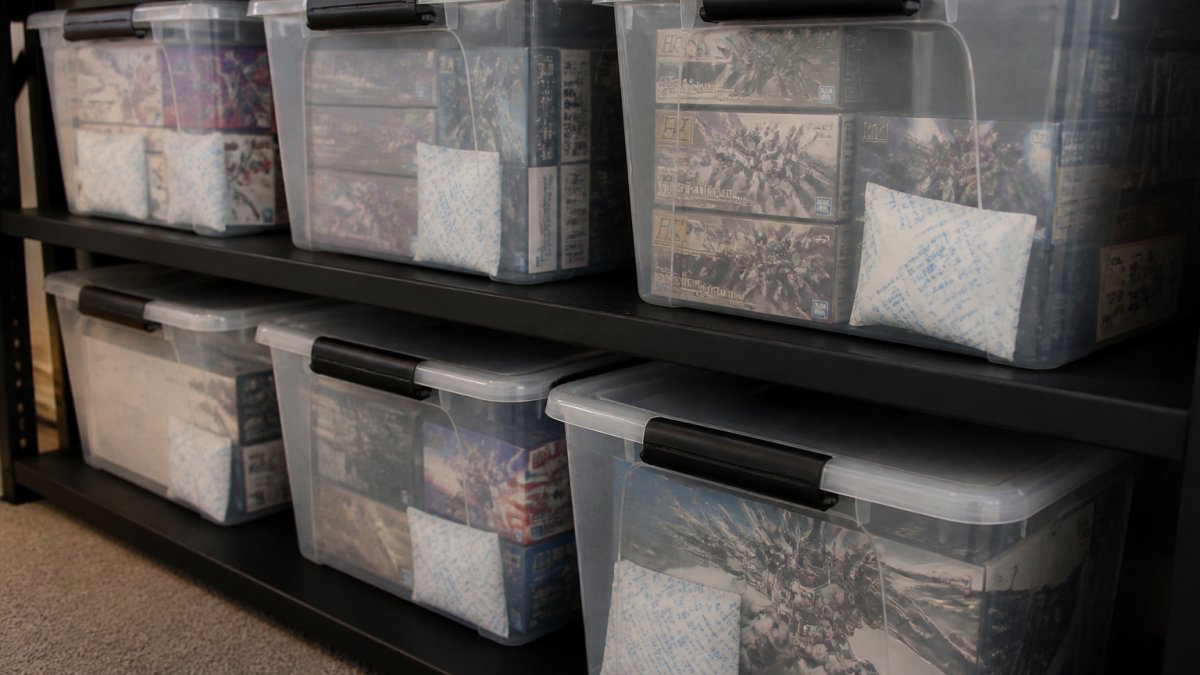
Choosing the Right Boxes and Bins
Plastic bins with sealed lids provide better moisture protection than cardboard boxes alone. Clear plastic bins let you see contents without opening them. Choose bins with locking mechanisms that create an airtight seal.
Cardboard boxes work for short-term storage but absorb moisture over time. If using cardboard, place models inside plastic bags first, then seal those bags before placing them in the box. This creates a moisture barrier.
For high-value models, consider double-boxing: place the sealed plastic bin inside a cardboard box, creating an additional insulation layer.
Moisture Control Inside Containers
Desiccant packets actively absorb moisture inside sealed containers. Place packets inside every sealed bin or bag. Replace desiccant packets annually or when they become saturated (many packets change color to indicate saturation).
Silica gel desiccants are inexpensive and effective. Buy them in bulk from retailers and refresh them regularly. For long-term storage, use multiple packets per container.
Avoid storing models in sealed containers without desiccant. Sealed containers trap whatever moisture exists inside. Without desiccant to absorb that moisture, humidity levels inside the container can actually increase over time.
Model Kit Storage Ideas for Home and Facility-Based Options
Your storage choice depends on collection size, available space, and budget. Home storage works for smaller collections. Facility-based climate-controlled storage suits larger collections or when home space is limited.
Home Storage Solutions
Interior closets in climate-controlled rooms offer excellent protection. They maintain stable temperature and humidity, protect from sunlight, and use existing space efficiently. Shelving inside closets maximizes vertical space.
Interior walls of bedrooms or living areas work better than exterior walls. Exterior walls experience more temperature fluctuation and may have moisture issues.
Avoid attics, garages, basements without climate control, and sheds. These spaces experience seasonal temperature swings and humidity spikes that damage models.
Evaluating Climate Controlled Storage Facilities
If you're considering a climate-controlled storage unit, evaluate facilities based on specific criteria. Ask about temperature ranges maintained year-round.
Request humidity specifications. Not all climate-controlled facilities monitor humidity, temperature control alone is insufficient. Facilities should maintain humidity between 30% and 50% for optimal model protection.
Inspect the facility in person. Look for signs of moisture, mold, or pest activity. Check how units are sealed and whether they're indoors or in a building with exterior walls.
Ask about security features. Climate-controlled storage protects from environmental damage but not theft. Facilities should have surveillance, access controls, and insurance options.
Comparing Storage Unit Costs and Specifications
Storage unit pricing varies by location, size, and facility. According to Public Storage's facility comparison data, climate-controlled units average around $200 monthly, though prices range based on unit size and local market conditions.
Smaller units (5x5 feet) suit modest collections and cost less than larger spaces. Medium units (10x10 feet) accommodate substantial collections and provide room for organization.
Compare facilities on these factors:
| Factor | What to Look For | Why It Matters |
|---|---|---|
| Temperature Range | 55-75°F preferred | Extreme ranges cause material stress |
| Humidity Control | 30-50% target | High humidity promotes mold and corrosion |
| Location | Interior unit preferred | Exterior walls experience temperature swings |
| Access Hours | 24/7 or extended | Convenient access without disrupting models |
| Security | Surveillance and controls | Protects collection from theft |
| Insurance Options | Available coverage | Protects against loss or damage |
Several facilities appear in Newsweek's 2026 readers' choice ranking for climate-controlled storage, including Go Store It, SmartStop Self Storage, StorageMart, 10 Federal Storage, Storage Sense, and U-Haul Storage. These recognized providers offer climate-controlled options worth evaluating in your area.
Temperature and Humidity Targets for Model Kit Collections
A single temperature and humidity number does not fit every item in a model kit collection. Plastic sprues, resin conversion parts, waterslide decals, acrylic and enamel paints, and finished display models each respond differently to heat, moisture, and cycling. The table below gives practical target ranges by material, followed by the mechanisms behind each number.
| Material | Target Temp | Target RH | Primary Risk Outside Range |
|---|---|---|---|
| Polystyrene plastic kits (unbuilt) | 60-75°F | 35-50% | Warping, sprue stress, box deterioration |
| Resin parts and conversions | 60-72°F | 30-45% | Softening, sagging, amine blush, brittleness |
| Waterslide and dry-transfer decals | 60-72°F | 30-45% | Curling, adhesive failure, yellowing |
| Acrylic and enamel paints (sealed) | 60-75°F | 35-55% | Separation, skinning, solvent loss |
| Finished display models | 62-75°F | 35-50% | Paint cracking, joint failure, decal lift |
| Photo-etch and metal details | 60-75°F | below 50% | Oxidation, adhesive failure |
Why Plastic and Resin Have Different Limits
Polystyrene, the most common model kit plastic, begins to soften noticeably above roughly 90°F and can warp under its own weight when stored in a hot attic or non-climate-controlled unit during summer. Resin is more sensitive: many two-part polyurethane resins used in garage kits and conversion sets soften at lower temperatures than polystyrene and can sag on thin parts such as gun barrels, fins, or figure limbs. Resin also absorbs ambient moisture, which can cause amine blush (a waxy surface film) and can make the material brittle over repeated wet-dry cycles.
Why Decals and Paints Are the First to Fail
Waterslide decals are the canary in the coal mine. Their adhesive layer is sensitive to both heat and humidity: above roughly 50% RH, decals can lift or curl at the edges; below 30% RH, the carrier film becomes brittle and cracks during handling. Enamel and acrylic paints stored in sealed jars tolerate a wider range, but temperature swings cause solvent expansion and contraction that can pop lids or cause pigment separation. Keeping paints in a stable 60-75°F range with moderate humidity preserves their working consistency.
The Cycling Problem
Steady conditions matter more than hitting an exact number. A unit that holds 70°F year-round is better than one that swings from 55°F in winter to 85°F in summer, even though both average near 70°F. Each swing causes materials to expand and contract at different rates, stressing glue joints, paint films, and decal edges. When evaluating any storage space, ask not just for the target range but for how often the space hits the extremes and how quickly it recovers.
Measuring Conditions Yourself
Do not rely on a facility's marketing language. Inexpensive digital thermo-hygrometers (often under $20 at hardware and home-improvement retailers) let you log temperature and humidity inside your actual storage space. Place one in the unit for at least a week before committing to a long-term lease, and check it after the first seasonal change. A unit that reads 72°F and 45% RH in spring may read 82°F and 58% RH in August. Data beats assumptions.
Common Storage Mistakes to Avoid
Experienced collectors know which storage approaches fail. Learning from these mistakes saves time and protects your collection.
Don't store models in uncontrolled spaces and assume they'll survive.
Don't use sealed containers without desiccant. Sealed containers trap moisture.
Don't skip documentation. Before storage, photograph your collection. If damage occurs, photos provide evidence for insurance claims.
Don't assume all climate-controlled facilities are equal. Some maintain only temperature without humidity control.
Don't overcrowd storage units. Models need air circulation. Stacking boxes too tightly traps moisture pockets.
Don't store models in direct sunlight, even in climate-controlled spaces. Some storage units have windows or skylights.
Protecting your model kit collection requires intentional storage planning. Whether you're storing finished Gundam models, display figures, or custom builds, the best climate controlled storage for model kits combines stable temperature, controlled humidity, and proper packaging.
Frequently Asked Questions
What temperature and humidity are best for storing model kits?
Plastic and resin models stay stable between 55°F and 75°F with humidity levels between 30% and 50%. Fluctuations in temperature and humidity cause plastic to warp and paint to crack. Climate controlled storage units maintain these conditions year-round, preventing the damage that occurs in uncontrolled spaces like attics or garages where temperatures swing 40+ degrees seasonally.
How do you protect model kits from humidity and heat?
Use sealed plastic bins or cardboard boxes with desiccant packets (silica gel) to absorb moisture inside containers. Store finished models away from direct sunlight and heat sources. Climate controlled storage eliminates the root cause by maintaining stable temperature and humidity, but even within climate controlled units, individual packaging adds a protective layer against any micro-fluctuations and prevents decals from peeling or resin from yellowing.
Do model kits need climate-controlled storage?
Unbuilt model kits in sealed boxes can survive non-climate-controlled spaces for short periods, but finished models and long-term storage benefit significantly from climate control. Plastic models are vulnerable to heat damage above 80°F, and humidity above 60% causes paint adhesion problems and rust on metal parts. If you're storing valuable or completed models for more than a few months, climate controlled storage prevents costly damage that cannot be repaired.
What is the best way to organize model kits in a storage unit?
Use clear plastic bins with labels so you can identify contents without opening them. Organize by collection type (Gundam, figures, supplies) and store bins on shelves rather than stacked on the floor to improve air circulation. Keep an inventory list and photograph contents before sealing. This workflow prevents you from damaging models while searching and makes retrieval quick when you want to display or work on a specific kit.
