

Table of Contents
- The Real Reason Your Model Kits Get Sticky Over Time
- Plasticizer Migration in PVC Figures: The Science Explained
- How to Clean Sticky Rubberized Plastic and Hard Plastic Parts
- The Soft-Touch Coating Myth: Why Some Kits Feel Tacky by Design
- The Best Way to Store Gundam Models for Long-Term Protection
- Common Mistakes That Make Sticky Model Kits Worse
- Conclusion: Preserve Your Builds for Years to Come
- Frequently Asked Questions
Last Updated: September 7, 2026
The Real Reason Your Model Kits Get Sticky Over Time
Most sticky model kits suffer from plasticizer migration, not dirt or poor handling. Plasticizers added during manufacturing to make plastics flexible can slowly leach to the surface, leaving a tacky, greasy film that attracts dust (pubs.acs.org). This guide explains why do model kits get sticky over time, how to fix it safely, and how to prevent it.
The wrong cleaning method can permanently damage your build. Many collectors assume the residue is grime and reach for harsh solvents, which can strip paint, cloud clear plastic, or melt the part. The good news is that sticky model kits are usually recoverable with a gentle, informed approach.
Plasticizer Migration in PVC Figures: The Science Explained
Plasticizer migration is where softening agents added to polyvinyl chloride (PVC) and other flexible plastics travel from the interior to the surface. Unlike hard plastics such as ABS or styrene, PVC figures rely on these additives for bendable limbs and soft details. Over time, the plasticizer molecules break free from the polymer chain and form a visible surface film.
This is not a defect but an inherent property of the material. The migration rate depends on the quality of the original compound and the storage environment. When the surface film oxidizes upon contact with air, it becomes tackier and can bond with dust, making the problem appear worse.
Washing with soap and water removes the current residue but does not stop the plasticizer inside the part from continuing to leach out. This is why a figure can feel sticky again within weeks of a thorough wash.
Why Heat, UV Exposure, and Humidity Accelerate the Process
Heat gives plasticizer molecules more energy to move, UV exposure can break down the polymer structure, and humidity can make the surface film feel wetter and stickier (nist.gov). Storing your collection near a window, above a radiator, or inside a hot car is the fastest way to accelerate this degradation.
Climate control is your first line of defense. A cool, dark, and dry room will dramatically slow the chemical breakdown of your figures. In a humid climate, running a dehumidifier in your display room can extend the shelf life of softer PVC parts.
How to Clean Sticky Rubberized Plastic and Hard Plastic Parts
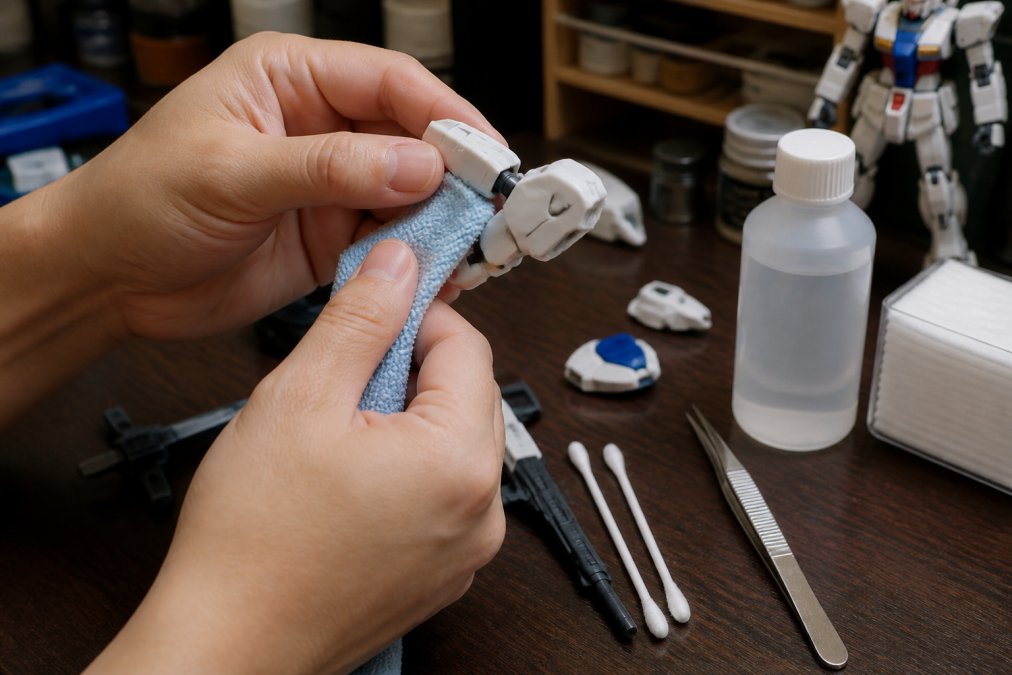
Cleaning sticky model kits is not one-size-fits-all. The wrong solvent can turn a salvageable part into a melted, cloudy mess. Match your cleaning agent to the specific polymer chemistry of your kit.
Solvent Safety by Plastic Type: ABS, Styrene (PS), and PVC
ABS (Acrylonitrile Butadiene Styrene): This is the workhorse plastic for Gundam inner frames and many action figure joints. It is relatively resistant to short-term alcohol exposure. You can safely use 70% isopropyl alcohol (IPA) on a cotton swab for surface cleaning, but avoid soaking the part. Prolonged immersion can cause the butadiene component to swell, leading to warping or stress fractures. Never use acetone, lacquer thinner, or enamel thinner on ABS, these will aggressively dissolve the polymer matrix.
Styrene (Polystyrene / PS): Used for most outer armor plates and runners. It is slightly more sensitive to solvents than ABS. Stick to 50% or lower IPA concentration for wiping. Higher concentrations can cause surface crazing, fine, spiderweb-like micro-cracks that permanently ruin the finish. For stubborn residue, use a mild degreaser like Simple Green diluted 1:10 with water. Apply with a soft toothbrush, then rinse immediately with distilled water.
PVC (Polyvinyl Chloride): Found in soft hands, skirts, and many standalone figures. PVC is the most vulnerable to chemical attack. Its high plasticizer content makes it swell and soften when exposed to even mild solvents. Do not use IPA above 25% concentration on painted PVC. For bare PVC, a 25% IPA solution is acceptable for short wipes, but the safest first pass is warm water with a drop of Dawn dish soap. The soap breaks the surface tension of the plasticizer film without penetrating the polymer.
The Two-Pass Cleaning Protocol
Most hobbyists stop after one wash and wonder why the tackiness returns in days. The plasticizer film is not a single layer, it is a continuous exudate. A two-pass protocol removes the bulk residue and then the residual molecular film.
Pass 1: Bulk Removal
- Disassemble the kit completely. Remove all armor, inner frames, and joint caps.
- Fill a glass bowl with lukewarm water (never hot, heat accelerates plasticizer migration) and add 2-3 drops of mild dish soap.
- Submerge the parts for 5 minutes maximum. Do not soak longer, as water can seep into seam lines.
- Gently agitate with a soft-bristle brush (an old makeup brush works well). Focus on recessed panel lines where the sticky film accumulates.
- Rinse each part under running lukewarm water. Shake off excess and pat dry with a lint-free microfiber cloth.
Pass 2: Molecular Film Removal
- After the parts are completely dry (wait at least 30 minutes), inspect the surface. You will likely see a faint sheen or feel a slight drag on your fingertip.
- Dip a cotton swab in your material-appropriate IPA solution (see chart above).
- Wipe in one direction only, back-and-forth motion can redeposit the dissolved film.
- Immediately follow with a dry section of the microfiber cloth to lift the dissolved plasticizer before it re-settles.
- Repeat this wipe-and-buff cycle up to three times. If tackiness persists after three passes, the plasticizer has saturated the surface layer, and further cleaning will not help, you need to move to the storage solutions in the next section.
What to Do When Cleaning Fails: The Saturation Point
If your part remains sticky after three cleaning cycles, the plasticizer has saturated the outer 0.1-0.5 mm of the polymer. This is common in figures stored in hot attics or direct sunlight for years. At this point, no surface cleaning will help. Your options are:
- Accept and isolate: Place the part in a sealed bag with silica gel. The desiccant will absorb some of the surface film, but the part will remain tacky. Keep it away from other plastics.
- Strip and repaint: For ABS and styrene parts, you can carefully strip the paint and apply a primer like Mr. Surfacer 1000 to seal the surface. This is a temporary fix, the plasticizer will eventually push through the primer.
- Replace the part: For critical structural parts, replacement is the only safe option. Aftermarket parts from brands like Kotobukiya or Bandai replacement runners are often available.
The pH Balance Factor
Hard tap water with high mineral content can leave a chalky residue that traps new plasticizer. Use distilled water for the final rinse on all parts to eliminate dissolved calcium and magnesium interfering with the surface chemistry.
The Soft-Touch Coating Myth: Why Some Kits Feel Tacky by Design
Not every sticky model kit is a victim of plasticizer migration. Some kits are manufactured with a soft-touch coating, a matte finish applied to provide a premium, velvety texture. This coating degrades over time into a genuinely tacky layer that cannot be cleaned back to its original state.
The myth is that this stickiness indicates a problem with your storage or cleaning routine. In reality, the soft-touch coating has a limited chemical lifespan. As it oxidizes, it becomes sticky regardless of how carefully you handle the item. No amount of cleaning will restore the original feel because the coating itself is the problem.
The only effective solution for a degraded soft-touch coating is removal. Carefully wiping with isopropyl alcohol will gradually dissolve and strip the coating, revealing the smooth hard plastic underneath. This requires patience and multiple applications, but the result is a clean, non-tacky surface far more durable than the original finish.
The Best Way to Store Gundam Models for Long-Term Protection
The best way to store gundam models is to interrupt the chemical reaction before it starts. Cleaning removes the symptom; storage prevents the disease. Most collectors focus on dust protection, but the real enemy is the microclimate inside your display case. fixing warped plastic.
The 65/65/65 Rule: Temperature, Humidity, and Light
Plasticizer migration is a diffusion process with predictable rates. Based on polymer science principles used in museum conservation, the safe zone for long-term plastic storage is:
- Temperature below 65°F (18°C): Every 10°F increase roughly doubles the rate of plasticizer migration. Room temperature (72°F) is acceptable, but anything above 80°F significantly accelerates the process. Avoid display cases near kitchen walls, south-facing windows, or electronics that generate heat.
- Relative humidity below 65%: High humidity does not directly cause plasticizer migration, but it hydrolyzes the surface film, making it tackier and more reactive. Use a digital hygrometer (a $10 unit from a hardware store is sufficient) to monitor your display room. If humidity consistently exceeds 65%, run a dehumidifier or place silica gel packets (rechargeable types like Eva-dry are reusable) inside enclosed display cases.
- UV exposure below 65 lux: Direct sunlight is obvious, but indirect UV from fluorescent lighting also degrades the polymer backbone. Use UV-filtering acrylic for display case doors or apply 3M UV film to existing glass. LED lighting emits negligible UV and is the safest choice for display illumination.
The Barrier Material Hierarchy
Not all storage containers are equal. Plasticizers can migrate through some materials and react with others. Here is the hierarchy of safe storage barriers:
Best: Polypropylene (PP) and Polyethylene (PE) These are the #5 and #2 recycling codes. They are chemically inert and do not interact with plasticizers. Use Really Useful Boxes (PP) or Ziploc brand freezer bags (PE) for individual kits. These materials do not outgas and provide a neutral barrier.
Acceptable: Glass Glass is completely non-reactive, but it offers no cushioning. Use glass containers only for small, sturdy parts. The risk is breakage, not chemistry.
Avoid: PVC (Vinyl) and Polystyrene (PS) Containers Many cheap storage bins are made from recycled PS or PVC. These materials can actually absorb plasticizers from your kits or release their own, creating a chemical exchange that accelerates degradation. Check the recycling code on your storage bins. If it says #3 (PVC) or #6 (PS), replace them.
Avoid: Wood and Cardboard Wood releases acetic acid (the same compound in vinegar) as it ages, which catalyzes polymer breakdown (loc.gov). Cardboard is slightly acidic and absorbs moisture. Never store kits directly in cardboard boxes for long-term storage. If you must use the original box, line it with a PE bag first.
The Outgassing Containment Strategy
Plasticizer migration does not stop when you seal a box. If you trap the migrating molecules in a sealed container, they will saturate the air inside and re-deposit on the surface. This is why sealed storage can sometimes make the problem worse.
The solution is an absorbent sink. Place a small activated charcoal sachet (used for aquarium filtration) inside each storage container. Activated charcoal has a massive surface area and will adsorb the outgassed plasticizer molecules, pulling them away from the plastic surface. Replace the sachet every 6 months. This is a technique borrowed from museum archival practice, where activated charcoal is used to protect cellulose acetate film from vinegar syndrome.
The Contact Rule: Separating Reactive Plastics
Plasticizer migration is a concentration gradient driven process. When a soft PVC part touches a hard ABS part, the plasticizer migrates from the high-concentration PVC into the low-concentration ABS. This makes the PVC brittle and the ABS stained and softened.
The interleaving protocol:
- Wrap each PVC figure or soft part in acid-free tissue paper (available at art supply stores). Do not use regular tissue, the acids accelerate degradation.
- Place the wrapped part in a separate PE bag.
- Store the bag in a PP container with a charcoal sachet.
- Never stack heavy kits on top of soft PVC parts. The pressure increases molecular contact and accelerates migration.
The Annual Audit
Prevention is not a one-time setup. Schedule a yearly inspection of your collection. Every 12 months:
- Remove all kits from storage.
- Check for early signs of tackiness on joints and soft parts.
- Wipe down all surfaces with a dry microfiber cloth to remove settled dust.
- Replace silica gel and charcoal sachets.
- Rotate displayed kits, move ones near windows to interior shelves.
This audit takes 30 minutes but catches plasticizer migration in its earliest stages, when a simple wipe-down is still effective.
Material-Specific Storage Solutions for ABS, Styrene, and PVC
ABS and styrene, the primary materials in most Gundam model kits, are relatively stable and resistant to plasticizer migration. They are best stored assembled or in their original runners, kept flat to prevent warping. The primary risk is physical damage, not chemical degradation. Store them in PP containers with dividers to prevent parts from rubbing against each other.
PVC figures and soft rubberized parts contain high levels of plasticizer and should never be stored in direct contact with hard plastics or painted surfaces. The migrating plasticizer can soften and imprint onto adjacent materials over time. Store these items separately in their own PE bags or with acid-free tissue between parts. For high-value PVC figures, consider museum-grade polyethylene foam (Ethafoam) to create custom cradles that hold the figure without pressure points.
Common Mistakes That Make Sticky Model Kits Worse
The most common mistake is using aggressive solvents like acetone, nail polish remover, or undiluted rubbing alcohol on sticky model kits. These chemicals are far too strong for most hobby plastics and will cause clouding, cracking, or complete dissolution. If unsure about a solvent, assume it is too harsh.
Another frequent error is applying talcum powder to absorb the stickiness. While this provides a temporary dry feel, it does not address the underlying plasticizer migration. The powder mixes with the surface film to create a paste that is difficult to remove and can clog fine panel lines, leaving your kit chalky and dirty.
A third mistake is cleaning the kit and then returning it to the same environment that caused the problem. Without addressing the heat, UV exposure, or humidity in your storage area, the stickiness will return quickly. Modifying your storage conditions is essential for a lasting fix.
| Plastic Type | Common Issue | Safe Cleaning Method | Storage Note |
|---|---|---|---|
| ABS / Styrene | Dust, light grime | Mild soapy water, diluted isopropyl alcohol | Stable, store flat to prevent warping |
| PVC (Figures) | Plasticizer migration, tacky film | Diluted isopropyl alcohol, multiple passes | Store separately, avoid contact with other plastics |
| Soft-Touch Coating | Coating degradation, sticky by design | Isopropyl alcohol to strip coating | Expect limited lifespan, plan for removal |
| Clear Parts | Clouding, scratches | Gentle soapy water only | Wrap individually, avoid abrasive cloths |
Conclusion: Preserve Your Builds for Years to Come
Sticky model kits are a frustrating but manageable reality of plastic chemistry. Understanding that plasticizer migration is the root cause allows you to choose the right cleaning method and storage conditions to slow the process. For soft-touch coatings, knowing when to strip the finish saves you from endless futile cleaning cycles.
Our curated selection of Gundam model kits and collectible figures comes from industry-leading brands, and our transparent availability status helps you plan your builds without surprises. Whether you are hunting for a specific kit scale or the latest Bandai release, our stock is ready to ship so you can start your next project with confidence.
Frequently Asked Questions
Why do old figures get sticky?
Old figures get sticky because of plasticizer migration. Manufacturers add plasticizers to PVC to keep it flexible, but these chemicals slowly migrate to the surface over time. Heat, UV exposure, and environmental humidity speed up this process. As the plasticizer reaches the surface, it forms a tacky film that collects dust and feels sticky to the touch. This is a chemical breakdown of the polymer structure, not a sign of poor craftsmanship.
Can you reverse plastic degradation on model kits?
You cannot fully reverse plastic degradation, but you can remove the sticky residue and slow further breakdown. Clean the surface with isopropyl alcohol or a mild degreaser to lift the tacky film. After cleaning, store the kit in a cool, dry place away from direct sunlight. For soft-touch rubberized plastic, the coating may eventually degrade completely, at which point the only fix is a careful solvent wash or repaint.
What is the best way to store Gundam models to prevent stickiness?
The best way to store Gundam models is in a cool, dry area with stable temperatures below 75°F. Avoid display cases near windows or heat sources, since UV exposure and warmth accelerate plasticizer migration. Use non-reactive storage containers, and avoid letting PVC parts touch ABS or styrene parts long-term, as the migrating plasticizer can cause surface film and even soften adjacent plastics.