

Table of Contents
- Model Kits vs Blind Box Figures: What You're Actually Buying
- Quick Comparison: Retail Price and Unit Cost
- Hidden Costs of Building Model Kits
- Average Cost of Gundam Model Kits Across Grades
- Are Blind Box Figures Worth the Money?
- Collectibility, Rarity, and Resale Value
- Which Should You Choose? A Decision Framework
- Frequently Asked Questions
Last Updated: September 18, 2026
Model Kits vs Blind Box Figures: What You're Actually Buying
When comparing model kits vs blind box figures, model kits demand upfront investment in tools, materials, and time. Blind boxes offer instant gratification and a lower entry price, but randomization can turn casual collecting into an expensive series-completion chase. This guide breaks down the real economics of each category to help you choose based on actual costs, not assumptions.
Defining Model Kits and Action Figures
Model kits are unassembled plastic components requiring nippers, hobby knives, glue, and paint. Bandai Gundam kits come in grades, High Grade (HG), Real Grade (RG), Master Grade (MG), and Premium Grade (PG), each increasing in complexity and price.
Blind box figures are pre-assembled collectibles sold sealed, with the character inside unknown until opening. Brands like Pop Mart and 52Toys dominate this space. The appeal is the surprise element and the hunt to complete a series or chase rare variants.
Key difference: one requires assembly and customization; the other is ready to display immediately.
Assembly, Tools, and Setup Requirements
Model kits require nippers, hobby knives, sandpaper, glue, and paint, all adding cost before building begins. Blind box figures skip this entirely: unbox, display, done. This zero-friction appeal makes them ideal for casual collectors and gift-givers.
Quick Comparison: Retail Price and Unit Cost
Entry Price Points for Each Category
Pricing for High Grade Gundam kits, Real Grade, Master Grade, and Premium Grade varies depending on the specific model and retailer. Blind boxes also have a range of prices per box. Surface comparison might favor blind boxes, but hidden economics on both sides complicate the picture.
Scaling Up: Per-Unit Economics at Higher Volumes
Here's where the math diverges sharply. If you're a casual buyer grabbing one or two items, the per-unit cost is straightforward. But collectors rarely stop at one.
For model kit builders, volume improves economics. Initial toolkit costs can be a significant investment (nippers, knife, sandpaper, paint). Once purchased, every subsequent kit costs only the kit itself plus minimal consumables.
For blind box collectors, randomization creates a hidden cost multiplier. Completing a twelve-character series typically requires opening more boxes than the number of characters due to duplicates, which can significantly increase the total cost compared to the theoretical price for one of each.
Hidden Costs of Building Model Kits
Essential Tools: Nippers, Hobby Knives, and Sanding Supplies
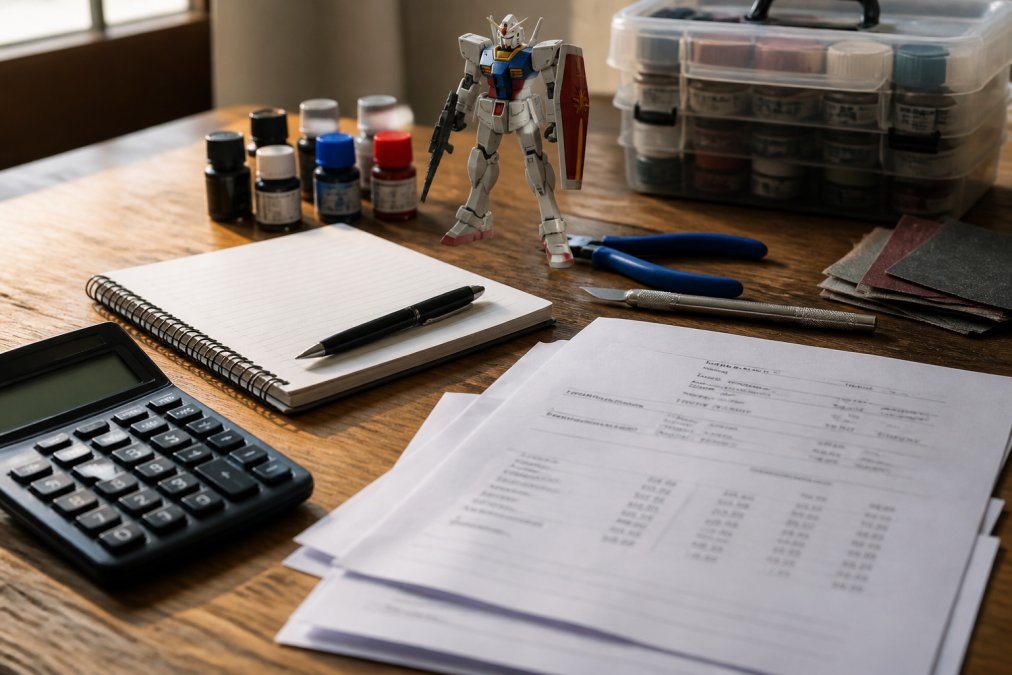
Initial toolkit investment can be substantial (nippers, knife, sandpaper, glue, paint). After this, each subsequent kit costs only the kit itself. Per-unit tool cost approaches zero over time if you build multiple kits.
Paint, Adhesives, and Finishing Materials
Most modern Gundam kits arrive color-molded, reducing painting costs. Optional finishing supplies (paint sets, panel lining markers, topcoat) enhance realism but aren't required for a quality build.
Time Investment and Skill Development ROI
High Grade kits take 3-6 hours; Real Grade 6-12 hours; Master Grade 15-30 hours; Premium Grade 40-60+ hours. Skills transfer across builds, so time-per-kit decreases with experience. Blind boxes require only 5-10 minutes total, offering high time-to-gratification.
Average Cost of Gundam Model Kits Across Grades
High Grade (HG) Kits: The Entry Point
High Grade kits are a popular entry point, featuring 100-200 parts and 3-6 hour builds. They offer excellent quality, good articulation, and snap together without glue. Most collectors own multiple HG kits due to affordability and quick builds.
Real Grade (RG) and Master Grade (MG) Complexity and Cost
Real Grade kits offer more detail and articulation than HG in 6-12 hours. Master Grade kits include 300-500 parts and require 12-30 hours, delivering superior proportions and joint mechanisms that justify the price for serious collectors.
Premium Grade (PG) and Limited Editions
Premium Grade kits are massive centerpieces with 1000+ parts requiring 40-60+ hours. They appeal to experienced builders and hold secondary market value well. Limited editions and collaborations command premium prices and appreciate if demand exceeds supply.
Are Blind Box Figures Worth the Money?
The Gamification Factor: Rarity, Chase Figures, and Series Completion
Blind boxes work because of psychological gamification. Each box is a mystery. You might get a common figure or a rare chase variant. This uncertainty creates dopamine hits that pure shopping doesn't provide.
Series completion is the trap. A twelve-character series seems completable. You buy three boxes and get three different characters. You buy three more and get two duplicates and one new character. You buy three more and get one new character and two more duplicates. By box twelve, you may have spent more than the theoretical cost to complete a set at standard retail.
Chase figures amplify this.
Secondary Market Resale and Depreciation
Blind box figures trade on secondary markets. eBay, Facebook groups, and specialized collector forums facilitate trades and sales. A common figure from a series might sell for its original retail price or slightly less. A rare chase variant might sell for a higher price.
Unboxing Experience vs Long-Term Display Value
Blind boxes excel at the unboxing moment. The ritual of opening the sealed box, revealing the figure, and discovering which character you got is genuinely satisfying. This experience is valuable if you enjoy the moment more than the long-term display.
Collectibility, Rarity, and Resale Value
Material Quality and Durability Impact on Long-Term Worth
Bandai Gundam model kits use high-quality plastic injection molding. Parts fit precisely, colors are stable, and the articulation mechanisms are engineered for repeated posing. A well-built Gundam kit can last decades with proper care.
Market Trends and Production Runs
Gundam model kit production runs are massive. Bandai manufactures millions of units annually. This high volume means prices stay stable and availability remains consistent. Rarity comes from older kits or limited special editions, not from normal production runs.
Which Should You Choose? A Decision Framework
Model Kits: Best for Hands-On Hobbyists
Choose model kits if you enjoy building things. The process matters as much as the result. You want to develop skills, invest time in a project, and create something uniquely yours through customization and painting.
Blind Boxes: Best for Casual Collectors and Display Aesthetics
Choose blind boxes if you value the unboxing experience and want low-friction collecting. You want instant gratification, no learning curve, and the thrill of the unknown. You're comfortable with the randomization and potential duplicate figures.
Hybrid Approach: Combining Both Hobbies
Many serious collectors do both. They build model kits for the hobby satisfaction and deep engagement. They collect blind boxes for variety, display aesthetics, and lower-friction collecting. The two hobbies complement each other, different moods call for different activities.
Frequently Asked Questions
Why are model kits so expensive compared to blind box figures?
Model kits carry higher retail prices because they include more plastic material, complex molds, and superior articulation engineering. A Bandai Gundam Master Grade kit requires precision manufacturing that drives up production costs. Beyond the kit itself, you'll invest in nippers, hobby knives, paint, glue, and sanding supplies. Blind box figures are pre-assembled and ready to display, eliminating tool and material costs entirely. The total cost of ownership for model kits can be higher due to these hidden expenses, but the time investment and customization potential justify the premium for dedicated hobbyists.
What are the hidden costs of building model kits?
Beyond the retail price of the kit, you need hobby-grade nippers, hobby knives, sanding supplies, and paint or finishing materials. If you're serious about the hobby, expect to spend a significant amount on a basic tool collection before building your first kit. Some builders invest in airbrushes and specialized equipment for advanced customization. Time is also a cost: a complex Master Grade Gundam kit takes 15-30 hours to build properly. For casual builders, these hidden expenses can significantly increase the total cost beyond the retail kit price.
Are blind box figures a cheaper way to start a collection?
Yes, blind box figures offer a lower entry point with no tool investment or assembly required. A single blind box arrives ready to display. However, the gamification mechanic creates its own cost trap: chasing rare chase figures or completing a series can lead to spending a significant amount per series trying to collect all variants. Model kits require upfront tool investment but reward patient builders with fewer duplicate purchases. For collectors focused on aesthetic variety and the thrill of unboxing, blind boxes are cheaper to start. For serious hobbyists building long-term collections, model kits offer better value per dollar spent.
Do model kits hold their resale value better than blind box figures?
Yes, completed or built model kits typically retain a portion of their retail value on the secondary market, especially limited editions and higher grades. The time and skill invested in assembly add perceived value. Blind box figures depreciate faster, especially common variants, which often sell for less than their retail price on secondary markets. Chase figures and rare blind box variants hold value better, but this depends entirely on rarity and collector demand. Material quality and condition matter for both: plastic injection-molded kits age well if stored properly, while blind box figures can show paint wear or discoloration over time.