

Table of Contents
- Master Grade vs Real Grade: Key Differences at a Glance
- Scale, Engineering, and Inner Frame Technology
- How Long Does It Take to Build a Master Grade Kit
- Best Real Grade Kits for Beginners
- Tools Needed for Gunpla Assembly
- Detail, Aesthetics, and Display Presence
- Which Grade Should You Choose
- Conclusion
Last Updated: August 12, 2026
Master Grade vs Real Grade: Key Differences at a Glance
Master Grade vs Real Grade kits represent two distinct engineering philosophies within the Gunpla hobby. Master Grade kits operate at 1/100 scale, while Real Grade kits use 1/144 scale, meaning a Master Grade Gundam stands roughly twice as tall. Master Grade models prioritize surface detail and aesthetic complexity with painted inner frames and extensive panel lining opportunities. Real Grade kits pack sophisticated inner frame technology and articulation into a compact design. Master Grade demands more shelf space and assembly time, while Real Grade rewards precision builders with engineering density in a smaller footprint. Master Grade kits typically take 20-30 hours to complete, while Real Grade builds average 12-18 hours. If you want a showpiece that dominates a display case, Master Grade wins. If you want mechanical depth and engineering innovation in a compact footprint, Real Grade delivers.
Scale, Engineering, and Inner Frame Technology
Master Grade kits operate at 1/100 scale, producing models that typically stand 7-8 inches tall. Real Grade kits use 1/144 scale, resulting in finished models around 4-5 inches in height. This 2:1 scale difference creates cascading consequences for engineering and display impact.
Master Grade inner frames are engineered for visual impact. The frame includes painted mechanical details, color-separated components, and gimmicks like moving pistons or articulated joints. When you build a Master Grade, the inner frame becomes part of the aesthetic, visible through panel gaps and transparent armor sections.
Real Grade inner frames operate under different constraints: maximum articulation and mechanical sophistication within minimal space. Engineers pack sophisticated joint engineering and mechanical gimmicks into a frame that's roughly 40% smaller in linear dimension. Real Grade frames prioritize function over visibility; the engineering is hidden but allows articulation that rivals or exceeds Master Grade despite the size difference.
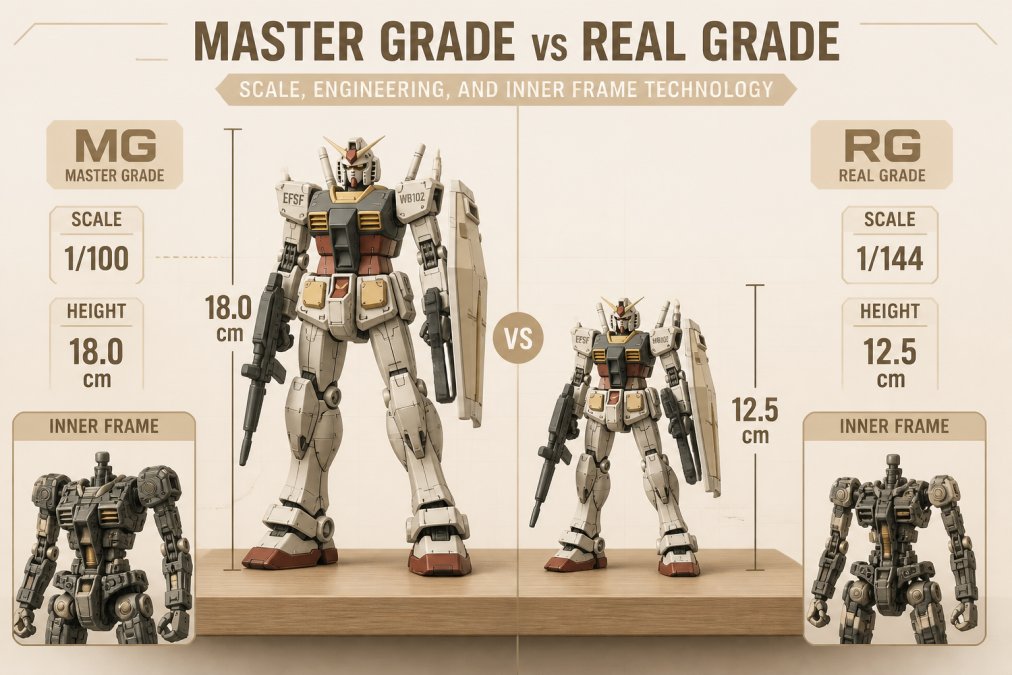
Master Grade kits feature extensive color-separated plastic, reducing paint requirements. Real Grade kits use less color separation, requiring more painting to achieve the canonical color scheme. Both are complex, just differently: Master Grade demands attention to paint masking and decal placement, while Real Grade demands precision in frame assembly and joint calibration.
How Long Does It Take to Build a Master Grade Kit
A typical Master Grade kit requires 20-30 hours of assembly time, though this varies based on the specific model and your experience level. Beginners often spend 30-40 hours on their first Master Grade, while experienced builders can complete one in 15-20 hours. The extended timeline reflects the engineering density: more runners, more polycaps, and more mechanical gimmicks.
The build process breaks down roughly as follows: frame assembly consumes 6-8 hours, armor assembly and panel lining takes 8-12 hours, decal application requires 2-4 hours, and final assembly accounts for 4-6 hours. If you're painting components, add 8-12 additional hours for paint prep and application.
Real Grade kits compress this timeline significantly. A Real Grade build averages 12-18 hours for experienced builders, with beginners typically finishing in 18-24 hours. The smaller frame and fewer armor pieces reduce assembly time, though the precision required in frame assembly can slow first-time builders.
For hobbyists juggling other commitments, Real Grade fits weekend and weeknight building schedules more naturally. Master Grade demands sustained focus and dedicated workspace.
Best Real Grade Kits for Beginners
The Real Grade RX-78-2 Gundam remains the canonical starting point for Real Grade builders. The frame assembly is logical, the polycap placement is forgiving, and the color separation is sufficient to produce a respectable model without painting.
The Real Grade Zaku II represents another beginner-friendly entry with a simpler silhouette and fewer armor pieces. Real Grade Wing Gundam offers a middle ground with more complexity but still accessible to developing builders.
Beginner-friendly Real Grade kits feature clear instruction manuals with step-by-step frame assembly guidance, color-separated plastic that produces acceptable results without paint, and mechanical gimmicks that work intuitively. Avoid early Real Grade releases with notoriously tight polycap tolerances or newer experimental designs.
A genuine beginner might be better served by a High Grade kit first, then moving to Real Grade once they understand runner removal and basic assembly discipline.
Tools Needed for Gunpla Assembly
Gunpla assembly requires a modest toolkit. At minimum, you need nippers (hobby-grade plastic cutters), a hobby knife for nub cleanup, and sandpaper or a sanding stick for smoothing cut edges. These three tools handle 80% of what any builder needs.
Nippers are non-negotiable. Quality matters; cheap nippers produce ragged cuts that require extensive cleanup. A mid-range hobby nipper set costs roughly the same as a single Gunpla kit and lasts years.
A hobby knife (X-Acto or equivalent) removes nubs, the small plastic remnants left where parts connected to sprues. Sandpaper in 400-1000 grit range smooths nub removal marks and rough edges.
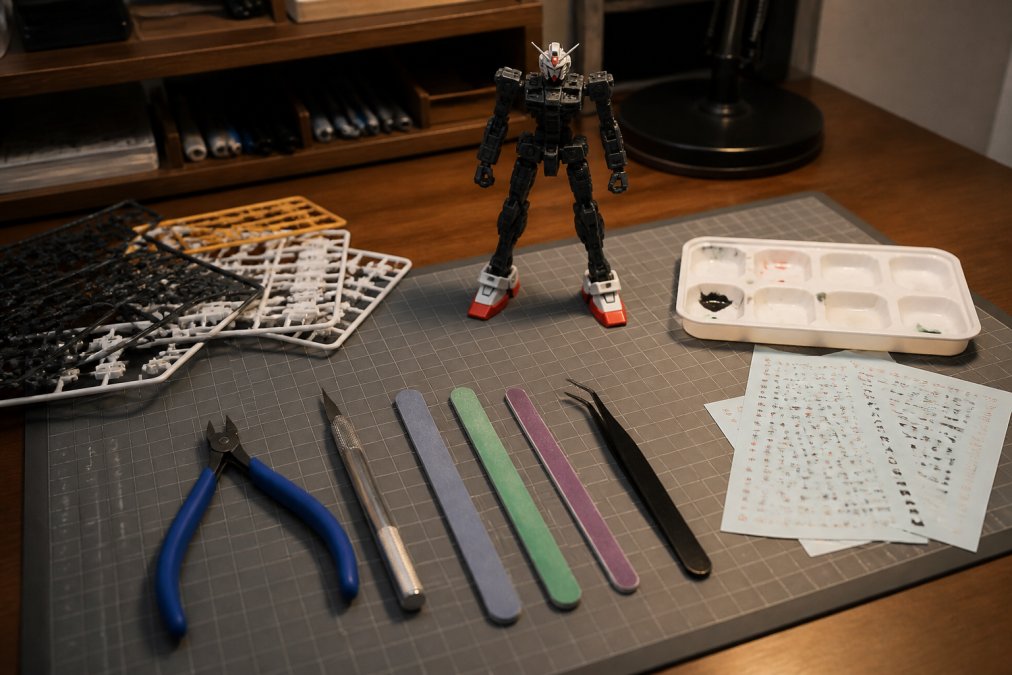
Optional tools expand your capabilities. Panel lining markers (Gundam Marker brand is standard) darken recessed panel lines, adding visual depth. A paint set and brushes enable color separation and detail work. Decal softener and setting solution improve water slide decal adhesion. A hobby glue pen bonds pieces that won't snap-fit securely.
For Real Grade builds, precision tweezers become valuable for small frame parts. A parts organizer keeps runners and polycaps organized. A magnifying lamp illuminates fine detail work.
Master Grade builds benefit from additional tools: masking tape for paint prep, primer, and a spray booth or well-ventilated area for paint application. Start with nippers, knife, and sandpaper, then add panel lining markers and decals as your ambition grows.
Detail, Aesthetics, and Display Presence
Master Grade kits dominate display shelves through sheer presence. A Master Grade Gundam at 1/100 scale commands attention and is large enough to showcase detail work from across a room. The engineering philosophy emphasizes visible mechanical detail: painted inner frames, extensive color separation, and mechanical gimmicks designed to be appreciated.
Panel lining, darkening recessed lines with markers or paint, transforms a freshly-built Master Grade into a dimensional showpiece. The larger scale makes panel lining visible and impactful. The visible inner frame creates depth and mechanical authenticity.
Real Grade kits operate differently. Their aesthetic strength lies in proportions, articulation, and mechanical authenticity rather than surface detail visibility. A Real Grade Gundam looks more accurate to the anime design with tighter proportions and a cleaner silhouette. Real Grade models excel in dynamic displays; superior articulation means you can pose them in action stances that look alive.
Surface detail density differs meaningfully. Master Grade armor pieces feature molded mechanical details and engineering flourishes that catch light. Real Grade armor is cleaner and more minimal; the design philosophy is anime-accurate proportions rather than mechanical detail maximalism. Real Grade builders who want surface detail add it through painting and panel lining.
A Master Grade collection fills shelf space quickly; three Master Grade kits consume as much linear shelf space as six Real Grade models. For collectors with limited display real estate, Real Grade density is an advantage.
Which Grade Should You Choose
Choosing between Master Grade and Real Grade kits depends on five practical factors: available shelf space, building time commitment, painting interest, display philosophy, and current skill level.
Choose Master Grade if: You have dedicated display space and want statement pieces. You enjoy painting and detail work. You prefer longer, meditative build sessions. You want visible mechanical engineering as an aesthetic element. You're comfortable with 20-30 hour time commitments per kit.
Master Grade suits collectors building 2-4 kits per year who treat each one as a significant project and view Gunpla as a creative outlet combining engineering appreciation with artistic expression.
Choose Real Grade if: You have limited shelf space but want engineering depth. You prefer compact, proportionally-accurate models. You want superior articulation and pose-ability. You enjoy precision frame assembly. You prefer 12-18 hour builds that fit weekend schedules. You want to build more frequently without massive time investment.
Real Grade suits hobbyists building 6-12 kits annually who value variety and mechanical innovation.
For beginners: Start with Real Grade if you're committed to precision. Start with High Grade if you want to build something quickly and assess whether Gunpla is your hobby. Avoid Master Grade as your first kit; the assembly length and paint requirements create frustration for builders still discovering their preferences.
For experienced builders: Master Grade offers depth if you haven't explored painting and detail work. Real Grade offers innovation if you want denser frame engineering in a compact form.
Neither grade is objectively superior. They're optimized for different goals. Master Grade wins on display impact and detail work. Real Grade wins on engineering density, articulation, and building frequency. Your choice should reflect which of those values matters most to your hobby.
Choosing your next Gunpla kit is ultimately about understanding what you want from the building experience. If you're ready to commit to either grade, Utopia Toys and Models maintains current inventory of both Master Grade and Real Grade kits from Bandai, with transparent stock status and reliable shipping. Whether you're drawn to the impressive presence of Master Grade or the mechanical innovation of Real Grade, having access to a curated selection from a trusted source eliminates guesswork and gets you building faster. Browse the current lineup at Utopia Toys and Models to find your next project.
| Grade | Scale | Typical Build Time | Best For | Display Impact |
|---|---|---|---|---|
| Master Grade | 1/100 | 20-30 hours | Detail work, painting, display presence | High, large, visible engineering |
| Real Grade | 1/144 | 12-18 hours | Precision, articulation, frequent building | Moderate, proportional accuracy, pose-ability |
Frequently Asked Questions
Is Master Grade better than Real Grade?
Neither is objectively better, it depends on your priorities. Master Grade kits offer larger scale (1/100), complex inner frame engineering, and impressive shelf presence, making them ideal for experienced builders who enjoy intricate assembly. Real Grade kits deliver exceptional detail in a compact 1/144 scale with advanced articulation and mechanical gimmicks, suiting builders who want complexity without the space commitment. Choose based on your display space, build time availability, and experience level.
How long does it take to build a Master Grade kit?
Most Master Grade kits require 15 to 30 hours of assembly time, depending on your experience and attention to detail work like panel lining and decal application. Beginners may take 25 to 40 hours, while experienced builders often complete them in 12 to 20 hours. The larger 1/100 scale and detailed inner frame engineering mean more parts, runners to manage, and assembly steps than smaller grades. Budget extra time if you're customizing, painting, or applying water slide decals.
What are the best Real Grade kits for beginners?
Real Grade kits marketed as 'beginner-friendly' typically feature fewer nubs, simpler polycap placements, and clearer assembly instructions. Look for recent RG releases with improved molding and color separation, which reduce the need for paint and decals. While RG kits are generally more complex than High Grade equivalents, newer designs prioritize accessibility. Start with a Real Grade kit that interests you visually, enthusiasm for the subject matter makes the learning curve easier to navigate.
What tools do I need to build Gunpla models?
Essential tools include hobby nippers for cutting parts from sprues, a hobby knife for removing nubs, and sanding tools (sanding sponges or files) for smoothing surfaces. A cutting mat protects your workspace. For detail work, panel lining markers or pens highlight mechanical details, and decal softener helps water slides conform to curves. Glue is optional for most kits but useful for loose joints. Beginners can start with nippers, a hobby knife, and sanding sponges; advanced builders add airbrushes, paint, and specialized detail tools.
Are Real Grade kits more detailed than Master Grade kits?
Real Grade kits pack exceptional mechanical detail and articulation into a smaller 1/144 scale through advanced inner frame engineering and tight tolerances. Master Grade kits, at 1/100 scale, offer larger surface area for panel lining, decals, and paint applications, plus more visible mechanical complexity. RG detail is denser and more intricate per unit of plastic; MG detail is larger and more immediately visible. Both grades excel at detail, RG rewards close inspection, while MG impresses from across a room.
This article was written using GrandRanker