

Last Updated: October 22, 2026
Quick Summary
Dr. Finkelstein design began as a small, hunched figure with an oversized cranium and laboratory context, then simplified for stop-motion into a smooth round head, hinged skullcap, strong nose, and graphic mouth. The wheelchair and exposed brain make his silhouette instantly readable.
- Tim Burton wrote the story and original poem while working as a Disney animator in the early 1980s.
- Henry Selick directed the 1993 feature after years of development.
- Stop-motion puppets use jointed metal armatures and replacement face plates for expression.
- The hinged skullcap stays mechanically simple: a hinge and a cap, no complex linkage.
- The wheelchair limits movement, simplifying animation and anchoring the puppet to a fixed base.
Table of Contents
- The Enduring Look of Dr. Finkelstein Design
- Dr. Finkelstein Character Inspiration: The Mad Scientist Tradition
- Early Concept Art and the Design Timeline
- How Nightmare Before Christmas Character Designs Shaped Finkelstein
- Visual Symbolism in Dr. Finkelstein's Design
- Dr. Finkelstein Drawing Tutorial: Capturing the Silhouette
- Later Appearances and Design Consistency
- Conclusion: Why Dr. Finkelstein Design Still Resonates
- Frequently Asked Questions
The Enduring Look of Dr. Finkelstein Design
The history of Dr. Finkelstein character design begins with a single, stubborn silhouette: a round head, a hinged skullcap, and a wheelchair. That outline is instantly recognizable to anyone who has watched The Nightmare Before Christmas since its 1993 release.
Dr. Finkelstein is the wheelchair-bound mad scientist of Halloween Town, the creator of Sally, and the resident who builds and reanimates the town's creations. His design compresses an entire personality into a few shapes: exposed brain, long nose, large glasses, pale complexion, and a duckbill-like mouth.
Dr. Finkelstein Character Inspiration: The Mad Scientist Tradition
Dr. Finkelstein's character inspiration draws directly from the long mad scientist tradition in literature and film, filtered through Tim Burton's personal visual tastes. He is not a parody of that tradition so much as a loving distillation of it.
Literary and Film Precedents
The mad scientist archetype stretches back through Frankenstein and the laboratory-obsessed inventors of early cinema. Finkelstein inherits the lab coat, the obsessive creation of life, and the physical frailty that marks so many of these figures. His name itself nods to the classic horror lineage, echoing the genre's habit of giving its scientists European-sounding surnames.
What sets him apart is tone. Where most mad scientists are threatening, Finkelstein is fussy, proud, and faintly ridiculous. That shift from menace to comedy is the film's signature move.
Tim Burton's Personal Influences
Tim Burton's design sensibility favors exaggerated proportions, gothic whimsy, and characters whose bodies express their psychology. Finkelstein fits that mold precisely. His oversized head and tiny, wheelchair-bound frame communicate a mind too large for its body. Burton's early art and illustration work established this vocabulary long before the 1993 film, and Finkelstein is one of its purest expressions.
Early Concept Art and the Design Timeline
Most profiles of Dr. Finkelstein show a piece of early art and move on. The documented design history is more useful, and it is also the part competitors skip: how the character traveled from pencil sketch to foam-and-steel puppet, and which features survived that trip.
The public record of the film's development is well established even where individual drawings are not. Tim Burton wrote the story and the original poem while working as an animator at Disney in the early 1980s, and the project spent years in development before Henry Selick directed the 1993 feature.
What the Early Art Establishes
Across the surviving concept material, the through-line is a small, hunched figure with an oversized cranium and a laboratory context. The features that recur, the domed head, the surgical cap, the spectacles, the lab coat, are the ones that made it to the screen. The features that vary are the ones a draftsman can change cheaply: the amount of facial detail, the proportion of the nose, the exact shape of the mouth. Artists iterate freely on surface detail while the load-bearing shapes are settled early, because those shapes are the ones the model shop will have to engineer.
From Drawing to Puppet: What Changed and Why
The most instructive part of the timeline is the translation step. A pencil drawing can suggest texture, translucency, and fine line work that a stop-motion puppet cannot easily reproduce at the scale the film required. When a design moves from concept art to a physical build, three things typically get simplified: surface ornament, thin protrusions, and anything that would need to flex repeatedly without tearing.
That is the central lesson of the character's art history: clarity won over complexity, and it won for practical reasons, not just aesthetic ones.
Why Provenance Matters
Much of the Finkelstein art circulating online is reposted without a source, a date, or an attribution, which makes it hard to tell a first-pass sketch from a later promotional drawing. Treat unattributed images as illustrative rather than documentary. The reliable anchors for the timeline are the film's own production history and the published art-of and making-of material, which identify the artists and the stage of production each piece belongs to.
How Nightmare Before Christmas Character Designs Shaped Finkelstein
Nightmare Before Christmas character designs were governed by the physical reality of stop-motion, and Finkelstein's final look reflects those constraints at every point. Every character in the film had to function as a real, hand-built puppet that animators could pose frame by frame, often for weeks of shooting on a single sequence. Finkelstein's design is a case study in that discipline, and the mechanics are where most profiles stop short.
The Stop-Motion Construction Challenge
A stop-motion puppet is built around an armature, a jointed metal skeleton, typically machined from steel or brass, that holds a pose without drifting between frames. Around that armature sits the body, usually foam or a silicone skin over padding, and on top sits a head engineered for expression.
Finkelstein's design is unusually friendly to that workflow. His round head and simple facial features made him practical to build and animate, and his expression range is narrow by design, he is fussy and peevish rather than broadly emotional, so a small library of face plates covers his scenes.
The Wheelchair as a Design Constraint and Choice
The wheelchair serves double duty. As a design constraint, it limits how the puppet moves, which simplifies animation and keeps his scenes controlled. A seated character is far easier to animate than a walking one: no weight shifts, no footfalls, no balance problems frame to frame.
As a choice, it defines him. Finkelstein is stationary, cerebral, and dependent on others, which fuels his relationship with Sally, he created her, and she is the one who moves through the world while he stays in his chair. The chair is not decoration.
What the Constraints Bought the Design
The production limits did not weaken Finkelstein; they sharpened him. A character who cannot walk, cannot change expression freely, and has a head built around a single moving hinge has to communicate through shape and staging. That is why his design is so legible: the round head, the open cap, the glasses, and the chair each carry a piece of the character, so the animator never has to fight the puppet to get a performance across. The constraint became the style.
Visual Symbolism in Dr. Finkelstein's Design
Visual symbolism runs through every part of Finkelstein's appearance. The exposed brain signals intellect and obsession. The large glasses and long nose exaggerate his scholarly, inquisitive nature. The pale complexion and duckbill-like mouth push him toward the uncanny, marking him as a creature of Halloween Town rather than the human world.
His round head and hinged skullcap create a visual pun: he is a thinker whose thoughts are literally on display. The design tells you he is brilliant and absurd at the same time, which is exactly the balance the film strikes with him.
Dr. Finkelstein Drawing Tutorial: Capturing the Silhouette
This Dr. Finkelstein drawing tutorial focuses on the one thing that makes the character recognizable: the silhouette. Follow these steps to capture the round head, hinged skullcap, and wheelchair-bound pose.
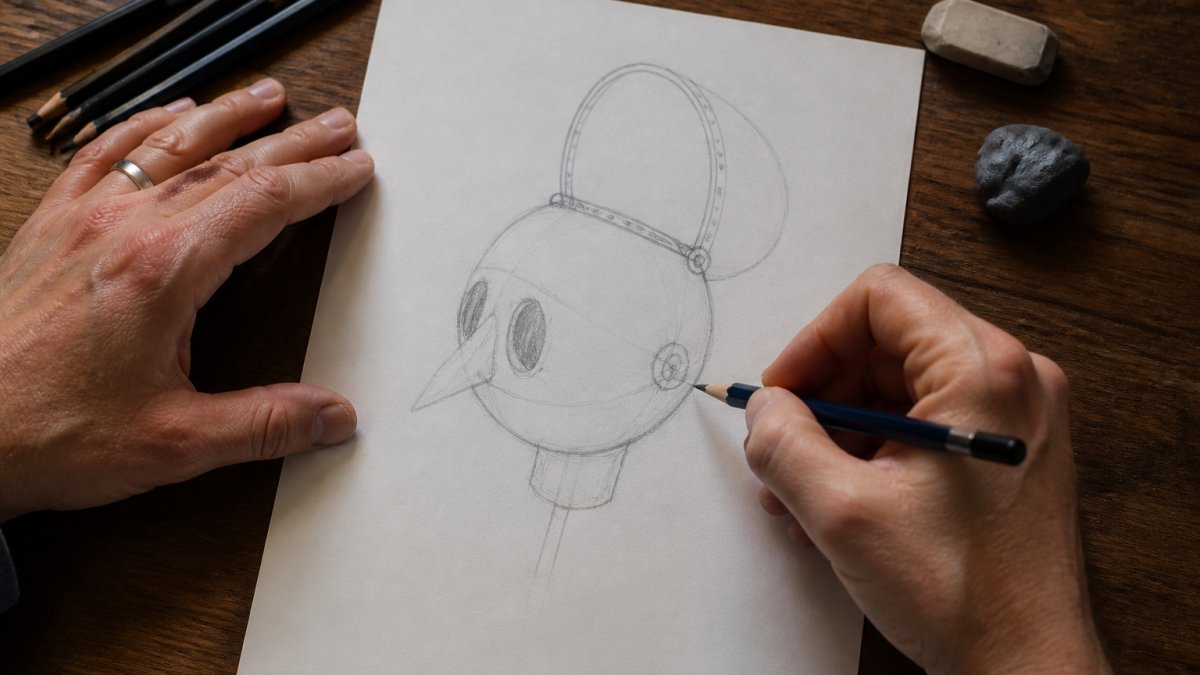
- Block the wheelchair first. Draw a simple seat and two large wheels. This anchors the pose before you add detail.
- Place the torso. Add a small, hunched body above the seat. Keep it compact; the head will dominate.
- Draw the round head. Sketch a large circle, then add the long nose and large glasses.
- Add the hinged skullcap. Draw the cap open at the top, with the exposed brain visible beneath.
- Refine the face. Add the duckbill-like mouth and pale, sunken cheeks.
- Ink the silhouette. Trace the outer outline to confirm the shape reads clearly, then erase construction lines.
Expected result: A figure that is identifiable from its outline alone, before any shading.
Later Appearances and Design Consistency
Later appearances have kept Finkelstein's design remarkably consistent. Related media, including video game crossovers such as the Kingdom Hearts series, preserve the round head, skullcap, glasses, and wheelchair. That consistency is a testament to how well the original design works. When a character can be translated from a stop-motion puppet into game models and character artwork without losing identity, the design was built right the first time.
Conclusion: Why Dr. Finkelstein Design Still Resonates
Dr. Finkelstein design still resonates because it solves a hard problem: making a character instantly readable while keeping him strange. The round head, the hinged skullcap, the exposed brain, and the wheelchair combine into a silhouette no other character shares. Collectors respond to that clarity, and it is why figures built around this design remain sought after.
If you are building a collection around The Nightmare Before Christmas or other character-driven lines, Utopia Toys and Models stocks collectible figures and model kits from brands like Bandai, Funko, and Kotobukiya.
Frequently Asked Questions
Who is Dr. Finkelstein based on?
Dr. Finkelstein draws from the classic mad scientist tradition, with roots in Mary Shelley's Victor Frankenstein and the many film adaptations of her story. Tim Burton and his design team layered in elements from B-movie horror scientists and German Expressionist cinema. The character's round head, exposed brain, and hinged skullcap echo earlier depictions of eccentric inventors, but the specific combination of these features made him distinct to Halloween Town. His wheelchair-bound status and pale complexion set him apart from typical monster-movie scientists.
How was Dr. Finkelstein designed for The Nightmare Before Christmas?
The Dr. Finkelstein design went through multiple concept iterations before the final stop-motion puppet was built. Early sketches explored different head shapes and body proportions. The production team settled on a round head with a hinged skullcap that could open to reveal the brain, large round glasses, a long nose, and a duckbill-like mouth. The wheelchair was integrated into the puppet's construction from the start. The final design balanced visual impact with the practical demands of stop-motion animation, where every movement had to be manually posed frame by frame.
Why does Dr. Finkelstein use a wheelchair?
Dr. Finkelstein's wheelchair serves both narrative and design purposes. In the story, it emphasizes his age and physical limitation, making his mental sharpness and creative drive more striking. From a design standpoint, the wheelchair creates a distinctive silhouette and limits his mobility, which adds tension to scenes where Sally must navigate around him. The chair also reinforces his role as a stationary, obsessive creator who stays in his laboratory while others move through Halloween Town. It is a deliberate character choice rather than an incidental detail.
What do Dr. Finkelstein's stitches and exposed brain represent?
The stitches and exposed brain in Dr. Finkelstein design signal his status as both a creator and a creation. The stitches suggest a body that has been assembled or repaired, blurring the line between scientist and monster. The exposed brain, visible through the hinged skullcap, represents intellect laid bare and the mad scientist's obsession with the mind as a machine. These visual cues connect him to the Frankenstein tradition while giving him a unique identity within The Nightmare Before Christmas character designs. They also make him instantly recognizable in silhouette.
