

Table of Contents
- Why Gunpla Kits Are So Expensive: The Core Factors
- Understanding Gunpla Price Factors Across Grades
- Cost of Gunpla Grades: High Grade vs. Master Grade vs. Perfect Grade
- Importing Gunpla from Japan: Regional Pricing and Tariffs
- P-Bandai Exclusive Kits and Secondary Market Pricing
- The Hidden Costs of Building Gunpla: Tools, Supplies, and Assembly
- Retail Markup, Counterfeit Concerns, and Authentication
- Resin Kits vs. Injection-Molded Plastic: Price and Quality Comparison
Last Updated: July 25, 2026
Why are gunpla kits so expensive? The answer lies in manufacturing precision, design investment, import costs, and market dynamics. At Utopia Toys and Models, we've tracked pricing trends across Bandai's entire Gundam lineup and can help you understand exactly where your money goes when you purchase a High Grade, Master Grade, or Perfect Grade kit.
Why Gunpla Kits Are So Expensive: The Core Factors
Manufacturing gunpla kits involves far more complexity than most people realize. Bandai uses injection molding, a process requiring precision engineering to achieve tight tolerances for clean assembly without glue. A single mold can cost tens of thousands of dollars to design and produce, and a new Master Grade kit requires dozens of individual molds for different plastic colors and components.
The resin used in gunpla injection molding must meet strict quality standards. Bandai sources high-grade ABS and polystyrene that holds detail while remaining flexible enough to avoid stress marks during assembly. This material selection directly impacts production costs.
Bandai's design and R&D investment represents another massive cost driver. Creating a new gunpla kit requires extensive CAD modeling, prototyping, and testing. For a Master Grade kit, this process can take 12-18 months from concept to retail shelf. Bandai employs hundreds of designers, engineers, and quality-control specialists whose salaries are distributed across their product line.
The licensing fees Bandai pays to create Gundam-branded products also factor into pricing. Sunrise (now owned by Bandai Namco Entertainment) controls the Gundam intellectual property, and Bandai must pay for the rights to produce these models.
Understanding Gunpla Price Factors Across Grades
Gunpla kits exist in several distinct tiers, each with different price points and complexity levels. High Grade kits typically cost less because they use simpler molds, require fewer plastic colors, and demand less assembly time. Master Grade kits cost significantly more due to increased part count and engineering complexity.
Perfect Grade kits represent the absolute top of Bandai's gunpla lineup. These models feature motorized components, LED lighting systems, and engineering that rivals some action figures in complexity. Manufacturing costs for Perfect Grade kits are substantially higher because each unit includes more sophisticated internal mechanisms and higher-quality materials.
Real Grade kits occupy an interesting middle ground. Despite their smaller size compared to Master Grade, Real Grade models often cost nearly as much because they pack incredible engineering density into a compact frame. The molds for Real Grade kits require even tighter tolerances than larger kits, increasing manufacturing complexity and cost.
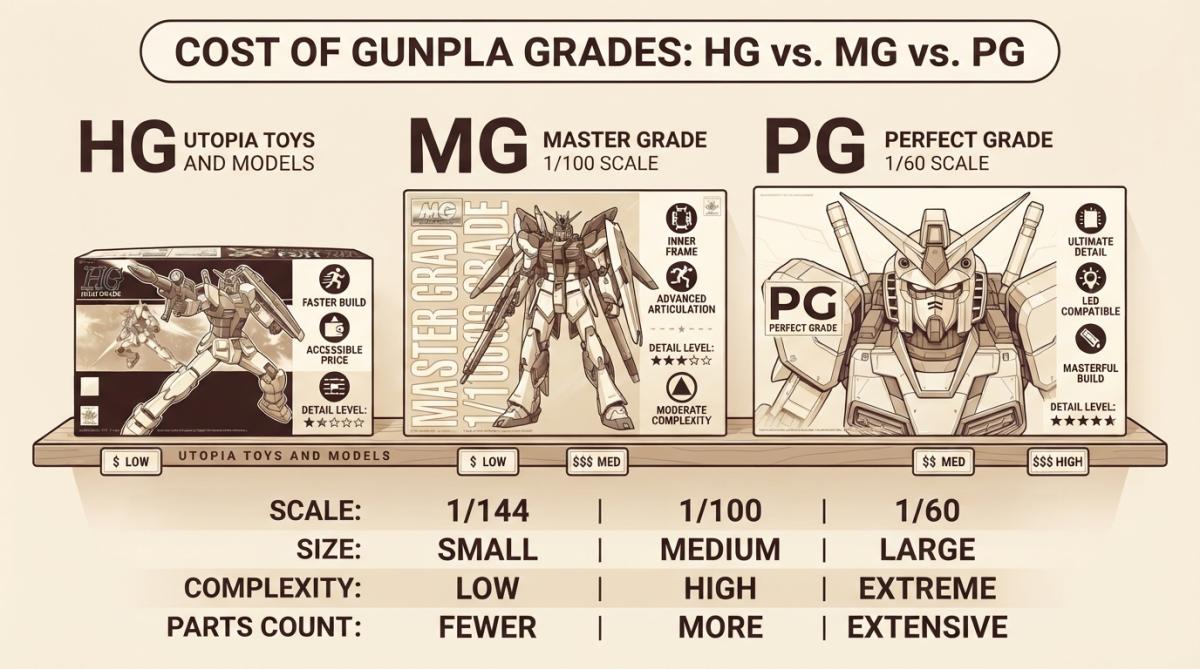
A Master Grade Gundam RX-78-2 costs substantially more than a High Grade version of the same suit because the Master Grade includes internal frame structures, articulated joints, and dramatically increased part count. The High Grade might have 100-150 pieces, while the Master Grade could contain 400-600 pieces. Each additional piece requires its own mold and quality control.
Perfect Grade kits include motorized walking mechanisms, LED light-up eyes, and engineering that requires mechanical engineers rather than just plastic designers. The manufacturing cost per unit is higher, and retail markup reflects this reality.
Importing Gunpla from Japan: Regional Pricing and Tariffs
Gunpla kits cost significantly less in Japan than in the United States because Bandai manufactures most kits there, minimizing transportation costs. When kits are imported to the United States, multiple layers of cost get added.
Import tariffs and customs duties represent a real expense that retailers must absorb or pass to consumers. Toys and models imported into the United States face tariff rates that can reach 20-30% depending on classification and country of origin. A kit costing $50 wholesale in Japan might incur $10-15 in tariff costs alone before reaching a U.S. retailer.
Currency conversion creates another pricing layer. When the U.S. dollar weakens against the Japanese yen, importing becomes more expensive for retailers. Conversely, when the dollar strengthens, prices might decrease, but retailers are often slow to pass savings to consumers.
Shipping costs from Japan to the United States add another 5-15% to the landed cost of imported gunpla kits. Retailers must account for ocean freight, customs brokerage, insurance, and warehousing.
P-Bandai Exclusive Kits and Secondary Market Pricing
P-Bandai (Premium Bandai) exclusive kits are sold exclusively through Bandai's official online store in limited quantities. When a P-Bandai exclusive sells out, the only way to acquire one is through the secondary market, where prices skyrocket.
A P-Bandai exclusive that retailed for a standard price might sell for 2-3 times that amount on secondary markets like eBay, Mercari, or specialty gunpla retailers. This occurs because dedicated collectors will pay premium prices to complete their collections. Bandai understands this dynamic and uses P-Bandai exclusivity to drive engagement and create artificial scarcity.
Limited production runs amplify secondary market pricing. If Bandai manufactures only 5,000 units of a specific P-Bandai exclusive, and 50,000 collectors want one, prices rise dramatically. Resellers purchase multiple units at retail, then list them at inflated prices once the initial allocation sells out.
| Kit Type | Typical Retail | Secondary Market (avg) | Price Multiplier |
|---|---|---|---|
| Standard High Grade | $15-25 | $20-35 | 1.2-1.8x |
| Standard Master Grade | $30-50 | $40-70 | 1.3-1.9x |
| P-Bandai Exclusive | $40-60 | $80-150 | 2-3x |
| Rare P-Bandai (2+ years old) | Original: $40-60 | $200-500+ | 4-8x+ |
The Hidden Costs of Building Gunpla: Tools, Supplies, and Assembly
Many newcomers underestimate the true cost of the hobby. The kit itself is only the beginning. Building a gunpla model properly requires tools and supplies that can easily double or triple your total investment.
Hobby nippers are essential for cleanly removing parts from plastic runners. Quality nippers from brands like Godhand or Tamiya produce clean cuts that require minimal cleanup. A good pair costs between $15-40 and represents an investment that pays off across dozens of builds.
Panel lining involves using fine markers or paint to highlight recessed panel lines, adding depth and detail that makes the finished kit look far more impressive. Quality panel lining markers cost more than basic markers and require steady hands and patience.
Decals add authentic markings and insignia to your finished model. Bandai includes water-slide decals with most kits, but applying them correctly requires decal setter solution, which softens decals and helps them conform to curved surfaces.
Sanding supplies, primer, and paint represent additional costs if you want to customize your gunpla or achieve a painted finish. A basic painting setup can easily cost more than the kit itself.
Assembly time also represents a hidden cost. A Master Grade kit typically requires 10-20 hours of assembly time. High Grade kits typically require 3-6 hours, making them better for casual builders.
Retail Markup, Counterfeit Concerns, and Authentication
Retail markups on gunpla kits typically range from 30-50% above wholesale cost. Online retailers like Utopia Toys and Models can often offer lower markups because they operate with lower overhead than brick-and-mortar shops.
Counterfeit gunpla kits represent an enormous problem in the hobby. Fake kits use inferior plastic that's brittle and prone to breaking, employ poor quality control, and often feature inaccurate details. Counterfeiters typically source these fake kits from manufacturers in Southeast Asia, where labor and material costs are minimal.
Identifying authentic versus counterfeit kits requires attention to detail. Authentic Bandai kits feature crisp, clean printing on the box with vibrant colors and sharp text. Counterfeit boxes often have blurry printing, spelling errors, or inconsistent color reproduction. The plastic itself feels different; authentic Bandai plastic has a specific texture and weight that counterfeits don't replicate.
According to Bandai's official product authentication guide, you can verify authenticity by checking the holographic security label on genuine kits and confirming that all text is printed clearly without smudging. The plastic runners should be smooth with no rough edges, and all parts should fit together precisely.
Counterfeit kits often cost 20-40% less than authentic versions, but the money saved is quickly lost when parts break during assembly or the finished model looks obviously inferior. Purchasing from authorized retailers eliminates this risk entirely.
Resin Kits vs. Injection-Molded Plastic: Price and Quality Comparison
Beyond Bandai's official gunpla lineup, the hobby includes resin kits produced by third-party manufacturers like Good Smile Company, Max Factory, and various independent makers. Resin kits cost substantially more than injection-molded plastic kits because they're produced in much smaller quantities and require entirely different manufacturing processes.
Resin casting involves pouring liquid resin into molds and allowing it to cure. This process produces fewer parts per production run compared to injection molding, which can produce thousands of parts per hour. A resin kit selling for $100-200 would be economically impossible to produce via injection molding at that price point.
Resin kits also require more builder skill. Parts often need significant cleanup, sanding, filling, and finishing before assembly can begin. Injection-molded plastic parts come ready to assemble; resin parts demand additional preparation work.
The quality of resin kits varies dramatically based on the manufacturer. High-end resin kit makers produce parts with exquisite detail and accurate proportions, but even premium resin kits require more post-purchase work than Bandai gunpla models.
| Kit Type | Typical Price | Assembly Time | Skill Required | Part Count |
|---|---|---|---|---|
| High Grade Plastic | $15-25 | 3-6 hours | Beginner | 100-150 |
| Master Grade Plastic | $40-60 | 10-20 hours | Intermediate | 400-600 |
| Perfect Grade Plastic | $100-150 | 15-30 hours | Advanced | 600-800 |
| Entry Resin Kit | $60-100 | 15-25 hours | Intermediate | 150-250 |
| Premium Resin Kit | $150-300+ | 20-40 hours | Advanced | 200-400 |
Bandai's injection-molded plastic kits represent the best value for most builders. The combination of reasonable pricing, high quality, minimal assembly difficulty, and exceptional detail makes gunpla the dominant choice in the hobby.
The pricing structure of gunpla kits reflects genuine manufacturing complexity, design investment, and material quality. Understanding these factors helps you make informed purchasing decisions and appreciate why your favorite kits cost what they do.
Finding the right gunpla kit at a fair price requires knowing where to look and understanding what factors drive costs. Utopia Toys and Models offers a curated selection of authentic Bandai kits with transparent pricing and reliable shipping, eliminating the guesswork and counterfeit risk that plague other retailers. With in-stock availability on most popular releases and clear information about upcoming pre-orders, you can build your collection with confidence and focus your budget on the models you actually want rather than overpaying on secondary markets.
Frequently Asked Questions
What factors contribute most to why Gunpla kits are so expensive?
Gunpla kits are expensive due to several interconnected factors. Bandai invests heavily in design, engineering, and mold production, precision injection molding requires significant upfront costs. High-tolerance engineering ensures parts fit perfectly without glue. Manufacturing quality, plastic material sourcing, and production volume all affect pricing. Additionally, import taxes, shipping costs, and retail markup add to the final price in the United States. Limited production runs and market demand further influence cost.
How much more expensive are Master Grade and Perfect Grade kits compared to High Grade?
The cost of Gunpla grades varies significantly. Master Grade kits typically include more detailed parts, better articulation, and superior engineering, making them substantially more expensive than High Grade versions of the same mobile suit. Perfect Grade kits represent the premium tier with exceptional detail, internal frame systems, and complex assembly, these command the highest prices. Real Grade kits offer a middle ground with modern engineering at moderate cost. Price differences reflect engineering investment, mold complexity, and plastic quality rather than just size.
Why does importing Gunpla from Japan affect U.S. pricing so much?
Importing Gunpla from Japan involves multiple cost layers. Currency conversion affects the base price, and U.S. import tariffs add a percentage to the total cost. Shipping and logistics from Japan to the United States are significant expenses. Retailers must account for these costs plus their own markup. Additionally, regional purchasing power differs, kits may be cheaper in Japan due to higher local demand and production volume. P-Bandai exclusive kits sold only in Japan often command premium prices on the secondary market when imported to the U.S.
Are P-Bandai exclusive kits worth the premium price on the secondary market?
P-Bandai exclusive kits are limited-production releases sold primarily in Japan through Premium Bandai. Their secondary market pricing reflects scarcity and collector hyperfixation, demand often exceeds supply, driving prices well above MSRP. Whether they're worth the premium depends on your collecting goals. Authentic P-Bandai kits from reputable retailers like Utopia Toys and Models offer assurance against counterfeits. Be cautious of counterfeit versions flooding the secondary market. If a kit is critical to your collection and unlikely to be reprinted, the premium may be justified; otherwise, standard retail releases offer better value.
This article was written using GrandRanker