

Table of Contents
- Why Managing Toy Collection Inventory Matters
- Setting Up a Toy Collection Inventory Spreadsheet
- How to Catalog Action Figures and Collectible Toys
- Using a Collectible Inventory App for Digital Management
- Tracking Collectible Spending and Collection Value
- Condition Grading and Provenance Documentation
- Storage, Preservation, and Maintenance Routines
- Maintaining Your Inventory System Over Time
- Frequently Asked Questions
Last Updated: October 16, 2026
Why Managing Toy Collection Inventory Matters
A toy collection without proper inventory management is like owning a library with no catalog. You know you have items, but finding what you need takes forever.
Managing inventory for private toy collections solves these problems. It transforms a scattered pile of figures, models, and blind boxes into an organized, trackable asset.
This matters whether you're a casual collector with 50 figures or a serious hobbyist with thousands. Without a system, your collection becomes invisible to you. You can't enjoy it fully.
The real value of managing inventory for private toy collections goes beyond organization.
Setting Up a Toy Collection Inventory Spreadsheet
A spreadsheet is the fastest way to get started with managing inventory for private toy collections. You don't need fancy software. A simple Google Sheet or Excel file works perfectly.
The key is capturing the right information and organizing it so you can find things fast.
Essential data fields to track
Your spreadsheet needs these core columns:
- Item Name, The exact name of the figure, model, or set
- Brand, Bandai, Funko, Kotobukiya, or other manufacturer
- Type, Action figure, model kit, blind box, doll, statue, etc.
- Series/Franchise, Gundam, Dragon Ball, Attack on Titan, etc.
- Location Code, Where it's stored (Shelf A1, Bin 3, etc.)
- Purchase Date, When you bought it
- Purchase Price, What you paid
- Current Estimated Value, What it's worth now
- Condition, Mint in box, loose but complete, damaged, etc.
- Notes, Special details (missing parts, variants, rarity)
Don't overcomplicate this. Start with these fields. Add more later if needed.
Organizing your spreadsheet for easy retrieval
Structure your spreadsheet so you can actually find things. Use these tactics:
- Sort by location first, Group all items by storage bin or shelf. This lets you grab everything in one place without hunting.
- Add filter buttons, Use spreadsheet filters to search by brand, type, or series instantly.
- Color-code by type, Highlight action figures one color, model kits another, blind boxes a third. Scanning is faster than reading.
- Keep one row per item, Never combine multiple figures in one row. Each item gets its own line.
- Update regularly, Add new purchases within a week. Stale data is useless data.
How to Catalog Action Figures and Collectible Toys
Cataloging is where most collectors get stuck. They start strong, then the process feels tedious and they quit. The trick is making it fast and systematic.
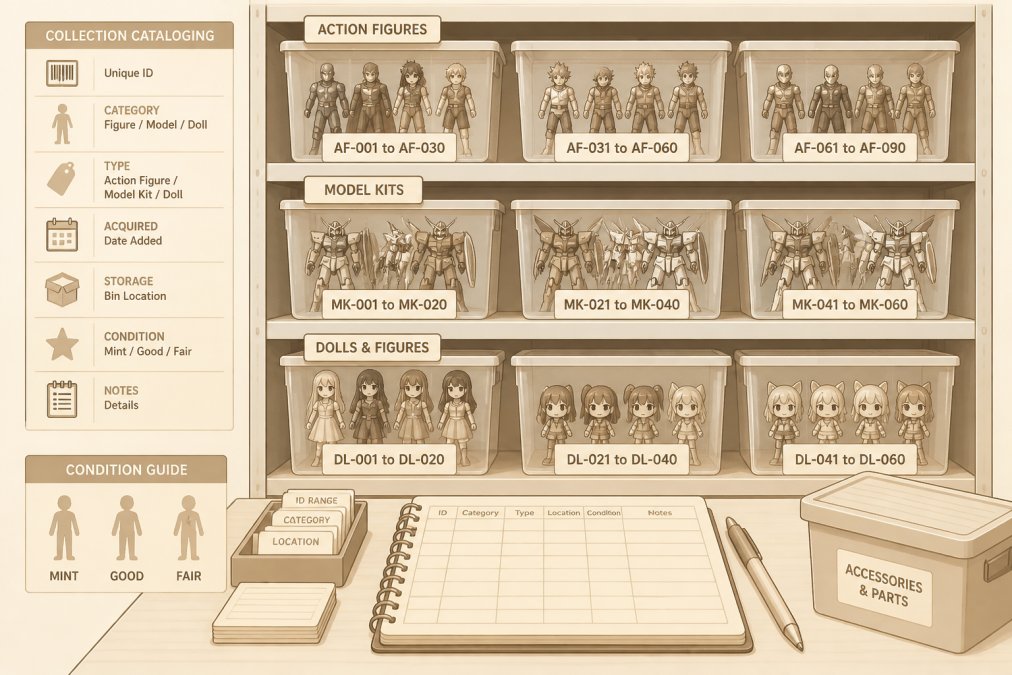
Sorting toys by type, brand, and franchise
Before you enter anything into a spreadsheet, sort your physical collection. This takes time but makes data entry way faster.
Separate items into piles:
- By type first, All action figures together, all model kits together, all blind boxes together, all statues together. This is your biggest grouping.
- By brand second, Within action figures, separate Bandai figures from Funko figures from Kotobukiya figures.
- By franchise third, Within Bandai figures, group all Gundam items, all Dragon Ball items, all other series together.
This sorting phase feels slow. But now when you sit down to catalog, you're not jumping around your collection. You're working through one organized pile at a time. Your data entry will be 3x faster.
Assigning location codes and storage bins
Location codes are how you find things. Without them, your spreadsheet is just a pretty list.
Create a simple location system:
- Label your shelves, Shelf A, Shelf B, Shelf C, or whatever makes sense for your space.
- Divide shelves into zones, Shelf A top, Shelf A middle, Shelf A bottom. Or Shelf A left, Shelf A center, Shelf A right.
- Number your storage bins, Bin 1, Bin 2, Bin 3. If you use clear bins, put a number label on the outside.
- Record the location in your spreadsheet, "Shelf A top left" or "Bin 3" tells you exactly where to find the item.
When you want to locate an action figure or rare model kit, you open your spreadsheet, search for it, and the location code tells you where it is. No guessing. No hunting through ten bins.
Using a Collectible Inventory App for Digital Management
Spreadsheets work, but apps designed for collectible inventory can save you time. Many apps let you photograph items, add details, and search your collection from your phone.
Some collectors prefer apps because:
- Mobile entry, Photograph a figure and add it to your inventory while you're at a shop or receiving a package.
- Barcode scanning, Some apps read product barcodes and auto-fill details.
- Cloud backup, Your data syncs across devices. You're never working offline.
- Search speed, Finding an item is instant, even with thousands of entries.
Apps aren't mandatory. A spreadsheet handles managing inventory for private toy collections perfectly well. But if you're a serious collector with hundreds or thousands of items, an app cuts data entry time in half.
The trade-off is learning a new tool and possibly paying a subscription. Evaluate whether that's worth it for your collection size.
Tracking Collectible Spending and Collection Value
Most collectors have no idea how much they actually spend on their hobby. They buy a figure here, a model kit there, blind boxes in batches. Over a year, the number shocks them.
Tracking spending isn't about guilt. It's about understanding your behavior and making smarter choices.
Recording purchase price and current market value
Your spreadsheet needs two price columns:
- Purchase Price, What you paid. Include shipping if you paid for it.
- Current Market Value, What it would sell for today on the secondary market.
The gap between these two numbers tells you a lot. If you paid $40 for a figure and it's worth $120 now, you made a smart purchase. If you paid $50 and it's worth $20, you overpaid or the market shifted.
Track this over time. After 12 months, you'll see patterns. Certain brands hold value. Certain series drop quickly. This teaches you what to buy and what to avoid.
Insurance documentation and data backup
Your collection has real value. Protect it.
Create a backup of your inventory spreadsheet:
- Cloud storage, Upload to Google Drive, Dropbox, or OneDrive. If your computer crashes, your data is safe.
- Annual export, Save a PDF or Excel copy to an external hard drive once a year.
- Photo documentation, Take photos of high-value items. Store them with your inventory file.
For insurance purposes, you need documentation. Your spreadsheet with purchase prices and photos is exactly what insurance companies want. If something is damaged or stolen, you have proof of ownership and value.
Condition Grading and Provenance Documentation
Condition determines value. A mint-in-box figure is worth 5x more than the same loose figure. Documenting condition protects your collection's value.
Use a simple grading scale:
- Mint in Box (MIB), Never opened, perfect condition, original packaging intact.
- Mint Loose, Opened but never displayed or played with. No damage.
- Near Mint, Displayed, minimal handling, no visible damage.
- Excellent, Light wear, no major damage, all parts present.
- Good, Visible wear, minor damage, all parts present.
- Fair, Significant wear, some damage, all parts present.
- Poor, Heavy damage, missing parts, or structural issues.
Record the condition in your inventory spreadsheet. When you photograph an item, take photos showing any damage or wear. These photos are your proof if you ever sell or need to claim insurance.
Provenance matters too. If you bought a figure directly from a shop, note that. If you got it secondhand, record where you bought it and from whom. This documentation adds credibility if you ever sell a rare or valuable piece.
Storage, Preservation, and Maintenance Routines
Your inventory system only works if your collection survives. Storage conditions matter.
Store your collectible toys properly:
- Keep them dry, Humidity damages figures, corrodes metal parts, and warps packaging. Use storage bins in a climate-controlled space.
- Avoid direct sunlight, Sunlight fades paint and discolors plastic. Store away from windows.
- Use clear bins, You can see what's inside without opening them. Label the outside with your location code.
- Organize by fragility, Heavy model kits on lower shelves, delicate figures on upper shelves where they won't get crushed.
- Separate accessories, Keep small parts, extra hands, and accessories in small labeled containers inside or near the main item.
Check your collection quarterly. Look for signs of damage, moisture, or pest activity. If you find issues, address them immediately. A small problem caught early prevents total loss.
Update your inventory spreadsheet when you move items or change storage locations. Stale location data defeats the system.
Maintaining Your Inventory System Over Time
A system only works if you maintain it. Most collectors set up an inventory, use it for a month, then abandon it. Don't be that person.
Build maintenance into your routine:
- Add new purchases within one week, Don't let items pile up uncatalogued. The longer you wait, the more likely you'll forget details.
- Review your spreadsheet monthly, Spend 15 minutes scanning for errors or missing data.
- Update location codes when you reorganize, Moving items? Update the spreadsheet at the same time.
- Photograph new items, Take a photo when you add it to your collection. Store photos with your spreadsheet.
- Back up your data quarterly, Export your spreadsheet and save it to cloud storage.
The system doesn't need to be perfect. It needs to be consistent. Ten minutes a week beats a perfect system you abandon.
Many serious collectors find that managing inventory for private toy collections becomes part of their hobby. They enjoy cataloging, tracking value, and reviewing their collection. Others see it as a necessary chore.
| Task | Frequency | Time Required |
|---|---|---|
| Add new purchases to spreadsheet | Weekly | 10-15 minutes |
| Review and check for errors | Monthly | 15 minutes |
| Update location codes after reorganizing | As needed | 5-10 minutes |
| Back up data to cloud storage | Quarterly | 5 minutes |
| Full inventory review and photo update | Annually | 1-2 hours |
Managing inventory for private toy collections protects your investment and actually lets you enjoy what you own. It's knowing what you have, where it is, and what it's worth. Learn more about collectible toy preservation from the American Institute for Conservation.
Frequently Asked Questions
What information should you record in a toy collection inventory?
Track the toy name, brand, franchise, purchase date, purchase price, current estimated value, condition grade, storage location, and any unique notes about accessories or variants. For action figures and model kits, include scale or series number. Add photos of the item and packaging. This data supports insurance claims, helps you find items quickly, and documents your collection's growth over time.
What's the easiest way to track collectible toys?
Start with a toy collection inventory spreadsheet using simple columns for item name, location, and value. As your collection grows, move to a collectible inventory app that syncs across devices and lets you search by brand, type, or storage bin. Apps also make photo documentation faster. The key is choosing a system you'll actually maintain, consistency matters more than complexity.
How often should you update a toy collection inventory?
Update your inventory immediately after acquiring new figures, dolls, or model kits so you don't forget details. Review and refresh estimated values quarterly or when market prices shift significantly. Conduct a full physical audit annually to catch any missing items, verify storage locations, and photograph condition changes. Regular maintenance prevents inventory drift and keeps insurance documentation current.
How do you estimate the value of a toy collection?
Record the original purchase price for each item. For current value, check recent sold listings on collector marketplaces and auction sites for the same figures or model kits in similar condition. Factor in rarity, condition grade, and whether the item includes original packaging. Update estimates annually. For insurance purposes, consider having a professional appraisal done if your collection exceeds $5,000 in total value.
