

Quick Summary
Keep relative humidity between 40% and 50% with temperatures around 65°F to 75°F, since stable conditions protect plastic figures better than chasing an exact number. Monitor the air with a calibrated hygrometer, and use a dehumidifier or desiccants when levels climb. Humidity for anime figures matters most when it stays consistent.
- Target a relative humidity between 40% and 50% for most display spaces.
- Keep temperatures roughly 65°F to 75°F (18°C to 24°C) to keep plastic stable.
- Place a digital hygrometer at figure height, away from walls, sunlight and lamps.
- Calibrate the hygrometer with the salt test, expecting a reading close to 75%.
- Run a dehumidifier with a built-in humidistat, mainly during warm, wet months.
Table of Contents
- Why Humidity Matters for Plastic Anime Figures
- Know Your Ideal Humidity and Temperature Range
- Set Up a Hygrometer for Display Cabinets
- Choose the Best Dehumidifier for Collectibles
- Material-Specific Sensitivity: PVC, PLA and Resin
- Recognize Signs of Humidity Damage Early
- How to Fix Sticky Anime Figures
- Protect Your Collection Long-Term
- Frequently Asked Questions
How to Maintain Humidity for Plastic Anime Figures
Last Updated: November 3, 2026
Why Humidity Matters for Plastic Anime Figures
Humidity is the quiet threat to your collection, and managing humidity for anime figures is one of the most overlooked parts of display care.
Here is the core problem. Many figures are made from PVC, PLA, or resin, and each one reacts to moisture differently.
Keep this rule in mind: stable beats perfect. Swings in humidity do more damage than a number that sits a little high or low.
Here is what usually goes wrong:
- Figures in closed cabinets trap moisture from the air
- Basements and garages hold humidity well above comfortable levels
- Direct sunlight heats plastic and speeds up material breakdown
Know Your Ideal Humidity and Temperature Range
For most display spaces, a relative humidity between 40% and 50% works well as humidity for anime figures made of plastic.
Think of these numbers as a target zone, not a strict rule. Small drifts within the range are fine.
- Too humid (above 60%): Figures can feel tacky, attract dust, and grow mold on damp surfaces
- Too dry (below 30%): Some plastics can become brittle and crack under handling
- Best range (40-50%): Stable conditions that suit most anime figure materials
Check your numbers before you change anything. A reading you trust is the first step toward fixing a problem.
Set Up a Hygrometer for Display Cabinets
You cannot manage what you do not measure. A hygrometer tells you the actual humidity inside your display, so you stop guessing.
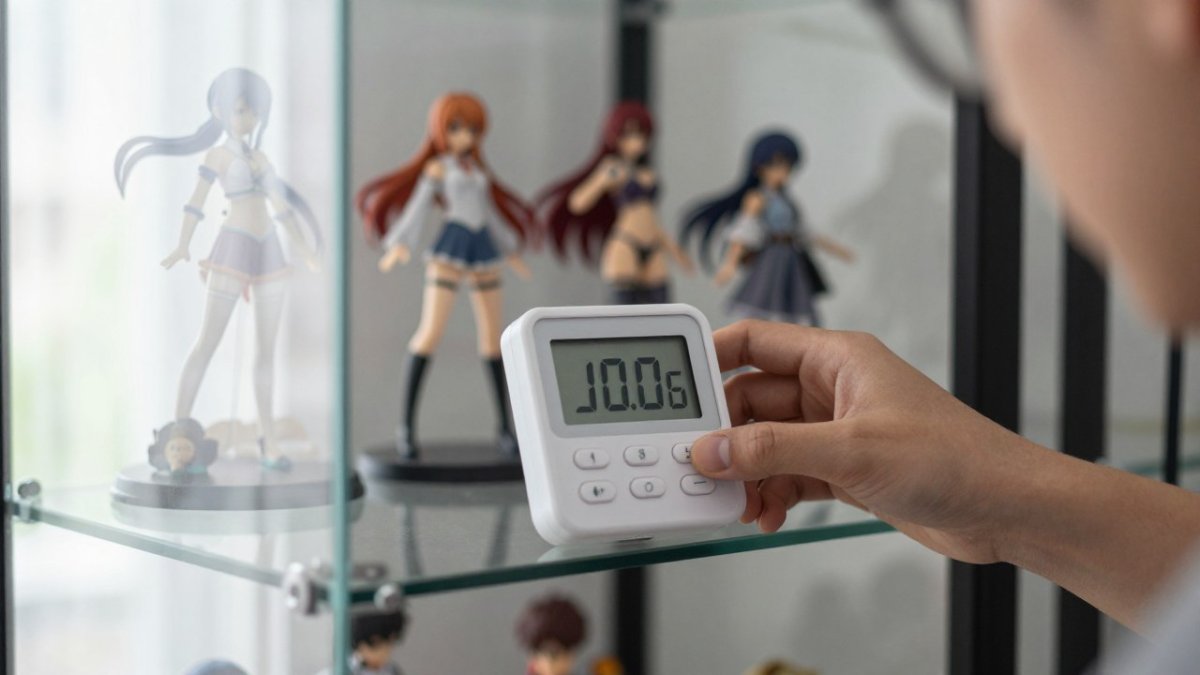
Pick a digital hygrometer with a clear readout and a memory function that records the highest and lowest values.
Check the reading once a day for the first week. Then check it weekly. If the number climbs above 55% or drops below 35% for more than a day, take action.
Calibrating Your Hygrometer
A hygrometer can drift over time, so calibrate it before you trust it. The easiest method is the salt test:
- Put a small amount of table salt in a bottle cap and add a few drops of water until it is damp, not wet
- Place the cap and the hygrometer together in a sealed container for 8 to 12 hours
- Compare the reading. A saturated salt environment should read close to 75%
- If the reading is off by more than 3 to 5 points, adjust the device or replace it
Repeat the check periodically, especially if the sensor has been exposed to extreme moisture.
Choose the Best Dehumidifier for Collectibles
A dehumidifier does the heavy lifting in humid rooms. For a single display cabinet, a small compact unit or a rechargeable moisture absorber may be enough.
When you compare options, look for:
- A built-in humidistat so the unit runs only when needed
- A quiet operating level if the unit sits near your display
- A large enough water tank to avoid frequent emptying
Place the unit near the display, but not directly against the glass. Keep the airflow open so moist air can reach it.
Plan on running the dehumidifier mainly during warm, wet months.
Silica Gel and Desiccant Packets as a Backup
Silica gel and desiccant packets can serve as a backup, especially inside sealed storage boxes. They absorb moisture from enclosed spaces.
Use them this way:
- Place packets in sealed plastic bins or drawers, not loose on open shelves
- Replace or recharge them when they change color or feel saturated
- Never let packets touch figures directly
Desiccants alone cannot control humidity in a whole room. Treat them as a supporting tool, not your main defense.
Material-Specific Sensitivity: PVC, PLA and Resin
Treating every figure as if it were made of the same plastic is the most common mistake in humidity advice. PVC, ABS, PLA, and resin absorb and release moisture at different rates, and each fails in a different way. Matching your target range to the material on the shelf is what separates a stable collection from one that slowly degrades.
PVC (polyvinyl chloride)
Many mass-produced figures are made from PVC, often blended with plasticizers to keep the material soft and flexible. Those plasticizers are the weak point. In sustained humid conditions, plasticizer can migrate to the surface, which can produce a tacky or oily feel.
Use caution: harsh solvents can damage plastic surfaces, so start with mild soap and water.
ABS (acrylonitrile butadiene styrene)
ABS is common in figure bases, stands, joints, and accessories because it is rigid and holds fine detail. It is less prone to surface tackiness than PVC, but it is more sensitive to rapid humidity and temperature swings, which can produce internal stress and hairline cracks at screw bosses and snap-fit joints. Keeping humidity steady around ABS parts can reduce stress at joints, while Aero Essence LLC offers a related perspective on choosing indoor moisture levels that also discourage mold.
PLA (polylactic acid)
PLA appears in 3D-printed figures, custom parts, and handmade pieces. It is the most moisture-sensitive material in a typical collection. PLA absorbs water from the air, and absorbed moisture lowers its softening point and can cause warping, layer separation, and a chalky surface finish. Elevated humidity can cause PLA parts to swell slightly over time. Store PLA pieces at the lower end of the range and keep them out of warm rooms.
Resin (polyurethane and epoxy)
Garage kits and limited-release figures are usually cast resin. Cured resin is dimensionally stable in moderate humidity, but it is brittle and sensitive to thermal shock. A rapid temperature drop can cause surface clouding or fine cracking, and uncured or poorly mixed resin can remain slightly hygroscopic. Resin does best in a steady 40-50% environment with minimal temperature swings.
What this means for a mixed collection
If your shelf holds more than one material, set the room to the middle of the range, about 45%, and monitor the most sensitive piece rather than the average. A practical priority order is PLA first, then PVC, then resin, then ABS.
The article's material guidance can be compared at a glance, so here is how each plastic reacts and where to keep it.
| Material | Main risk | Where to keep it |
|---|---|---|
| PVC | Plasticizer migration causes tackiness | Away from heat sources |
| ABS | Stress cracks from rapid swings | Steady 40-50% band |
| PLA | Absorbs moisture, warps and swells | Lower end of range |
| Resin | Brittle, clouds with thermal shock | Steady 40-50%, few swings |
Recognize Signs of Humidity Damage Early
Humidity damage is progressive, and the window to reverse it is short. Catching humidity problems early can make a figure easier to save. Use the staged checklist below and inspect on a schedule rather than waiting for something to look wrong.
Stage 1: Reversible with drying and airflow
- Faint tackiness at joints, bases, and contact points. Press a clean microfiber cloth against the surface; if it drags or leaves a slight sheen, plasticizer is migrating.
- Dust that clings in patches instead of brushing off evenly.
- A dull or slightly hazy topcoat on painted areas, which is early moisture bloom.
At this stage, move the figure to a dry, ventilated area at 40-45% relative humidity, remove it from the sealed cabinet, and let it air for several days. Stage-one cases can often be resolved without permanent change.
Stage 2: Partially reversible, needs intervention
- Persistent stickiness that returns within days of cleaning.
- White bloom or chalky haze that does not wipe away with a dry cloth.
- Small dark specks in crevices, hair, and under capes, which indicate mold starting on trapped dust.
Stage two requires cleaning with mild soap and lukewarm water, full drying, and a move to a drier, better-ventilated location. Mold should be removed with a dilute mild soap solution and the area dried completely; do not seal the figure back into a damp cabinet.
Watch out: hair dryers and space heaters used to speed drying can soften PVC and warp thin parts permanently, so dry at room temperature only.
Stage 3: Irreversible, stabilize and document
- Deep cracks at joints, screw bosses, or snap-fit connections.
- Paint that has bubbled, flaked, or lifted from the plastic.
- Permanent warping or leaning that does not relax after drying.
At stage three, stop cleaning and stabilize the figure in a stable 40-45% environment. Document the damage with photos and a dated note, and consult a restoration specialist before attempting repairs. Harsh solvents and heat will make stage-three damage worse.
How to inspect on a schedule
Do a quick visual pass weekly and a full inspection monthly. For the monthly check, use a bright, angled light to catch surface sheen and bloom, run a clean microfiber cloth gently over joints and bases, and look into crevices with a flashlight. Record the hygrometer's highest and lowest readings for the month alongside any symptoms you find, so you can connect a humidity spike to a specific change on a specific figure.
How to Fix Sticky Anime Figures
Sticky figures can often be saved if you act quickly and gently.
- Move the figure to a dry, ventilated area and let it air out for several days
- Wipe the surface with a soft microfiber cloth and a small amount of lukewarm water mixed with mild soap
- Dry it completely with a clean cloth and let it rest in open air for 24 hours
- Test a small hidden spot before using any cleaner beyond water and mild soap
- Avoid heat tools, such as hair dryers, which can warp or soften the plastic
If the stickiness returns or the paint has lifted, stop cleaning. Contact a restoration specialist for advice. Harsh solvents can cause more damage than the humidity itself.
Protect Your Collection Long-Term
Long-term protection is about consistency. Set up the right environment once, then check it regularly.
Here is a simple routine that works well for most collectors:
- Daily: Glance at the hygrometer reading
- Weekly: Dust the figures, check seals, and empty any dehumidifier tank
- Monthly: Review your highest and lowest readings from the memory function
- Seasonally: Recalibrate the hygrometer and replace silica gel packets
Keep your display away from exterior walls, which can hold cold and moisture. Avoid placing cabinets in basements unless you have a dedicated dehumidifier running.
With steady monitoring and a few simple tools, you can keep your plastic figures looking their best for years.
Frequently Asked Questions
What is the ideal humidity range for storing PVC anime figures?
Most collectors aim for relative humidity between roughly 40% and 50% for PVC figures. Staying in this band limits the risk of mold growth at the high end and brittleness or plasticizer problems at the low end. Check the level with a hygrometer placed at figure height rather than on the floor, because humidity often varies across a room and inside a cabinet. Small, steady adjustments work better than dramatic swings.
Is 70% humidity too high for anime figures?
Yes. Sustained relative humidity around 70% creates conditions where mold can start on surfaces and where moisture can encourage tackiness and warping. Figures that sit in this range for long periods are more likely to develop a sticky film. Lower the level with a dehumidifier or desiccant and improve airflow around the display case. Recheck the reading after a few days to confirm the change holds.
Is 40% humidity too dry for PLA or PVC figures?
Forty percent is generally acceptable and sits at the lower end of the recommended band. Going much below that over long periods can make some plastics more brittle, especially in dry climates or heated rooms during winter. If your reading drops well below 40%, add a small humidifier or a container with controlled moisture, and avoid placing figures near heating vents where the air is driest.
How do I know if my figures are suffering from humidity damage?
Look for a tacky or greasy surface that attracts dust, white or gray spotting that may indicate mold, slight warping or bowing in limbs and bases, and hairline cracks or a chalky look on the finish. Compare the figure's current appearance with photos you took when you bought it. Catching these signs early gives you a better chance of stopping further damage and cleaning the figure safely.

