

Table of Contents
- Why 2026 Is the Best Year to Start a Gunpla Collection
- Gunpla Grade Differences Explained: Choosing Your First Kit
- The Best Beginner Gunpla Kits 2026 Has to Offer
- Essential Gunpla Building Tools You Need Before Your First Build
- Setting Up Your Workspace and Understanding the Build Process
- Panel Lining, Detailing, and Finishing Your First Gunpla
- Displaying, Storing, and Tracking Your Growing Gunpla Collection
- Your Gunpla Collection Starter Checklist
- Frequently Asked Questions
Last Updated: September 9, 2026
The plastic model kit industry has seen a remarkable resurgence, with Bandai's Gundam franchise leading a global boom in hobby building. In this guide from Utopia Toys and Models, we break down exactly how to start a gunpla collection in 2026, from selecting your first kit to mastering the fundamentals of assembly and display.
Gunpla collection is the practice of assembling and displaying model kits from the Mobile Suit Gundam anime series. The hobby blends precision craftsmanship with creative expression, and the community is famously welcoming, with countless forums and local groups eager to help new builders. Below, we show you how to navigate the grade hierarchy and choose a kit that matches your skill level.
Why 2026 Is the Best Year to Start a Gunpla Collection
Kit availability has never been stronger, with Bandai continuously reprinting popular models and releasing new variants. The current market offers unprecedented variety, from simple snap-fit kits to complex master grades, so you can find a kit that fits your budget and time commitment.
The social aspect of the hobby has also matured. Online communities and local meetups provide immediate access to tutorials, troubleshooting advice, and inspiration, so you are entering a hobby with a rich support network ready to help you succeed.
Gunpla Grade Differences Explained: Choosing Your First Kit
Understanding the gunpla grade differences explained is the single most important step before making a purchase. The grade determines the kit's scale, complexity, part count, and price point. Choosing the right grade ensures your first build is enjoyable rather than frustrating.
The primary grades you will encounter are High Grade (HG), Real Grade (RG), Master Grade (MG), and Perfect Grade (PG). High Grade kits are 1/144 scale, typically have fewer parts, and are designed for snap-fit assembly, making them ideal for beginners. Real Grade kits pack incredible detail into the same 1/144 scale with advanced articulation, but their small, intricate parts are better suited for builders with some experience. Master Grade kits are larger at 1/100 scale, offering a balance of detail and manageable complexity, while Perfect Grade kits are the pinnacle of the hobby, with thousands of parts and a premium price tag.
| Grade | Scale | Part Count | Complexity | Best For |
|---|---|---|---|---|
| High Grade (HG) | 1/144 | Low | Beginner | First build, snap-fit fun |
| Real Grade (RG) | 1/144 | High | Advanced | Detail seekers with patience |
| Master Grade (MG) | 1/100 | Medium | Intermediate | Balanced building experience |
| Perfect Grade (PG) | 1/60 | Very High | Expert | Ultimate display piece |
The Best Beginner Gunpla Kits 2026 Has to Offer
The best beginner gunpla kits 2026 has on the market focus on clean engineering and forgiving assembly. Look for kits from the High Grade line, specifically the "Revive" or newer "The Origin" sub-lines, which feature modern articulation and excellent color separation without stickers. These kits are designed to look great straight out of the box, requiring minimal extra work to achieve a satisfying result.
Popular recommendations include the HGUC RX-78-2 Gundam Revive, a modern take on the iconic original mobile suit, and the HGCE Strike Freedom, which offers a striking presence on a shelf. The key is to pick a mobile suit design you love; the motivation to finish a kit you find visually exciting is much higher. Most kits come with water slide decals or sticker decals, but a beginner can skip these entirely and still have a model that looks fantastic.
Essential Gunpla Building Tools You Need Before Your First Build
You do not need a workshop full of expensive equipment to start. The essential gunpla building tools list is short: a pair of side cutters or nippers, a hobby knife, and a sanding stick or file. The nippers are used to cut parts from the runner or sprue, and a quality pair makes a significant difference in preventing stress marks on the plastic.
A hobby knife is useful for cleaning up the gate, the small attachment point left on the part after cutting. A common mistake is cutting too close to the part with nippers, leaving a divot or nub mark. Instead, leave a small amount of the gate and shave it off with the knife. Sanding sticks smooth the surface and remove any remaining imperfections. A hobby mat to protect your desk and a pair of hobby tweezers for handling small parts are also helpful additions to your setup.
Setting Up Your Workspace and Understanding the Build Process
Before you open the box, prepare a clean, well-lit workspace. Many hobbyists spend 2-4 hours per session hunched over a kit, and without proper posture, that can lead to neck strain, back pain, and eye fatigue. Treat your workspace as a long-term investment in your health, not just a place to cut plastic.
Lighting is your first line of defense. A single overhead light creates shadows that hide gate marks. Use a dual-light setup: a main task lamp with a daylight-balanced LED (5000K-6500K) at a 45-degree angle, plus a secondary light to fill shadows. A magnifying lamp with a built-in ring light combines illumination with 2x-5x magnification, preventing eye strain and the urge to lean in close.
Posture and chair height matter more than you think. Your work surface should be at elbow height so your forearms rest parallel to the floor. A simple adjustable office chair with lumbar support is sufficient. Set a timer for 45 minutes and stand up, stretch, and look at something 20 feet away for 20 seconds, the 20-20-20 rule adapted from screen-use guidelines.
Repetitive strain prevention is a real concern. The motion of squeezing nippers and twisting a hobby knife puts repeated stress on your thumb, index finger, and wrist. Choose nippers with a spring-loaded handle, alternate hands for sanding when possible, and take a 5-minute break every hour to stretch your fingers and wrists. This is the difference between a hobby you enjoy for decades and one you abandon due to pain.
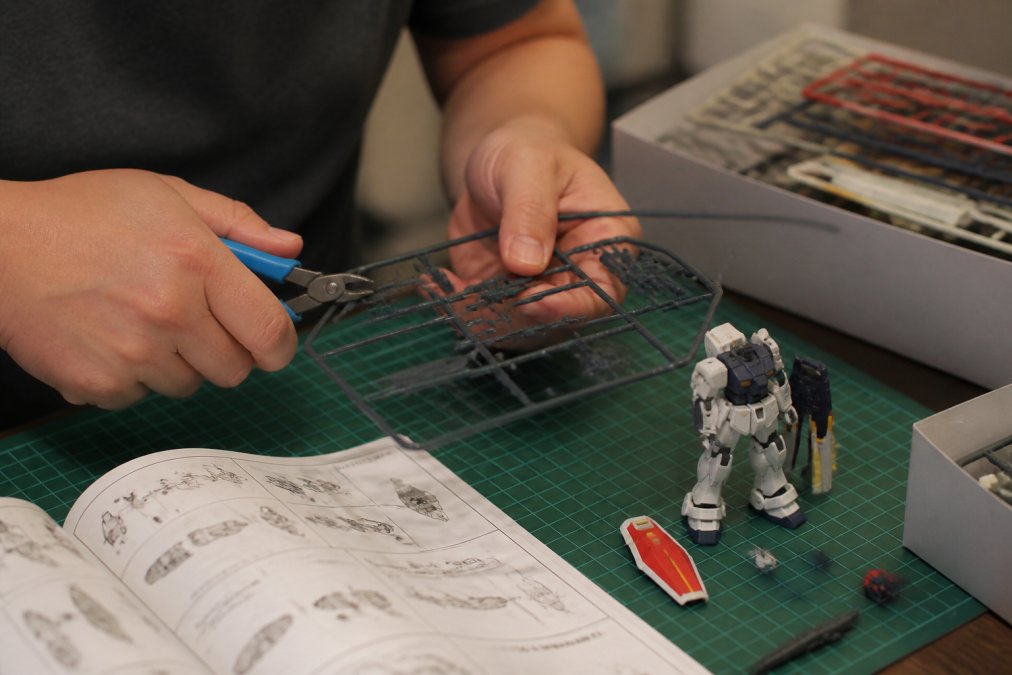
Organize your space for flow, not just tidiness. Keep tools in a desk organizer or on a magnetic tool strip within arm's reach, and place a small parts tray with dividers on your dominant side. A silicone mat with a raised lip catches small parts that would otherwise roll off the desk.
The build process itself is straightforward, but a systematic approach prevents mistakes. Cut all the parts for a single section, clean up the nubs, then follow the manual to snap the parts together. A "polycap" is a soft plastic joint that allows for articulation. You will see the model taking shape quickly, which is part of the hobby's appeal.
Panel Lining, Detailing, and Finishing Your First Gunpla
Once your kit is assembled, you can elevate its appearance with simple detailing techniques. Panel lining is the process of applying a thin ink to the engraved lines on the plastic to create depth and definition. A gundam marker is the easiest tool for this job, as it applies a clean, controlled line that can be smudged and cleaned with an eraser.
After panel lining, you can apply a top coat, a clear spray that seals the decals and lining while giving the model a uniform finish. A matte top coat reduces the plastic's shine for a more realistic look, while a gloss coat gives a vibrant, toy-like appearance. For those interested in further customization, weathering with dry brushing or learning to paint with an airbrush or hand brush are natural next steps, but they are entirely optional. A clean, straight build with panel lining and a top coat is a source of pride for any builder.
Displaying, Storing, and Tracking Your Growing Gunpla Collection
Your finished model deserves a proper display. An action base or display stand allows you to pose your Gunpla in dynamic action poses, showcasing its articulation. For storage, a simple shelf is often sufficient, but be mindful of direct sunlight, which can cause the plastic to yellow and become brittle over time. UV-protective display cases, such as those from Detolf-style glass cabinets, offer a more premium solution, but even a basic shelf with a curtain to block direct light works well.
Display considerations go beyond aesthetics. Dust dulls the finish and settles into panel lines. A soft makeup brush or canned air duster is standard for routine cleaning. A cabinet with doors cuts dust accumulation by 90% compared to open shelving; if you use open shelves, rotate your displayed kits periodically.
The real gap in most guides is digital inventory management. As your collection grows, you cannot remember which kits you own, which are in your backlog, and which you have built, leading to accidental duplicate purchases. The solution is a simple, consistent tracking system.
Spreadsheet tracking is the most flexible option. A basic spreadsheet with columns for Kit Name, Grade, Scale, Purchase Date, Price Paid, Build Status, and Notes gives you full control. Add a "Source" column to track where you got each kit. The key is to update it immediately after every purchase or build.
Dedicated collection apps offer convenience. Several hobby-focused apps let you scan a kit's barcode or search a database, then log it with a photo and status. Databases can be incomplete for older releases, so you may need custom entries. A common pattern is to use an app for quick reference and a spreadsheet as the authoritative record, consistency matters more than the tool.
Backlog management is a discipline, not a chore. If your backlog exceeds what you can build in a year, consider pausing new purchases. A common rule of thumb is to keep the backlog to 3-5 kits, allowing for variety without overwhelming your storage space or wallet.
Your Gunpla Collection Starter Checklist
Before you make your first purchase, use this checklist to ensure you have everything you need for a smooth start.
- Choose a High Grade kit featuring a mobile suit design you love
- Purchase a pair of quality side cutters or nippers
- Get a hobby knife and a pack of sanding sticks
- Set up a clean, well-lit workspace with a hobby mat
- Read the instruction manual fully before starting assembly
- Cut parts from the runner, leaving a small gate to clean
- Clean up nub marks with your knife and sanding stick
- Assemble the kit following the manual's diagrams
- Panel line the kit with a gundam marker for added depth
- Apply a top coat to seal and protect your work
- Display your finished Gunpla on a shelf or action base
The journey of building Gunpla is as rewarding as the finished product. The hobby offers a unique blend of focus, creativity, and community that keeps builders returning for decades. As your skills grow, you can explore more complex grades and advanced techniques like kit bashing, where you combine parts from different kits to create something entirely new. Many builders also find the repetitive, hands-on nature of the work to be a genuine relief from stress, offering a mindful escape that is hard to find elsewhere. For those looking to deepen their practice, resources on model building techniques and community forums provide endless inspiration, and understanding the history and design philosophy of the Gundam franchise adds another layer of appreciation to the craft. Enthusiasts interested in the broader benefits of hands-on hobbies can find relevant discussions on the psychological benefits of crafting and DIY projects.
Starting your gunpla collection is about enjoying the process, not just the result. The challenge of a new kit is a welcome one, and the community is full of builders who remember their first nervous cuts. At Utopia Toys and Models, we stock a curated selection of Bandai kits and the essential tools you need to begin, with most items ready to ship so you can start building without delay. Our transparent availability status means you will know exactly when your order arrives. Get started with Utopia Toys and Models and build your first Gunpla with confidence.
Frequently Asked Questions
What is the best Gunpla kit for a beginner in 2026?
High Grade (HG) kits remain the best starting point. They are affordable, snap together without glue, and take roughly 2-4 hours to complete. Look for recent HG releases from the last few years, as they feature better articulation and part separation than older kits. Kits from popular series like The Witch from Mercury or the newer SEED Freedom movie are excellent entry points.
What is the difference between HG, RG, and MG model grades?
High Grade (HG) kits are 1/144 scale, simple, and perfect for beginners. Real Grade (RG) kits are also 1/144 scale but feature advanced engineering, an inner frame, and many small parts, making them a challenging second or third build. Master Grade (MG) kits are larger at 1/100 scale with detailed inner frames and high articulation, suited for builders with some experience.
What essential tools do I need to start building Gunpla?
You only need three things to start: a pair of single-bladed nippers to cut parts from the runners, a hobby knife for cleaning nubs, and optionally a glass sanding file or sanding sticks for a smoother finish. You can skip glue and paint entirely for your first build. A cheap cutting mat protects your work surface.
How do I avoid leaving white stress marks on my Gunpla parts?
White stress marks appear when you cut too close to the part with your nippers. Always cut the runner about 1-2 millimeters away from the part, leaving a small nub. Then, use your hobby knife to shave the remaining nub down flat. For stubborn marks, a glass file or sanding stick will remove them cleanly.
How should I store and display my growing Gunpla collection?
A simple shelf away from direct sunlight is the most practical start. Direct sunlight will yellow white plastic over time. For dust protection, consider a display case with doors. As your collection grows, use a spreadsheet or a hobby tracking app to log your kits, their grade, and your backlog to avoid duplicate purchases.
Are there specific 2026 releases recommended for new hobbyists?
Bandai continues to release new High Grade kits that are ideal for beginners due to modern engineering. Check hobby news sites for upcoming releases from the current anime series. Reprints of popular kits also happen regularly, so if a kit is sold out, it is often restocked within a few months. Pre-ordering from a reliable shop secures your copy.