

Table of Contents
- How to Identify Bootleg Anime Figures: The 8-Point Inspection System
- 1. Inspect Paint Quality and Application for Defects
- 2. Examine Hair Sculpt and PVC Material Quality
- 3. Verify the Holographic Sticker and Official Seals
- 4. Check Eye Decals, Facial Expression, and Shiny Skin Texture
- 5. Authenticate Manufacturer Info, Copyright, and Serial Numbers
- 6. Evaluate Box Art, Packaging, and Base Plate Details
- How to Spot Fake Nendoroids and Brand-Specific Bootleg Tells
Last Updated: July 12, 2026
Learning to identify bootleg anime figures is essential for collectors who want to protect their investments and ensure authenticity. Counterfeit figures flood the secondary market, and many collectors unknowingly purchase knock-offs at premium prices. This guide walks you through eight critical inspection points that separate genuine collectibles from bootlegs.
The anime figure market has exploded in recent years, with popular franchises commanding high prices. Unfortunately, this demand has created a lucrative opportunity for counterfeiters. According to research from MyFigureCollection community data, bootleg figures represent a significant portion of resales on secondary markets. The good news: bootlegs almost always show telltale signs if you know what to look for.
Why This Matters for Collectors
Bootleg figures deteriorate quickly, lose value, and support criminal operations. Authentic figures hold their value and come with the satisfaction of owning a genuine product from manufacturers like Good Smile Company, Bandai, Funko, and Kotobukiya. A single counterfeit purchase can cost you hundreds of dollars and fund operations that undermine legitimate manufacturers.
1. Inspect Paint Quality and Application for Defects
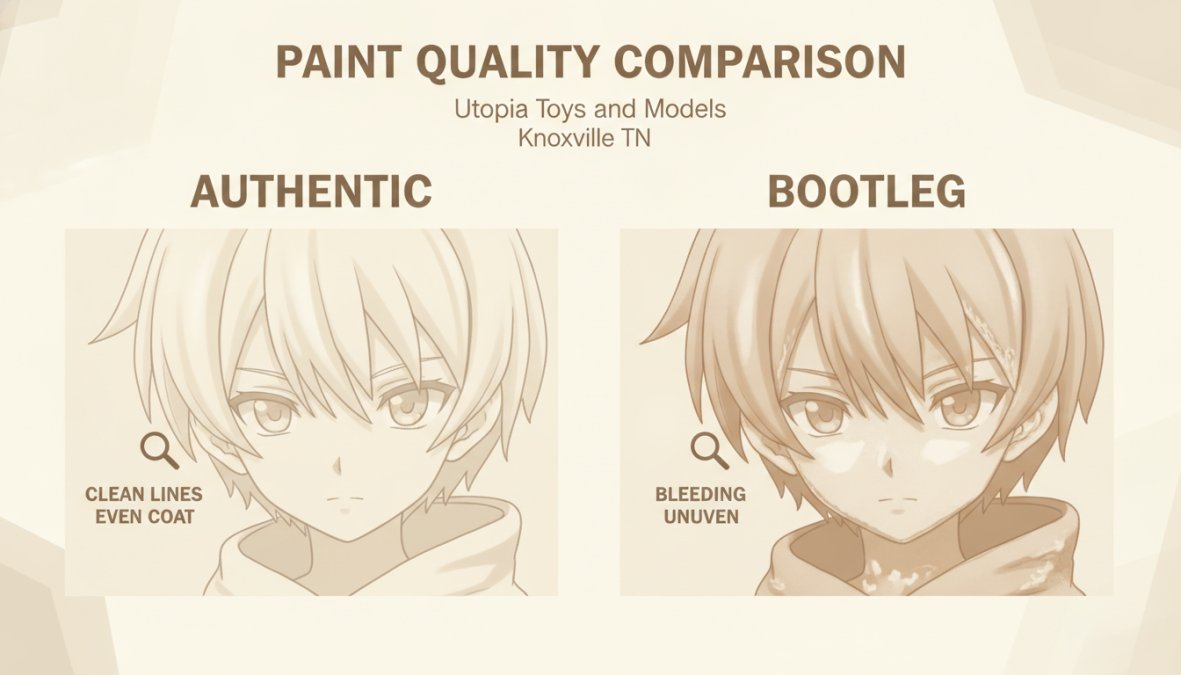
Paint quality is the first and most obvious tell. Authentic figures use precision painting with clean, even application. Bootlegs almost always show sloppy paint work.
Examine the face closely for paint bleeding, where one color spills into an adjacent area. Authentic figures have crisp, defined lines between colors. Bootleg paint jobs show fuzzy edges, especially around the eyes and mouth. The eye decals on authentic figures are perfectly centered and sharp. Bootleg eyes often appear misaligned with uneven pupil placement.
Check the hair for clean paint lines that follow the sculpt's contours. Bootlegs show paint pooling in crevices and uneven coverage. Run your finger lightly over the painted surface, authentic figures feel smooth, while bootlegs often have visible brush strokes or rough spots.
Examine the body and clothing for consistent paint coverage with no visible drips or runs. Bootlegs frequently show paint drips that have dried in place, especially on clothing folds or seam lines.
2. Examine Hair Sculpt and PVC Material Quality
Hair sculpts reveal manufacturing differences between authentic and bootleg figures. Authentic manufacturers invest in detailed molds that capture fine hair strands and complex layering. Bootleg manufacturers use cheaper molds that lack this detail.
Feel the hair texture. Authentic PVC has a smooth, slightly waxy feel. Bootleg plastic often feels cheaper, either too soft and rubbery or overly brittle. Authentic figures display individual strand definition, especially in layered hairstyles. Bootlegs have flat, generic hair shapes that lack dimensional quality.
Look for mold lines where two halves of the mold came together. Authentic figures minimize these lines through careful finishing. Bootlegs show prominent, unfinished mold lines running through the hair.
Check the PVC material itself. Authentic figures use high-quality ABS or PVC that feels substantial and durable. Bootleg plastic often feels thin and flimsy. Some bootlegs use yellowed or discolored plastic that suggests poor storage or inferior material.
Press gently on the figure's limbs. Authentic joints have appropriate stiffness and move smoothly. Bootleg articulation often feels overly loose or stiff, indicating poor joint engineering.
3. Verify the Holographic Sticker and Official Seals
The holographic sticker is one of the most important authentication markers. Nearly every major manufacturer includes holographic stickers on authentic figures. Bootlegs either lack these stickers entirely or use cheap imitations.
Examine the hologram closely. Authentic holograms display multiple colors that shift when tilted under light with sharp, detailed imagery. Bootleg holograms appear flat with poor color reproduction and blurry images. Some bootlegs use simple printed stickers instead of true holograms.
Check the sticker placement. Authentic manufacturers place holographic stickers consistently in the same location, usually on the box base or figure base plate. Bootlegs show inconsistent placement or stickers applied carelessly with bubbles, wrinkles, or misalignment.
Look for copyright information on the sticker. Authentic stickers include manufacturer name, copyright year, and batch number. Bootleg stickers often have incomplete or incorrect copyright information.
Verify the sticker adhesion. Authentic stickers are applied firmly and don't peel easily. Bootleg stickers often peel up with minimal pressure.
4. Check Eye Decals, Facial Expression, and Shiny Skin Texture
Eye decals are precision-printed details that separate authentic from bootleg instantly. Authentic eye decals are perfectly centered with sharp lines and accurate pupil placement. Bootleg eyes show misalignment, bleeding paint, or derpy expressions where pupils point in different directions.
Examine the eye whites. Authentic figures have bright white eye backgrounds with minimal yellowing. Bootlegs often show yellowed or discolored eyes. The iris should be perfectly round and centered. Bootleg eyes often show irregular iris shapes or off-center pupils.
Check the eyelashes and eyebrows. Authentic figures display fine, precise details. Bootlegs show thick, clumsy lines or missing details entirely.
Evaluate the overall facial expression. Authentic figures capture the character's intended expression perfectly. Bootlegs often display derpy or unintended expressions due to paint misalignment or poor eye decal placement.
Inspect the skin texture. Authentic figures display appropriate skin finish, either matte or slightly glossy. Bootlegs frequently show shiny, oily skin texture that looks unnatural. Run your finger lightly over the face. Authentic skin feels smooth and even. Bootleg skin often feels sticky or has visible texture inconsistencies.
Check for paint overspray on the face. Authentic figures show clean paint application with no overspray. Bootlegs frequently display paint particles or overspray around the face, especially near the ears or hairline.
5. Authenticate Manufacturer Info, Copyright, and Serial Numbers
The base plate tells the complete story. Flip the figure over and examine it thoroughly. Authentic figures include clear manufacturer name, copyright year, and often a batch number or serial number.
Look for the manufacturer name. Authentic figures clearly state the manufacturer, Good Smile Company, Bandai, Kotobukiya, Banpresto, or another licensed producer. Bootlegs either omit this information, use generic text, or misspell the manufacturer name.
Check the copyright information. Authentic figures include the copyright year and copyright holder with clear, properly aligned text and correct spelling. Bootlegs show blurry copyright text, incorrect years, or missing information entirely.
Verify the batch number or serial number. Many manufacturers include batch numbers that allow collectors to verify production runs. Bootlegs either lack this information or use obviously fake numbers.
Research the manufacturer information. Visit the official manufacturer website or consult MyFigureCollection database to verify the copyright holder and confirm the figure exists.
Compare the base plate text to reference images. Authentic figures maintain consistent text formatting, font, and alignment across production runs. Bootlegs show variations in text placement, font size, or spelling.
6. Evaluate Box Art, Packaging, and Base Plate Details
The box provides crucial authentication clues. Authentic boxes display crisp, vibrant artwork that matches official product images. Bootleg boxes show faded, pixelated, or poorly reproduced artwork.
Examine the box printing quality. Authentic boxes use high-quality printing with sharp text and vivid colors. Bootleg boxes show blurry text, color misalignment, or pixelated images.
Check the box construction. Authentic boxes use sturdy cardboard with clean folds and secure gluing. Bootleg boxes often show poor construction, weak glue, uneven folds, or flimsy cardboard.
Inspect the figure base plate. Authentic base plates show clean manufacturing with no visible defects. Bootleg base plates often show visible mold lines, rough edges, or discolored plastic.
Verify the official seals and stickers on the box. Authentic boxes include manufacturer seals that indicate the figure is unopened. These seals should be properly applied and difficult to remove. Bootleg boxes either lack seals or use cheap imitations that peel off easily.
Look for the product code or barcode. Authentic boxes include a product code that can be verified through the manufacturer's database. Bootlegs often display incorrect or non-existent product codes.
How to Spot Fake Nendoroids and Brand-Specific Bootleg Tells
Different manufacturers have distinct authentication markers. Understanding brand-specific tells accelerates your identification process.
Nendoroid-Specific Red Flags
Good Smile Company's Nendoroids are heavily counterfeited because of their popularity and premium pricing. Bootleg Nendoroids show several consistent tells.
Examine the face plate. Authentic Nendoroids display perfectly smooth face plates with no visible texture or imperfections. Bootleg face plates often show grainy texture or visible dust particles embedded in the plastic.
Check the joint stiffness. Authentic Nendoroids have appropriately stiff joints that hold poses firmly. Bootleg joints are either overly loose or painfully stiff, indicating poor manufacturing tolerances.
Inspect the hair pieces. Authentic Nendoroid hair sculpts are detailed and precise. Bootleg hair pieces show flat, generic sculpting with rough edges and visible mold lines.
Verify the holographic sticker. Good Smile Company includes a distinctive holographic sticker on the base plate. Bootlegs use cheap imitations or omit the sticker entirely.
Check the box artwork. Authentic Nendoroid boxes display vibrant, detailed artwork. Bootleg boxes show pixelated or faded images.
Other Brand-Specific Bootleg Indicators
Banpresto figures are commonly counterfeited. Authentic Banpresto figures display clean paint application and smooth plastic. Bootlegs show paint defects and rough plastic texture. Banpresto's distinctive packaging should be crisp and colorful. Bootleg Banpresto boxes show faded or pixelated artwork.
Kotobukiya figures are premium collectibles that attract counterfeiters. Authentic Kotobukiya figures show exceptional paint quality and detailed sculpting. Bootlegs lack this precision. Kotobukiya includes detailed base plates with clean manufacturing. Bootlegs show rough base plates with visible defects.
Funko Pop figures are frequently counterfeited due to their mass appeal. Authentic Pops display consistent paint application and smooth vinyl. Bootleg Pops show paint bleeding and rough plastic. The holographic sticker on authentic Pops is always present and clearly visible. Bootlegs either lack the sticker or use poor imitations.
Comprehensive Authentication Checklist
| Inspection Point | Authentic Figure | Bootleg Red Flag |
|---|---|---|
| Paint Application | Clean, even lines; no bleeding | Sloppy edges; paint bleeding into adjacent areas |
| Hair Sculpt Detail | Individual strand definition; clean edges | Flat, generic shapes; rough, unfinished edges |
| PVC Material Quality | Smooth, waxy feel; appropriate stiffness | Cheap plastic; overly soft or brittle |
| Holographic Sticker | Multiple color shifts under light; sharp imagery | Flat appearance; blurry images; missing sticker |
| Eye Decals | Perfectly centered; sharp lines; proper pupil placement | Misaligned; bleeding paint; derpy expression |
| Skin Texture | Smooth, appropriate matte or gloss finish | Shiny, oily appearance; texture inconsistencies |
| Base Plate Info | Clear manufacturer name; correct copyright; batch number | Blurry text; missing information; misspelled names |
| Box Printing | Crisp artwork; vibrant colors; sharp text | Pixelated images; faded colors; blurry text |
| Box Construction | Sturdy cardboard; clean folds; secure gluing | Weak construction; uneven folds; flimsy cardboard |
| Manufacturer Seals | Properly applied; difficult to remove | Missing seals or cheap imitations that peel easily |
Verification Tools and Resources
MyFigureCollection (MFC) is the definitive database for anime figure authentication. Upload photos of the figure you're considering, and the community provides feedback. MFC displays official product images, release dates, and known bootleg variations.
Reverse image search on Google can confirm whether product photos match official manufacturer images. Bootleggers often use stolen product photos from legitimate sellers. If the seller's photos don't match official images, that's a major red flag.
Check the seller's reputation. Reputable anime figure retailers maintain strict quality control and only stock authentic products. Sellers on secondary markets should have extensive positive feedback from previous buyers. Be wary of sellers with limited feedback or negative reviews mentioning counterfeit figures.
Contact the manufacturer directly if you're unsure. Good Smile Company, Bandai, and other manufacturers respond to authentication inquiries. Provide photos and the figure's product code.
Post-Purchase Protection and Dispute Resolution
Sometimes bootlegs slip through despite careful inspection. Know your options if you discover a counterfeit after purchase.
Document everything immediately. Take detailed photos of the figure showing paint defects, missing holograms, or other authentication issues. These photos become evidence for disputes.
Contact the seller within the return window. Explain that the figure appears to be counterfeit and provide your photographic evidence. Many reputable sellers accept returns for bootlegs.
File a dispute if the seller refuses to accept the return. Most payment platforms and secondary markets have buyer protection policies. Document your case with clear photos and detailed explanations.
Report the seller to the platform. If a seller knowingly sells counterfeit figures, report them to the marketplace. This protects other collectors and may result in account suspension.
Identifying bootleg anime figures protects your investment and supports legitimate manufacturers. These eight inspection points catch the vast majority of counterfeits before you make a purchase. Start with paint quality and work through each check systematically. When you're ready to build your collection with confidence, Utopia Toys and Models offers a curated selection of authentic figures from industry-leading brands including Bandai, Funko, and Kotobukiya.
Frequently Asked Questions
How can you tell if an anime figure is fake?
Start with the eight-point inspection: examine paint quality for bleeding and uneven coverage, check PVC material for cheap plastic feel, verify the holographic sticker authenticity, inspect eye decals for clarity, confirm manufacturer copyright information, evaluate box art detail, check for excessive seam lines, and compare the figure's weight and articulation to known authentic examples. Bootleg figures typically show multiple defects across these areas, while authentic figures maintain consistent quality standards from manufacturers like Good Smile Company and Banpresto.
What are the most common signs of a bootleg figure?
The most frequent bootleg tells include sloppy paint application with visible bleeding, cheap ABS or PVC plastic that feels lightweight, missing or poorly printed holographic stickers, blurry or misaligned eye decals, incorrect or missing copyright and manufacturer information, low-quality box art with color inaccuracies, and excessive mold lines. Counterfeit figures also often exhibit shiny or oily skin texture rather than the matte finish of authentic sculpts. Price significantly below retail is another strong indicator, if a figure is priced too low, verify the seller's reputation before purchasing.
How to spot fake Nendoroids specifically?
Nendoroids have specific vulnerability points: check the face plate attachment mechanism for loose or poorly fitted connections, examine the paint on the face for derpy or misaligned features, verify the holographic sticker placement and quality on the back, inspect the interchangeable parts for paint consistency across pieces, and confirm the Good Smile Company copyright stamp on the base plate. Counterfeit Nendoroids commonly have weak joint stiffness, allowing parts to move too freely, and the base plate is often poorly molded with visible defects. Always cross-reference listings on MyFigureCollection (MFC) to verify the figure's official specifications.
Where is the best place to buy authentic anime figures?
Purchase from reputable anime figure retailers that specialize in official licensed products from manufacturers like Bandai, Kotobukiya, and Good Smile Company. Authorized resellers typically display official seals, maintain transparent inventory status, and clearly label pre-order vs. in-stock items. Verify retailers through community forums and MyFigureCollection reviews. Avoid secondary market sellers with suspiciously low prices or limited seller history. Utopia Toys and Models offers a curated selection of authentic collectibles from industry-leading brands with ready-to-ship inventory and transparent availability information.
What should I check on the box to spot a bootleg figure?
Examine box art for color accuracy, print sharpness, and correct spelling of the figure's name and manufacturer. Authentic boxes feature crisp, high-resolution images with consistent color reproduction, while counterfeit packaging often shows pixelation, color bleeding, or faded printing. Check for the official holographic sticker placement, it should be in the exact location specified by the manufacturer. Verify the batch number, serial number, and copyright information match official records. The base plate inside should also display the manufacturer's logo and copyright stamp clearly printed, not smudged or poorly aligned.
Are bootleg anime figures dangerous to buy?
Beyond supporting counterfeit manufacturers, bootleg figures pose quality risks: cheaper ABS and PVC materials may degrade faster, paint may contain unsafe compounds, and poor articulation can cause breakage. More importantly, purchasing counterfeits funds knock-off production and harms legitimate manufacturers. You also lose resale value, bootleg figures have zero secondary market value on MFC or collector platforms. Additionally, if purchased through unofficial channels, you have limited recourse for disputes or returns, unlike purchases from reputable retailers offering buyer protection.
This article was written using GrandRanker