

Table of Contents
- How to Fix Loose Figure Joints: Diagnosis and Preparation
- What You'll Need: Action Figure Joint Repair Kit Essentials
- Tightening Loose Action Figure Joints: Core Techniques
- Loose Ball Joint Fix: Socket and Articulation Repair
- How to Fix Loose Marvel Legends Joints and Similar Figures
- Reversibility and Environmental Factors in Joint Repair
- Common Mistakes to Avoid When Fixing Loose Figure Joints
- Troubleshooting Stuck Joints and Residue Removal
How to Fix Loose Figure Joints: Complete Repair Guide
Last Updated: July 31, 2026
Loose joints plague collectors of action figures, anime models, and articulated toys. Whether you're dealing with Marvel Legends, Bandai figures, or high-end Kotobukiya collectibles, knowing how to fix loose figure joints extends the life of your collection and restores poseability. This guide covers everything from diagnosis through advanced repair techniques, with special attention to material compatibility and reversibility.
How to Fix Loose Figure Joints: Diagnosis and Preparation
Before reaching for adhesives, understand what's actually loose. Not all joint problems are the same.
Identifying the Problem
Isolate which joints are problematic by rotating each limb, head, and articulation point individually. A truly loose joint moves freely with minimal pressure. A stiff joint resists movement and requires deliberate force to rotate.
Assessing Material Type and Damage
Most action figures use polyvinyl chloride (PVC) or acrylonitrile butadiene styrene (ABS). Some premium collectibles use softer synthetic polymers. Knowing your material prevents costly mistakes. Look at the socket itself. If the plastic is visibly cracked, discolored, or has stress fractures radiating from the joint, you're dealing with plastic degradation. If the joint looks intact but moves too freely, the socket has simply worn smooth from repeated articulation.
What You'll Need: Action Figure Joint Repair Kit Essentials
Assembling the right tools before you start prevents mid-repair scrambling and reduces damage risk.
Adhesives and Reinforcement Materials
Clear nail polish remains the fastest, most reversible friction solution. A single coat applied to the ball joint creates immediate grip without permanent bonding. Application takes 30 seconds; drying takes 2-3 minutes.
Silicone shock oil (also called silicone damping oil) addresses stiff joints but can temporarily loosen already-loose joints before curing. Use only when you've confirmed your joint is stiff, not loose. Thicker oils provide more grip on loose joints.
Cyanoacrylate adhesive (super glue) is permanent and fast-curing but risky on valuable figures. It bonds in 30-60 seconds and is nearly impossible to reverse. Reserve this for figures you don't mind modifying permanently.
Two-part epoxy cures slower (24 hours) but provides stronger reinforcement for severely worn sockets. The extended curing time lets you position the joint correctly before the bond sets.
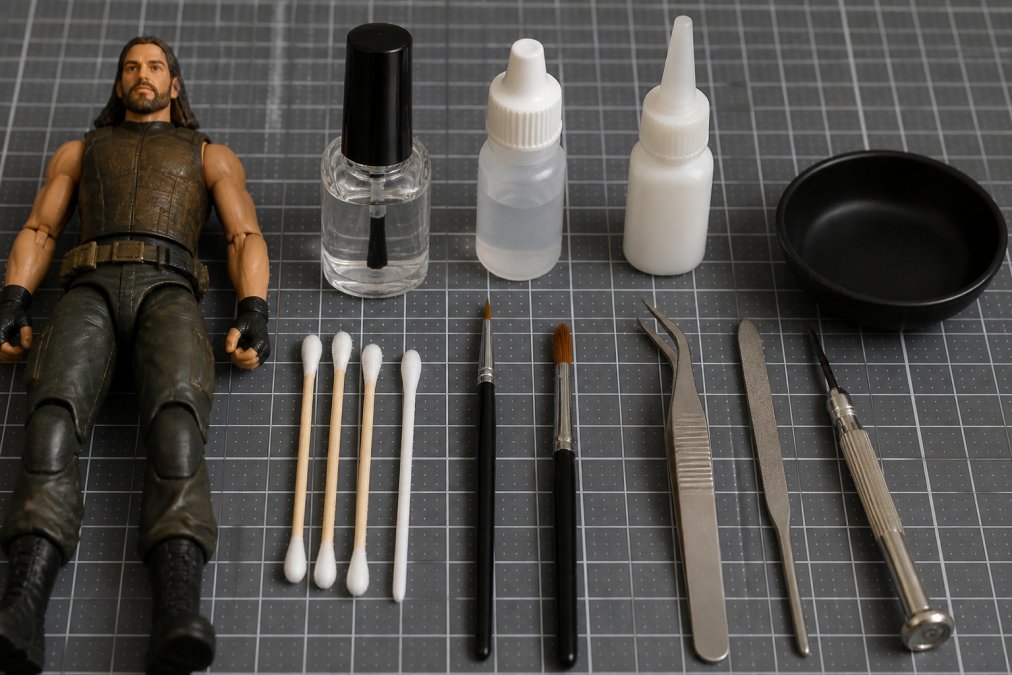
Tools and Safety Equipment
Keep cotton swabs for applying adhesives precisely. Toothpicks work for spreading epoxy into tight sockets. A small brass brush cleans residue without scratching plastic. Tweezers help position small parts during curing. Cyanoacrylate fumes irritate eyes and respiratory passages. Work in ventilated spaces and wear nitrile gloves; super glue bonds skin instantly. Keep acetone nearby for cleanup and emergency debonding.
Tightening Loose Action Figure Joints: Core Techniques
The clear polish method works because it adds friction without permanently altering the joint. Adhesive methods work by either increasing surface tension or filling worn gaps.
Clear Polish and Friction Method
Apply a thin coat of clear nail polish directly to the ball joint, the male part that inserts into the socket. Use a small brush or the applicator that comes with the bottle. A single coat is usually sufficient. Let the polish dry completely (2-3 minutes), then reinsert the joint into the socket and test the fit. The added thickness and texture create immediate grip. If the joint still feels loose, apply a second coat after the first fully dries.
The beauty of this method is reversibility. Acetone dissolves it completely, returning the joint to its original state. This makes clear polish ideal for figures you might want to restore to factory condition or resell.
Adhesive Reinforcement for Permanent Solutions
When clear polish doesn't provide enough grip, adhesive reinforcement becomes necessary. For most figures, cyanoacrylate applied sparingly to the ball joint creates a durable bond. Apply a tiny amount, less than a drop, to the ball joint. Insert immediately into the socket and hold for 60 seconds. Work over a paper towel and have acetone ready to clean any spills before they cure.
Two-part epoxy works differently. Mix equal parts of the resin and hardener on a disposable surface. Apply the mixed epoxy to the ball joint using a toothpick, coating the surface evenly. Insert the joint into the socket and hold for 2-3 minutes while the epoxy begins to cure. Full strength develops over 24 hours. Epoxy fills microscopic gaps in the socket, effectively tightening it through material buildup rather than relying solely on the adhesive bond.
Loose Ball Joint Fix: Socket and Articulation Repair
Ball-and-socket joints are common in premium figures because they allow multi-directional movement. When they loosen, the problem usually stems from wear on either the ball or the socket.
Diagnosing Ball and Socket Wear
A ball joint has a spherical male part (the ball) that rotates inside a hemispherical female part (the socket). Wear appears as smoothness; the plastic loses its original texture and becomes slippery. Examine the ball under bright light. If it's visibly shiny or polished compared to surrounding plastic, it's worn. Worn balls are harder to fix than worn sockets. Once the ball's spherical shape is flattened, no amount of adhesive fully restores the original movement. Worn sockets can be tightened through adhesive reinforcement because the adhesive fills the enlarged space.
Viscosity-Based Lubrication and Curing
Silicone shock oil comes in different viscosities, measured in centistokes (cSt). Thicker oils provide more grip on loose joints. For loose ball joints, use a thicker silicone oil (500-1000 cSt range). Apply a drop to the ball joint, insert into the socket, and rotate several times to distribute the oil evenly. Curing takes 24-48 hours. After curing, test the articulation. If the joint is still loose, apply a second coat.
Silicone oil is reversible. Acetone or mineral spirits dissolve the oil, returning the joint to its original state.
How to Fix Loose Marvel Legends Joints and Similar Figures
Marvel Legends and similar articulated figures use specific plastic compounds and joint designs that respond predictably to repair methods.
Material Compatibility for Synthetic Polymers
Marvel Legends figures use a blend of PVC and ABS. Cyanoacrylate works reliably on these joints because it bonds to both PVC and ABS. Two-part epoxy also bonds well. Silicone oil is compatible with both plastics and doesn't degrade them. Clear nail polish is compatible with all approaches. Test any new adhesive on a spare figure or inconspicuous joint before applying it to a valuable piece.
Preventing Plastic Degradation During Repair
Clear polish and silicone oil introduce minimal chemical stress. They're compatible with PVC and ABS at room temperature. Cyanoacrylate generates slight heat as it cures, but the amount is negligible on small joints. Avoid acetone-based solvents on PVC figures if possible. Acetone softens PVC slightly, and repeated exposure can cause permanent warping. Isopropyl alcohol is a safer solvent for cleaning PVC joints. Store repaired figures in cool, dry environments away from direct sunlight.
Reversibility and Environmental Factors in Joint Repair
Not every repair should be permanent. Understanding reversibility helps you choose methods that match your long-term plans for each figure.
Choosing Reversible vs. Permanent Fixes
Clear polish is fully reversible. Acetone dissolves it completely, returning the joint to its original state. This method is ideal for figures you might sell, display in different poses frequently, or want to restore to factory condition eventually. Silicone oil is mostly reversible. Acetone or mineral spirits dissolve most of the oil, though some residue may remain in the socket. Cyanoacrylate and two-part epoxy are permanent. Once cured, they cannot be removed without damaging the plastic. Consider the figure's value and rarity when choosing reversibility. Rare or valuable figures deserve reversible repairs that don't alter the original plastic.
Temperature, Humidity, and Long-Term Maintenance
Temperature fluctuations stress adhesive bonds. Plastic expands and contracts as temperature changes. Figures in temperature-stable environments hold repairs longer than figures in garages or basements with seasonal temperature swings. Humidity affects silicone oil-based repairs. High humidity can cause the oil to separate from the plastic or promote oxidation. Moderate humidity (40-50%) is ideal for long-term storage. Inspect repaired joints every 6-12 months. If the joint feels loose again, the repair has degraded and needs reapplication.
Common Mistakes to Avoid When Fixing Loose Figure Joints
Most repair failures stem from predictable errors that are easy to prevent. The first mistake is applying adhesive to both the ball and socket. This creates too much bonding surface and often results in the joint being too stiff to articulate. Apply adhesive to the ball joint only.
The second mistake is applying too much adhesive. Excess super glue drips onto the figure's body, creating visible residue that's difficult to remove. Excess epoxy pools in the socket and hardens in ways that block articulation. Use the minimum amount needed.
The third mistake is not letting adhesives cure fully before testing the joint. Cyanoacrylate needs 60 seconds minimum. Epoxy needs 24 hours. Testing too early disrupts the cure and weakens the bond.
The fourth mistake is applying clear polish to the socket instead of the ball joint. This creates drag that makes articulation difficult. Polish the ball joint only.
The fifth mistake is choosing permanent methods for valuable figures. Once super glue or epoxy cures, removal requires damaging the plastic. For figures you might want to restore later, use reversible methods first.
Troubleshooting Stuck Joints and Residue Removal
Sometimes repairs create new problems: joints that are now too stiff, or adhesive residue that's visible and difficult to remove. If a joint becomes too stiff after repair, the adhesive layer is too thick. Silicone oil can help. Apply a small amount of thin silicone oil to the joint and rotate gently. If the joint is completely immobile, you may need to use acetone to partially dissolve the adhesive, then reapply more carefully.
Adhesive residue on the figure's body is cosmetic but noticeable. For super glue residue, acetone dissolves it completely. Soak a cotton swab in acetone and dab the residue repeatedly until it softens and lifts away. For epoxy residue, acetone works but may require longer soaking. Dried polish residue appears as a glossy coating on the figure's body. Acetone dissolves it, but rubbing alcohol is gentler on paint.
| Repair Method | Reversibility | Curing Time | Best For | Limitations |
|---|---|---|---|---|
| Clear nail polish | Fully reversible | 2-3 minutes | Loose joints, frequent articulation | Minimal tightening effect |
| Silicone shock oil | Mostly reversible | 24-48 hours | Moderately loose joints, preservation | Slower than polish, requires patience |
| Cyanoacrylate adhesive | Permanent | 60 seconds | Quick repairs, damaged figures | Excess drips, difficult to remove |
| Two-part epoxy | Permanent | 24 hours | Severely worn sockets, strong bonds | Longer curing, requires mixing |
Loose joints don't mean the end of a figure's useful life. Most repairs take minutes and cost almost nothing. The key is matching the repair method to the problem, diagnosing whether the joint is truly loose or stiff, choosing reversible methods for valuable figures, and applying adhesives sparingly to avoid visible residue or over-tightening. With these techniques, your collection will stay poseable and display-ready for years.
Frequently Asked Questions
What causes action figure joints to become loose over time?
Action figure joints loosen due to repeated articulation, plastic degradation from UV exposure or temperature fluctuations, and wear on ball-and-socket connections. Synthetic polymer materials naturally lose surface tension and structural integrity with use and age. Environmental factors, particularly humidity and heat cycling, accelerate this degradation by causing micro-stress fractures in the hinge and socket areas.
Can I use a loose ball joint fix with clear nail polish on Marvel Legends figures?
Yes, clear nail polish is a popular method for tightening loose action figure joints, including Marvel Legends. The polish adds friction and viscosity to the socket without permanently bonding parts. Apply thin coats to the ball joint or hinge, allow proper dry time between applications, and test articulation carefully. This approach is reversible, you can remove the polish with solvent if needed, making it ideal for figures you may customize later.
How do I know if my figure needs an action figure joint repair kit or just lubrication?
If your figure's joints wiggle but hold position with light resistance, lubrication (silicone shock oil) may suffice. If joints collapse under their own weight or won't stay posed, you need reinforcement, either clear polish for reversible friction or adhesive-based methods for permanent solutions. A visual diagnostic involves rotating the joint slowly; smooth wiggle = lubrication, floppy movement = reinforcement needed. Material compatibility matters: check that your chosen adhesive or polish won't degrade the specific plastic polymer used in your figure.
Is there a reversible way to fix loose figure joints if I want to undo the repair later?
Yes. Clear nail polish and silicone shock oil are both reversible methods. Polish can be removed with acetone or solvent, and silicone oil evaporates or can be cleaned away. Adhesive-based reinforcement (cyanoacrylate or epoxy) is permanent and difficult to reverse without damaging the figure. If you're uncertain about customization or resale, start with reversible friction methods. Test on a less-visible joint first, and always allow full curing time before posing to avoid residue or drips that could damage paint or decals.
This article was written using GrandRanker