

Table of Contents
- Gundam vs Real Grade Model Kits: Key Differences at a Glance
- What Is Real Grade (RG) and How It Differs from Standard Gundam Grades
- Master Grade vs Real Grade Gundam: Scale, Detail, and Build Complexity
- Gundam Model Kit Scales Explained: 1/144 vs 1/100 and Shelf Presence
- Best Gundam Grade for Beginners: Should You Start with RG or HG?
- Gundam Model Kit Difficulty Levels: Inner Frame Technology and Articulation
- Durability and Fragility: Which Grade Holds Up Better Over Time
- Tools, Paint, and Customization Requirements for Each Grade
Last Updated: July 23, 2026
When comparing gundam vs real grade model kits, the differences go far deeper than just the box they come in. At Utopia Toys and Models, we've helped thousands of collectors navigate this choice, and the answer depends entirely on what you're building for: shelf presence, complexity, durability, or pure detail. This guide breaks down every meaningful distinction between these Bandai Gundam grades, from scale and articulation to the tools you'll need and the fragility factor that catches most builders off guard.
Gundam vs Real Grade Model Kits: Key Differences at a Glance
Real Grade (RG) kits represent Bandai's most technically advanced 1/144 scale offering, engineered with an internal frame system that rivals Master Grade articulation in a smaller package. Standard Gundam kits, typically High Grade (HG) at 1/144 scale, prioritize accessibility and build speed over intricate engineering. Real Grade demands precision, specialized tools, and patience in exchange for stunning articulation and detail density.
The fundamental tension is this: HG kits are designed so beginners can build them in an afternoon with basic nippers. RG kits expect you to own a hobby knife, understand sprue removal, and accept that parts separation is part of the experience.
| Grade | Scale | Build Time | Complexity | Best For | Shelf Presence |
|---|---|---|---|---|---|
| High Grade (HG) | 1/144 | 2-4 hours | Beginner | New builders, quick projects | Compact, many kits fit limited space |
| Real Grade (RG) | 1/144 | 4-8 hours | Intermediate-Advanced | Detail enthusiasts, experienced builders | Highly detailed, impressive despite small size |
| Master Grade (MG) | 1/100 | 8-16 hours | Advanced | Collectors, serious hobbyists | Dominant shelf presence, museum-quality |
What Is Real Grade (RG) and How It Differs from Standard Gundam Grades
Real Grade is Bandai's 1/144 scale system featuring the Advanced MS Joint system, an internal frame architecture that allows unprecedented articulation in a small package. Unlike HG kits, which use simplified ball joints and fixed parts, RG frames include detailed skeletal structures with multiple articulation points per limb.
An RG Gundam can hold complex poses that an HG cannot. Its frame allows the legs to bend at the knee and hip with realistic range. The arms rotate at the shoulder, elbow, and wrist. The torso twists. This articulation comes from dozens of tiny plastic parts assembled with precision before the armor goes on.
The trade-off is fragility. Those tiny frame parts are thin and easy to break during assembly or posing. An HG kit's simpler construction means fewer failure points.
Bandai markets RG as the "Real Grade" because it prioritizes realistic proportions and mechanical detail over simplicity. The instruction manual dedicates pages to frame assembly.
Master Grade vs Real Grade Gundam: Scale, Detail, and Build Complexity
Master Grade and Real Grade occupy different spaces in the Gundam model ecosystem.
Master Grade kits are 1/100 scale, exactly twice the linear size of RG's 1/144. This size difference compounds: an MG Gundam takes up roughly 4x the shelf space of an RG. The increased size allows for larger internal frame parts, thicker plastic, and more resilient engineering.
Detail density favors Real Grade. Because RG engineers must fit detail into a smaller package, they've developed advanced molding techniques that produce finer panel lines, smaller mechanical details, and more complex frame architecture.
Build complexity differs significantly. Master Grade kits typically require 8-16 hours of assembly time. Real Grade typically requires 4-8 hours. MG complexity comes from part count and assembly steps. RG complexity is front-loaded into frame assembly; once the frame is done, armor application is relatively straightforward.
Both RG and MG achieve impressive pose-ability through their internal frames. MG's larger size makes posing feel more stable.
Cost favors Real Grade. An average RG kit costs less than an equivalent MG, despite comparable complexity.
Gundam Model Kit Scales Explained: 1/144 vs 1/100 and Shelf Presence
Scale determines everything about how your finished model looks on a shelf. 1/144 scale means the model is 1/144th the size of a real Mobile Suit. 1/100 scale means 1/100th. The math is simple: 1/100 is roughly 44% larger in each dimension, translating to roughly 2x the volume.
On a shelf, this difference is dramatic. A 1/144 model occupies a footprint roughly 5-6 inches tall. A 1/100 model occupies roughly 7-8 inches. Three 1/144 models fit comfortably on a standard shelf. Three 1/100 models dominate it.
Real Grade's advantage is detail density relative to size. Because the frame is engineered for complexity, an RG model reads as more detailed than an HG of the same scale. Master Grade's advantage is commanding presence. A 1/100 model simply looks more impressive because it's bigger.
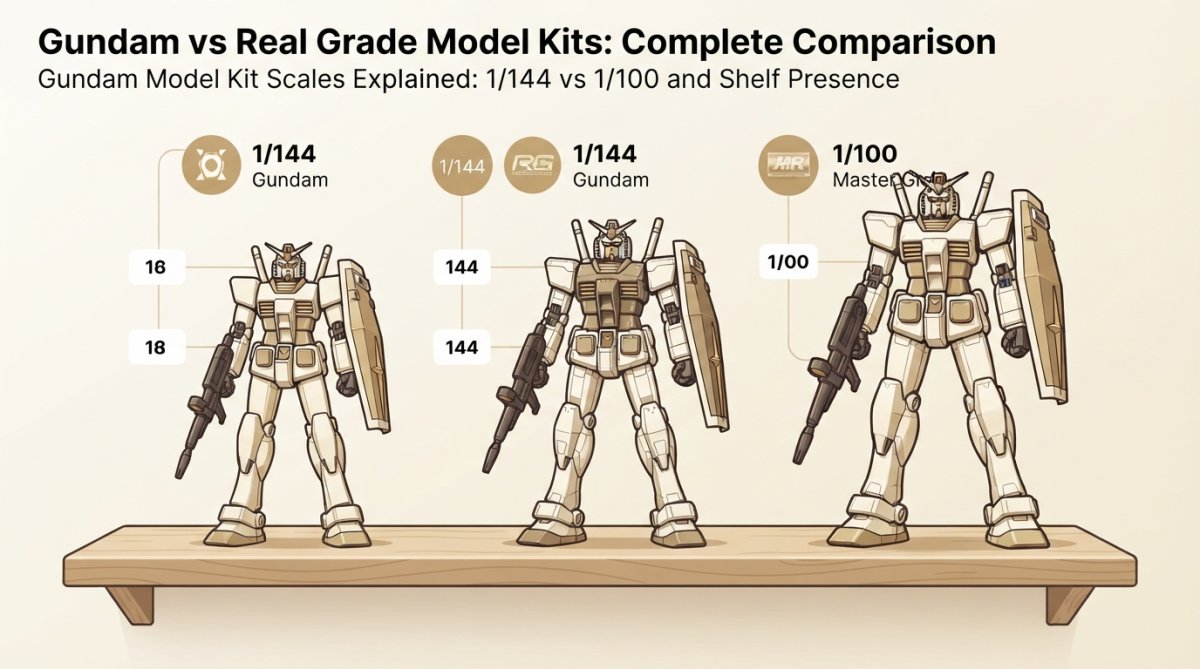
Consider your display space before committing to a grade. If you're building a collection of 10+, RG maximizes variety in limited space.
Best Gundam Grade for Beginners: Should You Start with RG or HG?
Start with High Grade. This isn't a compromise recommendation, it's the only sensible starting point.
High Grade kits teach you the fundamentals: how to use nippers without crushing parts, how to remove seam lines, how to apply decals, how to pose without breaking things. An HG build typically takes 2-4 hours. You can finish a kit in an afternoon and understand whether you want to invest in more advanced grades.
Real Grade as a first kit sets you up for frustration. The frame assembly is intricate. Parts are small. If you make a mistake, you might not realize it until you're 4 hours in and the legs don't pose correctly. You'll need specialized tools: a hobby knife for seam line removal, paint for color correction, possibly glue for loose joints.
The progression should be: HG → RG → MG. This path lets you develop skills incrementally.
Gundam Model Kit Difficulty Levels: Inner Frame Technology and Articulation
Difficulty in Gundam model building isn't just about part count, it's about the systems you're working with. Inner frame technology is the core differentiator between grades.
High Grade kits use simplified internal structures. The torso might have a single frame piece. Limbs connect via basic ball joints. The frame is functional but not detailed. You assemble the frame in minutes, then snap on armor. The engineering is forgiving.
Real Grade kits feature the Advanced MS Joint system, a frame architecture with multiple articulation points per limb. The frame is a model in itself. You're assembling dozens of small parts into a skeletal structure before adding armor. Each frame joint must be assembled correctly because misalignment compounds through the model.
Master Grade kits use even more sophisticated frame engineering than RG. Larger parts mean more detailed joint mechanisms.
The real difficulty is the consequence of mistakes. In an HG kit, a small assembly error is invisible once armor is applied. In an RG kit, the same error creates visible joint problems that persist through the finished model.
Inner Frame Complexity in RG Kits
Real Grade frames are built from dozens of individual plastic parts. A typical RG Gundam frame includes separate pieces for the waist, upper and lower torso, upper and lower arms, upper and lower legs, feet, and hands. Each section includes multiple articulation points.
Assembly requires following the instruction manual precisely. The order matters. Some parts must be inserted before others. If you skip a step or misread the manual, you might assemble something incorrectly and not realize it until later.
The reward for precision is exceptional articulation. An RG Gundam can hold poses that look dynamic and realistic.
Advanced MS Joint Systems
Both RG and MG kits use Bandai's Advanced MS Joint system, though implementation varies. The system features ball-and-socket joints with multiple degrees of freedom. A single shoulder joint might allow rotation, forward/backward movement, and side-to-side movement.
These joints require careful assembly. The ball portion must seat properly in the socket. Too loose and the joint is floppy. Too tight and the plastic can crack. Finding the balance takes experience.
Durability and Fragility: Which Grade Holds Up Better Over Time
Real Grade's engineering becomes a liability regarding durability. RG kits are more fragile than HG kits, and this matters if you plan to pose and repose your models frequently.
High Grade kits are built from thicker plastic. Parts are larger. Joints are simpler. You can pose an HG kit repeatedly without worry. The plastic is forgiving.
Real Grade kits use thinner plastic to achieve detail density in a small package. The frame parts are delicate. Joints are more complex, which means more potential failure points. If you repeatedly pose an RG kit, you risk breaking frame parts. The tiny ankle joints can crack. The waist frame can split.
Master Grade kits occupy a middle ground. The larger parts are more resilient than RG, but the engineering is sophisticated enough that mishandling can cause problems.
The practical implication: if you plan to pose your models frequently and handle them regularly, HG is more durable. If you build a kit, pose it for photos, and then leave it on a shelf, durability is less critical.
Tools, Paint, and Customization Requirements for Each Grade
The kit price is only part of the investment.
High Grade kits require minimal tools. You need hobby nippers to cut parts from the sprue. A hobby knife for seam line cleanup is optional but recommended. Paint is optional, HG kits come in reasonably accurate colors. Total tool investment: under $30.
Real Grade kits demand more investment. You need quality nippers, a hobby knife for seam line removal on small parts, and paint is strongly recommended because RG uses fewer color-separated molds than HG. You'll want acrylic paint, brushes, and possibly a spray primer. Total tool investment: $75-150.
Master Grade kits require the full toolkit. Nippers, hobby knife, paint, brushes, primer, decal solution, glue, sandpaper, and possibly an airbrush. Paint is mandatory. Total tool investment: $150-400 with an airbrush, or $75-150 with brush application.
Essential Tools for Real Grade Assembly
A Real Grade build requires these tools at minimum:
- Quality hobby nippers ($20-30): For cutting parts cleanly from the sprue
- Hobby knife ($5-10): For removing seam lines and cleaning up nub marks
- Sandpaper or sanding sponge ($5-10): For smoothing rough edges
- Paint and brushes ($30-50): For color correction on unpainted parts
- Decal solution ($5-10): For applying water slide decals
- Glue ($5): For sealing seam lines if desired
Optional but valuable:
- Spray primer ($8): For base coat before painting
- Panel line markers ($10-15): For emphasizing mechanical details
- Masking tape ($5): For clean paint lines
Total investment: $80-150 for a complete basic toolkit. This toolkit serves for multiple kits, so the per-kit cost decreases with each build.
Painting and Detailing Expectations
High Grade kits require minimal painting. Most parts come in correct colors. You might paint hands, head, and a few small details. Painting time: 1-2 hours if you paint at all.
Real Grade kits typically require 2-4 hours of painting. Common unpainted parts include hands, some frame sections visible through armor gaps, and small mechanical details.
Master Grade kits require 4-8 hours of painting. Large armor sections come in base plastic color. The entire kit usually needs at least a base coat.
Choosing between gundam vs real grade model kits ultimately depends on your priorities: speed and simplicity point toward High Grade, while detail and articulation favor Real Grade. If you're building your first Gundam model, start with HG to learn fundamentals without frustration. Once you've completed 2-3 HG kits, you'll have the skills and confidence to handle Real Grade's precision demands. At Utopia Toys and Models, we stock a comprehensive selection of both grades from Bandai, ensuring you find exactly what matches your skill level and shelf space. Browse our collection of High Grade, Real Grade, and Master Grade kits, all ready to ship, and start building with confidence.
Frequently Asked Questions
What is the main difference between Real Grade and High Grade Gundam kits?
Real Grade (RG) kits feature advanced inner frame technology with enhanced articulation and detail in a compact 1/144 scale, while High Grade (HG) kits use simpler construction at the same scale. RG models require more precision during assembly and offer superior posing capability due to their sophisticated Mobile Suit Joint systems. HG kits are more forgiving for beginners and faster to build, making them ideal entry points into Gunpla.
Are Real Grade Gundam kits suitable for beginners, or should I start with another grade?
Real Grade kits are challenging for absolute beginners due to their complex inner frame and small parts. Most hobbyists recommend starting with High Grade (HG) kits to learn basic assembly, nippers technique, and decal application before progressing to RG. Once comfortable with sprue removal, panel lining, and water slides, builders typically find RG kits rewarding despite their complexity.
How do Real Grade and Master Grade kits compare in terms of detail and build difficulty?
Master Grade (MG) kits are larger (1/100 scale) with exceptional detail and articulation, but Real Grade kits pack comparable detail into a smaller 1/144 footprint through innovative inner frame design. MG kits take longer to build but offer more surface area for customization and painting. RG kits demand higher precision and care during assembly due to smaller parts, making them technically more difficult despite shorter build times.
What tools and supplies do I need specifically for building Real Grade Gundam kits?
Essential tools include high-quality nippers for clean sprue removal, a hobby knife for gate marks, and fine-grit sandpaper for finishing. Real Grade builders typically invest in panel lining markers or pens, water slide decals (superior to stickers), and a top coat for protection. Advanced customization may require airbrush equipment and acrylic paints. High Grade kits need similar basics but are more forgiving with tool quality.
Are Real Grade Gundam kits fragile, and how do they hold up compared to other grades?
Real Grade kits are more delicate than High Grade or Master Grade due to smaller, thinner parts and complex joint articulation. The advanced MS Joint systems, while enabling superior posing, are susceptible to stress fractures if over-manipulated. Proper handling and careful posing prevent damage. Master Grade kits are generally more durable due to larger parts, while High Grade offers a middle ground. All grades benefit from careful assembly and display practices.
This article was written using GrandRanker