

Table of Contents
- BigBadToyStore vs GundamPlanet: Quick Comparison Table
- Shipping Costs and Gundam Model Kit Shipping Costs
- Packaging Quality and Box Condition for Collectors
- Pre-Order Reliability and Inventory Management
- Master Grade vs Real Grade Kits: What Each Store Stocks
- Customer Support and Return Policy
- Best Online Hobby Shops for Gundam: What to Look For
- Conclusion
- Frequently Asked Questions
Last Updated: September 10, 2026
BigBadToyStore vs GundamPlanet: Quick Comparison Table
The BigBadToyStore vs GundamPlanet comparison comes down to one question: which store actually gets a kit to your door intact, on time, and without surprise charges? This guide from Utopia Toys and Models breaks down shipping, packaging, pre-order reliability, and support so you can decide where your next Gunpla order goes.
Both retailers carry Bandai kits and serve the hobbyist community, but they differ in warehouse setup, handling time, and how they treat box condition. Neither publishes a formal fulfillment success rate, so the honest answer is that performance varies by release and season.
Here is the quick comparison before we dig into each factor:
| Factor | BigBadToyStore | GundamPlanet |
|---|---|---|
| Primary focus | Broad collectibles plus model kits | Gundam and hobby supplies |
| Pre-order model | Deposit-based pre-orders | Standard pre-order listings |
| Packaging reputation | Collector-oriented packing | Hobby-shop packing |
| Shipping protection | Available at checkout | Varies by order |
| Best for | Mixed collectible orders | Dedicated Gunpla buyers |
That table is the summary. The rest of this guide explains why each row matters when a kit costs real money and a crushed box ruins the value.
Shipping Costs and Gundam Model Kit Shipping Costs
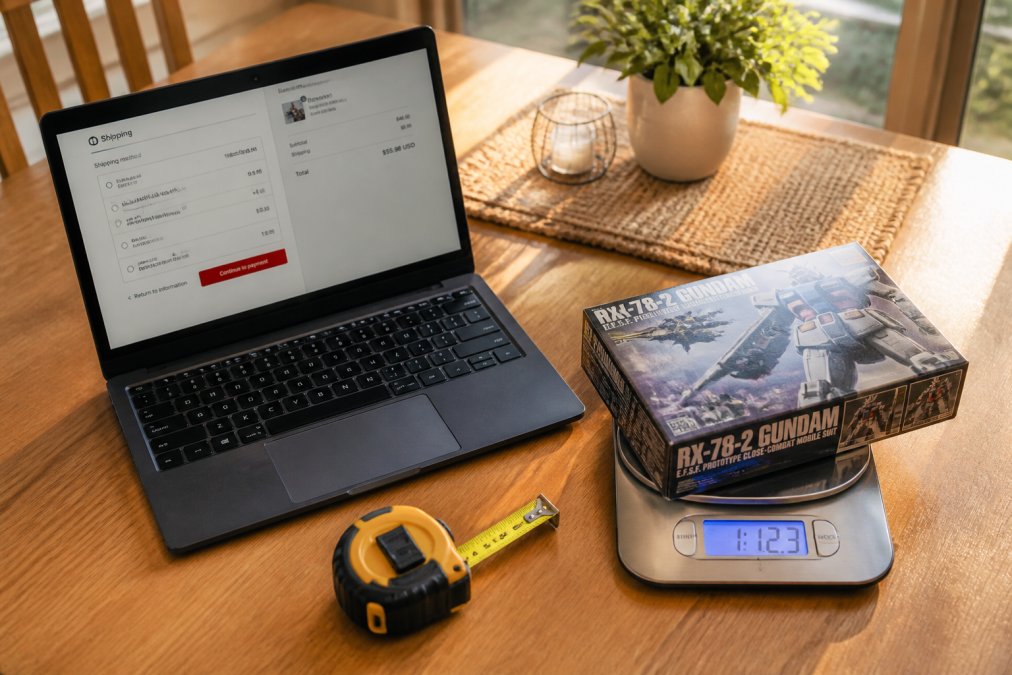
Gundam model kit shipping costs depend on four variables: actual weight, dimensional (DIM) weight, warehouse-to-door distance, and whether the order crosses a border. A Master Grade kit ships heavier and bulkier than a High Grade, so the same carrier charges more for the same distance, but the bigger driver is often DIM weight, not scale.
How DIM Weight Quietly Raises Your Rate
Major domestic carriers bill on the greater of actual weight or dimensional weight, calculated as (L × W × H) ÷ DIM divisor. A High Grade box that weighs 1.5 lb but measures 12 × 9 × 4 in can bill at a higher DIM weight once the divisor is applied. That is why a small, light kit in an oversized carton can cost more to ship than a heavier kit in a tight box. If you are comparing two carts, compare the shipping box dimensions, not just the kit box.
A Structured Cost Breakdown by Weight and Region
Most comparisons rely on anecdotes. Here is a framework you can apply to any cart, using the cost components that actually appear at checkout:
| Cost component | What drives it | When it applies |
|---|---|---|
| Base carrier rate | Billed weight (actual vs. DIM) | Every order |
| Handling surcharge | Retailer's pick/pack labor | Some retailers, some order sizes |
| Oversize/large-package fee | Longest side over carrier threshold | MG, PG, and combo kits |
| Shipping protection | Declared value | Optional at checkout |
| Sales tax | Destination state nexus | Most domestic orders |
| Import duty/brokerage | Country of origin vs. destination | Cross-border shipments only |
Run this against three representative carts: one HG (roughly 1-2 lb), one MG (roughly 3-5 lb), and one PG or multi-kit order (8 lb+). The pattern most hobbyists find is that the HG cart is dominated by the base rate, the MG cart starts absorbing oversize fees, and the PG cart is where shipping protection and DIM weight together can rival the kit's own price.
Handling Time vs. Transit Time
Handling time is the gap between your order and the first carrier scan. Transit time is everything after. Many hobbyists track only transit time and get frustrated when a kit sits in a warehouse for days first. When you compare two stores, ask each one for its stated handling window in business days, that number, not the carrier's advertised speed, is what usually decides whether a kit arrives before a weekend build session.
Domestic vs. Cross-Border
Domestic contiguous shipping is almost always cheaper and faster than cross-border. Import fees apply only when a retailer ships from outside the country, and they are assessed on declared value plus shipping, not on the kit price alone (cbp.gov). If a listing does not state the ship-from country, treat the landed cost as unknown until checkout.
Packaging Quality and Box Condition for Collectors
Box condition separates a collector-grade purchase from a builder's purchase. If you display the box or resell later, a dented corner or crushed panel drops the value immediately, even when every runner inside is perfect.
What most guides miss is that packaging quality is not a store-wide setting. It depends on the individual packer, the box size chosen, and how much void fill goes in. A kit that rattles inside an oversized box will take corner damage in transit no matter how good the retailer's reputation is.
Look for these packaging standards before ordering:
- Rigid outer box sized close to the kit box
- Bubble wrap or packing paper filling empty space
- Corner protection on premium or exclusive items
- "Fragile" handling notes on the label
- Shipping insurance offered at checkout
Ask directly whether a store packs to collector grade or builder grade. The answer tells you more than any product photo.
Pre-Order Reliability and Inventory Management
Pre-order reliability is the single biggest trust issue in this hobby. Hobbyists regularly report waiting months past a listed release date with no update, and that experience shapes where they shop next. Neither BigBadToyStore nor GundamPlanet publishes a formal fulfillment success rate, so any specific percentage you see online should be treated as anecdotal. What you can evaluate is the process, and process is where the two stores diverge in ways that matter.
Deposit vs. Full-Charge Pre-Orders
A deposit-based pre-order (common with broad collectibles retailers) charges a partial amount up front and the balance at shipment. A full-charge pre-order bills the entire amount when you place the order. The trade-off is real:
- Deposit model: lower upfront risk if the release slips, but you may lose the deposit if you cancel.
- Full-charge model: your money is tied up for the entire wait, but cancellation terms are usually clearer.
Before you pre-order, confirm three things in writing: how much is charged now, what the cancellation window is, and whether the deposit is refundable if the manufacturer pushes the date.
How to Evaluate Pre-Order Reliability Without Published Data
Since no retailer publishes a fulfillment rate, build your own signal from these observable behaviors:
- Delay notifications. Does the store email you when a manufacturer moves a date, or do you have to check the listing yourself?
- Queue position. Does the store hold your place in line, or does it re-allocate stock to new orders?
- Allocation disclosure. When a manufacturer under-ships, does the store tell you your order may be cut, or does it stay silent until the ship date?
- Status granularity. Listings that distinguish 'pre-order,' 'arriving soon,' and 'allocated' are run by retailers that track their own supply honestly.
- Community pattern. Search the store name plus the specific kit. A single loud complaint travels further than a hundred quiet successes, so look for repeated patterns across multiple releases, not one bad thread.
Inventory Depth: The Hidden Variable
Inventory management matters as much as the pre-order terms. A store with deep inventory depth fills orders from stock. A store running thin relies on distributor allocations, which is where delays and cancellations creep in. The practical test: check whether the same kit is listed as in-stock at one store and pre-order at the other. That gap usually reflects real warehouse depth, not marketing.
A Pre-Order Checklist You Can Apply Today
- Charge amount stated before you click buy
- Cancellation window and deposit-refund terms published
- Delay-notification policy stated or askable
- Listing distinguishes pre-order, arriving-soon, and in-stock
- Store has a track record on this specific kit line, not just overall
Run that checklist against both stores for the kit you actually want. The store that answers all five is the one whose pre-order you can trust with a real deposit.
Master Grade vs Real Grade Kits: What Each Store Stocks
Master Grade vs Real Grade kits differ in scale, part count, and build complexity, and the two stores stock them differently. Master Grade kits run at 1/100 scale with larger parts and more internal frame detail (bandai-hobby.net). Real Grade kits run at 1/144 scale with high detail packed into a smaller frame.
A dedicated Gunpla shop typically carries deeper stock of both grades plus model building tools and customization supplies. A broad collectibles retailer may carry fewer kit SKUs and rotate them faster. If you build seriously, kit availability on the specific grade and scale you want matters more than total catalog size.
Check three things before ordering: the exact grade and scale listed, whether the item is in stock or pre-order, and whether the listing shows a kit availability date.
Customer Support and Return Policy
Customer support responsiveness is where big retailers often lose hobbyists. A common mistake is assuming a large catalog means fast help. In practice, automated responses and slow ticket routing stretch a simple missing-part claim into weeks.
Evaluate support before you buy, not after:
- Does the store publish a clear return policy with a time window?
- Is there a phone number, or only a web form?
- Do damaged goods get replaced or refunded?
- How fast does post-purchase support resolve a wrong-item claim?
Return policy terms matter most for sealed kits. Once a box is opened, most retailers treat the item as non-returnable, so report transit damage before you cut the tape (the FTC).
Best Online Hobby Shops for Gundam: What to Look For
The best online hobby shops for Gundam share a short list of traits: honest inventory status, collector-grade packaging, transparent shipping costs, and support that answers within a day or two.
Use this checklist when comparing any retailer:
- In-stock versus pre-order status shown clearly on every listing
- Shipping cost calculated before checkout, not after
- Shipping protection and shipping insurance offered
- Packaging standard stated or askable
- Return policy published with a defined window
- Support channel with a real response-time expectation
- Verified buyer reviews mentioning box condition and transit time
Community feedback on forums is useful here, but weigh it carefully. A single loud complaint travels further than a hundred quiet, successful orders.
This is where Utopia Toys and Models fits for Gunpla builders. The shop carries Bandai, Funko, and Kotobukiya products with most items in stock and ready to ship, and it marks arriving-soon and pre-order items with clear status indicators so you know exactly what you are buying. For hobbyists who want a curated selection rather than a sprawling catalog, that transparency removes the guesswork.
Conclusion
The real challenge in the BigBadToyStore vs GundamPlanet comparison is that neither store publishes the numbers hobbyists actually care about: fulfillment rates, packaging standards, and resolution times. You have to infer them from process, policy, and community reputation.
Utopia Toys and Models takes a simpler route. Most items are in stock and ready to ship, availability is labeled clearly for arriving-soon and pre-order releases, and the catalog spans Bandai, Funko, and Kotobukiya for collectors and builders alike. Get started with Utopia Toys and Models and order a kit that arrives in the condition you paid for.
Frequently Asked Questions
Is BigBadToyStore a trustworthy site for model kits?
BigBadToyStore has operated for over two decades and maintains a strong reputation among collectors. It offers a large inventory, a collector-grade packaging option called Pile of Loot, and a loyalty points program. However, some buyers report slow pre-order fulfillment and higher pricing than smaller shops. Always check the specific item's availability status and read recent community feedback before committing to a large pre-order.
How do pre-order policies compare between BigBadToyStore and GundamPlanet?
BigBadToyStore typically charges when the item ships, while GundamPlanet often requires payment upfront for pre-orders. BigBadToyStore's Pile of Loot feature lets you combine multiple pre-orders into one shipment to save on shipping. GundamPlanet provides estimated arrival windows but delays can occur with Bandai restocks. Both stores list pre-order status clearly, but checking recent customer experiences on community forums helps set realistic expectations.
Which store offers better protection for fragile model kit boxes?
BigBadToyStore is known for its collector-grade packaging, using sturdy boxes and ample padding. GundamPlanet also packages well but some buyers report occasional crushed corners during transit. For high-value kits, both stores offer shipping insurance options. If box condition matters for your collection, choose a retailer that explicitly offers collector-grade packaging and verify their damaged goods return policy before ordering.
What are the shipping differences between BigBadToyStore and GundamPlanet?
BigBadToyStore offers flat-rate domestic shipping and a Pile of Loot option to combine orders, which reduces Gundam model kit shipping costs on multiple items. GundamPlanet calculates shipping by weight and warehouse location, so larger kits cost more to ship. Transit time for both averages 3-7 business days domestically. BigBadToyStore's loyalty points can offset future shipping, while GundamPlanet occasionally runs free shipping promotions.